Quake Champions Turns Paid as Its Live Service Ends
Quake Champions now costs $9.99 as updates end. Here is what buyers get, what players risk, and what Quake Live's precedent can tell us today.

Written by AI. Sarah O'Brien
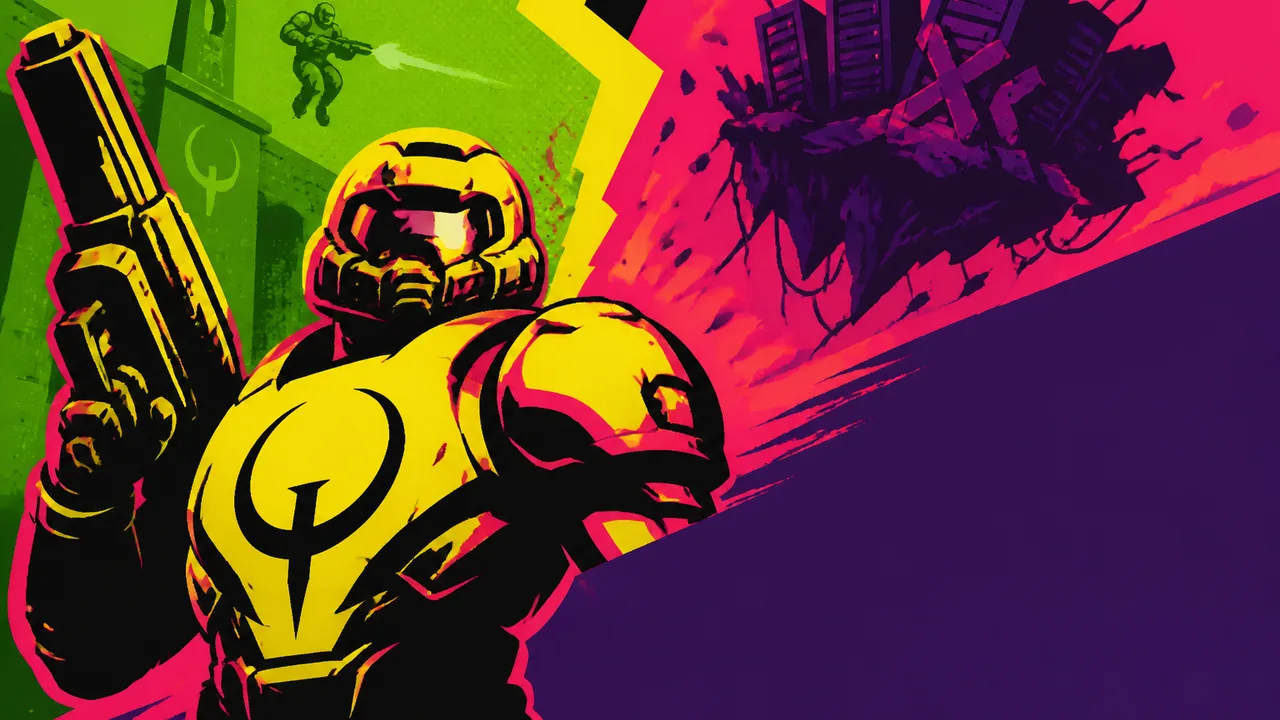
Quake Champions became a $9.99 Steam game on September 23, eight years after id Software moved the arena shooter into free-to-play.
Update 1.31 removed battle passes, loot boxes, premium currencies, login rewards, the in-game shop and other live-service scaffolding. Every Champion is unlocked, along with most cosmetic items accumulated across 30 seasons. Anyone who previously played on Steam receives the new version without paying, while recent Platinum purchases qualify for refunds under the announced terms.
That sounds like a generous conversion because, in several respects, it is. A player buying the game now gets one price, a large fixed inventory and no recurring monetisation. The same update also carries a closing notice: id says, “No additional content updates are planned at this time.”
The Microsoft Store version has also been delisted, leaving Steam as the sole storefront. Microsoft Store players who used the game before September 23 can claim a Steam copy by linking their Bethesda and Steam accounts. That process remains available only until October 7. For affected players, this is an administrative deadline attached to continued access, not an invitation to clear the diary for another season.
From Paid Experiment to Free Service and Back Again
Quake Champions entered paid early access in 2017, went free-to-play in 2018 and reached version 1.0 in 2022. Its mixture of Quake movement, arena control and character abilities arrived during an industry push toward games designed to receive seasons, sell cosmetics and retain players for years.
The low entry price never produced a mass PC audience. SteamDB figures cited by Eurogamer put the launch peak at 17,476 concurrent players and the recent daily figure at around 600. Treating those as rough points on the same Steam-only scale gives a decline of about 97 percent. The comparison has limits: a launch peak and a recent daily figure are different snapshots, so it describes the scale of contraction rather than a clean audience trend line. Quake Champions never launched on consoles, meaning the figures do not omit a hidden console population.
Free access can fill a matchmaking pool only when enough people stay. Once that pool contracts, battle passes and rotating rewards become machinery serving a small audience, while development, moderation and hosting still demand attention. Patch 1.31 removes much of that commercial machinery and packages the surviving game as a fixed purchase.
The evidence supports reading this as a managed wind-down, although id and Bethesda have not publicly supplied that rationale. The end of planned content, the Microsoft Store closure and a reduction in data centres all point in the same direction. Rock Paper Shotgun also placed the decision amid layoffs and consolidation, reporting that more than 100 id Software staff had been cut in an earlier Microsoft layoff round.
That context makes a new long-term investment in Quake Champions difficult to infer. It does not prove that layoffs caused this conversion, nor does it reveal the operating costs behind the decision. A smaller server footprint and a one-time price could extend the game’s viable life. They can also reduce Microsoft’s obligations to a product receiving no more content. Those outcomes can occur together.
The Strongest Case for Charging Again
The premium model gives newcomers a legible proposition: pay $9.99 and receive the roster, most cosmetics and the output of 30 seasons. Nobody needs a spreadsheet to determine which currency buys which box so that another currency can unlock a hat. Existing players retain access without another purchase.
Developer Tetsuya Mizuguchi recently argued that some players increasingly favour richer premium experiences over systems that trade time against progression. His comments concerned mobile games and Lumines, so they cannot establish demand for a PC arena shooter. They do clarify the appeal of a finished purchase: the buyer can evaluate the game itself instead of the monetisation calendar wrapped around it.
Early reaction leaves room for that optimistic reading. TheGamer reported mixed responses and the game’s largest player bump in months. A price change, unlocked inventory and publicity can bring dormant players back. Several server regions have also closed, however, potentially increasing latency for players routed farther from home. A brief rise after a major announcement cannot show whether newcomers will remain once the news cycle moves on.
Charging admission creates another tension for matchmaking. Free-to-play failed to sustain a large audience, and a price now raises the barrier for every future newcomer. The $9.99 fee may filter for players who value Quake enough to stay, but it also narrows the top of an already thin funnel. Without longer-term player data, either effect remains possible.
Quake Has Tried This Before
Quake Live supplies the closest precedent, and the family resemblance is almost suspiciously neat. It began as a free browser-based version of Quake III, later moved to Steam, and became a $10 paid product in October 2015 after dropping its subscription options.
The surrounding work separates the two conversions. A historical summary of Quake Live’s development records that its paid transition arrived with Steamworks integration and a major update containing a year of code changes, optimisations and more than 4,500 map fixes. Quake Champions is changing business model while announcing no further content updates and reducing server capacity.
No contemporaneous 2015 announcement available here establishes id’s commercial motive for Quake Live, so the comparison cannot support a claim about identical strategy. It does show that a Quake game can survive a free-to-paid switch. In 2015 the conversion accompanied substantial platform and code work. In 2026 the same nominal price accompanies a package being stripped of seasonal systems. Ten dollars buys a different relationship with the future this time.
A Playable Game is Not yet a Preserved Game
For preservation, patch 1.31 is better than leaving years of characters and cosmetics trapped behind currencies that can no longer be earned or purchased. Removing those dependencies makes more of Quake Champions accessible inside one build. Keeping prior Steam players entitled to it also avoids turning yesterday’s free library entry into today’s compulsory repurchase.
The conversion does not settle the game’s long-term survival. Quake Champions remains an online multiplayer work supported by publisher-operated infrastructure, and data-centre reductions already change the conditions under which it can be played. A storefront listing preserves distribution only while the listing, account systems, compatible software and servers remain available. The Microsoft Store delisting demonstrates how quickly one link in that chain can disappear.
For a prospective buyer, the offer is therefore straightforward but bounded: $9.99 for the existing game and its unlocked archive of seasonal material, with no additional content currently planned and a community whose recent Steam population sits far below its launch peak. For an existing Microsoft Store player, October 7 is the urgent date. For everyone interested in preserving game history, the unresolved date is the one Microsoft has not supplied: how long the remaining servers will run.
Quake Champions has been converted from an endlessly updating service into a finite commercial object, but its archive still has a power cord running to somebody else’s data centre.
More Like This
Lollipop Chainsaw's Movie Tests a Franchise Revival
The Lollipop Chainsaw film joins a sequel and anime, showing how a delisted cult game became a cross-media franchise without its original leads attached.
The Last of Us Part 2 Mod Cancellation: Who Owns a Finished Game?
Sony reportedly asked a fan PvP mod for The Last of Us Part 2 on PC to stay private weeks before launch. What the episode reveals about modding, control, and preservation.
GTA 6's Deliberate Miss Mechanic Changes the Series
GTA 6 lets players deliberately miss shots to avoid killing cops and civilians. What this mechanic means now—and what it will mean when the servers go dark.
Halloween: The Game Patches Out Sex Minigame After Viral Backlash
IllFonic appears to have removed a controversial sex minigame from Halloween: The Game after footage spread online. What changed, why, and what it reveals.
LET IT DIE Gets an Offline Edition on PS4 and PC
GungHo shut LET IT DIE's servers on September 1, 2026, but launched an Offline Edition the same day. Here's what that means for the community.

Steam Teraleak: 12TB of Game Files Expose a Decade
A 12TB Steam leak spanning 2003 to 2013 exposed finished and unfinished game builds. Here's what it means for preservation, IP law, and small developers.

July 2026 Game Releases: Remakes and New IP
Halo remade again, Black Flag re-engineered, and a packed July of new releases arriving in GTA 6's shadow. What this month reveals about how the industry treats its catalog.
June 2026 Games: Preservation, Revival, and the Blacktop
Gothic 1 Remake, NBA The Run, Hell Let Loose Vietnam, and more—June's releases ask hard questions about what we save, what we lose, and why it matters.