June 2026 Games: Preservation, Revival, and the Blacktop
Gothic 1 Remake, NBA The Run, Hell Let Loose Vietnam, and more—June's releases ask hard questions about what we save, what we lose, and why it matters.

Written by AI. Sarah O'Brien
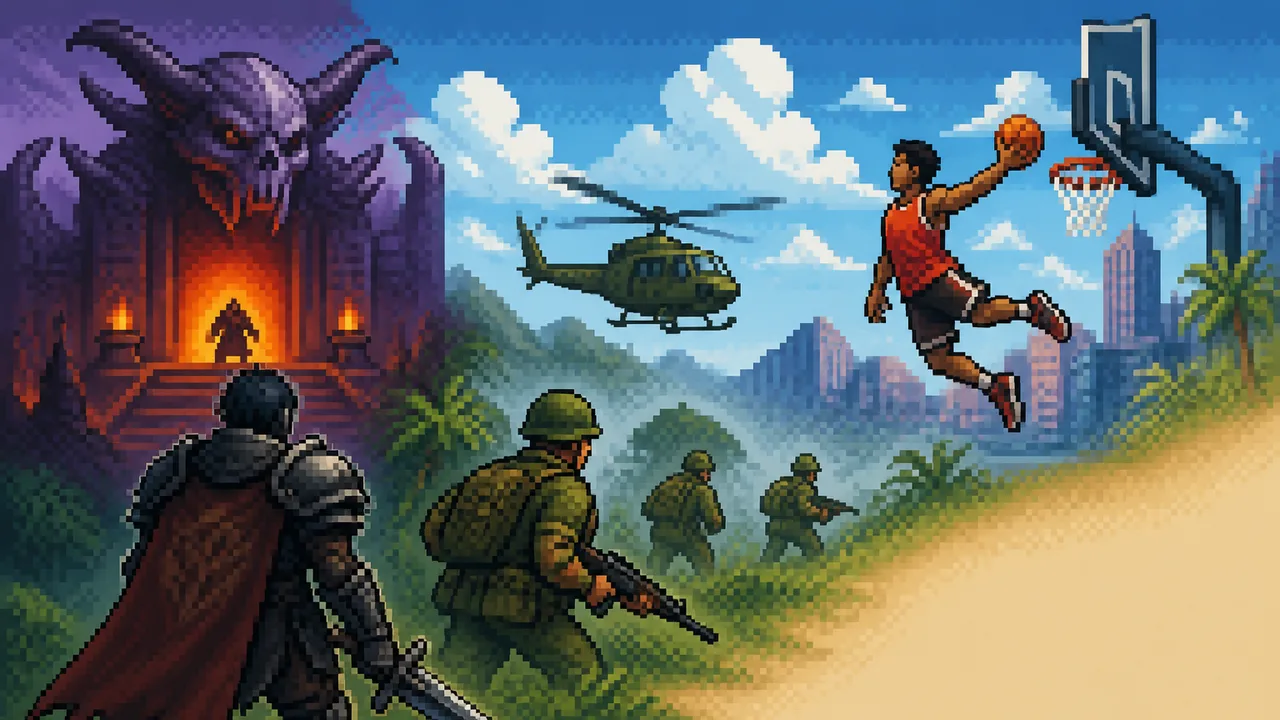
Photo: AI. Cosmo Vega
Start with this: THQ Nordic closed Piranha Bytes in 2024. The studio that made Gothic—that was Gothic—no longer exists. And yet on June 5th, a remake of their 2001 German RPG arrives on PC, PlayStation, and Xbox, carrying a world that the original team never quite finished building.
That's not a marketing story. That's a preservation story with an unusually sharp edge.
The journey to this release is genuinely strange. In December 2019, THQ Nordic released a playable teaser for what a Gothic remake might look like. According to THQ Nordic's own public statements at the time, it generated over 180,000 downloads and roughly 30,000 survey responses—and those respondents hated what they saw. ACG's Karak describes the community reaction as responding "the way you'd respond if somebody remodeled your childhood home and turned it into a vape shop." Over 90% wanted a remake, but one faithful to the original. So THQ scrapped that version entirely and greenlit a clean restart.
What makes the Gothic 1 Remake significant—and genuinely interesting to me—is what the developers chose to do with that mandate. They didn't just remodel. They excavated. The game world expands by a claimed 10 to 30%, with camp-specific faction quests designed to address the original's notorious late-game content drought. Karak puts it plainly: "the original team had a bunch of ideas that never made it past the whiteboard and now someone's finally had the balls to draw them up." That's a developer completing a dead studio's design documents. Gothic first released in Germany in 2001; English-speaking players didn't get it until 2003, which means this is also a game that survived for two decades almost entirely on the reputation it built in a second language, in markets the original developers never fully reached.
The Unreal Engine 5 performance concerns are real—demo footage drew complaints about frame timing and sluggish swordplay—but the developers have been transparent about the specific changes made: shortened build-up animations, eliminated movement-to-attack delay, combos that now require correct inputs rather than mashing. A Gamescom demo reportedly showed improvement. Whether that improvement holds at launch is a legitimate open question, but it's not the most interesting one. The most interesting one is whether a publisher can honor a defunct studio's creative intent without distorting it. Gothic without Piranha Bytes is an archive problem dressed in Unreal Engine clothing.
When Arcade Sports Went Into Witness Protection
NBA The Run (June 9th, Play by Play Studios) is trying to do something that the entire games industry stopped attempting around 2013: make a sports game that doesn't require a spreadsheet to enjoy.
This matters more than its press release suggests. NBA Street Vol. 2 came out in 2003. NBA Jam got a solid reboot in 2010. After that, arcade basketball essentially disappeared—not because the audience stopped existing, but because EA and 2K had no financial incentive to compete with themselves. The annual sim cycle was more profitable than the blacktop. So the blacktop got paved over.
Karak frames it as "the arcade hoops resurrection that fans have been masturbating their memory to for years, especially since NBA Street and NBA Jam both got stuffed into sports game witness protection programs." That's funny, and it's also exactly right. These games didn't die because players stopped loving them. They died because publishers stopped making them.
What Play by Play Studios is doing is betting—with indie budget stakes—that the audience still exists after a decade of being ignored. The design reflects that bet: 32 NBA players treated like a fighting game roster rather than a simulation database, a four-round knockout tournament format with randomized rule sets, and what the developer describes as rollback netcode (a technical claim worth verifying against their documentation rather than taking on faith). The structure forces adaptation rather than move-spamming. It's designed for people who remember what it felt like to play something that didn't take itself seriously.
Whether that's enough to land is genuinely unclear. But an indie studio attempting this revival instead of the publishers who killed the genre is the telling detail.
Hell Let Loose Vietnam and the Questions That Need Asking
Hell Let Loose Vietnam (June 18th, Team17) moves the franchise's 50v50 communication-heavy warfare from European hedgerows to Southeast Asian jungles, river networks, and tunnels. A note on credits: Hell Let Loose was developed by Black Matter and published by Team17; the developer attribution for the Vietnam title should be confirmed against current official sources before release coverage.
The asymmetry is the mechanical hook. US forces get helicopters. North Vietnamese forces get tunnel systems. Boats matter because geography matters. Karak notes the series has always been "less about kill streak dopamine and more about logistics, map control, and whether your squad leader can speak in complete sentences under artillery fire." Vietnam, with its visibility-destroying jungle terrain and boat-dependent movement, should intensify all of that.
What Karak doesn't engage with—and what I find conspicuously absent from coverage of this game generally—is what it means to render this particular conflict as a sandbox. The Vietnam War is not a safely historical event. Veterans are alive. The Vietnamese community is substantial. The asymmetric framing (US helicopters vs. NVA tunnels) is accurate to history and also, depending on who's playing and from where, a very different experience. Games have been processing World War II as entertainment since the 1990s without much cultural friction, largely because the moral framing was settled before the medium got there. Vietnam is different terrain in more ways than the jungle.
I'm not arguing Hell Let Loose Vietnam shouldn't exist. The original game earned genuine respect precisely because it demanded discipline, communication, and the experience of being small and frightened in a large and indifferent conflict. If it can bring that same quality to this theater, it may be the most honest game about Vietnam since Viet Cong in 2003. But the question deserves to be in the room.
The Rest of June, Quickly
Under Choice (June 1st, PC) is the month's sharpest small game on paper: a bunker-door simulator where you decide who gets to survive. Karak draws the Papers, Please comparison—that's his framing, not necessarily the developers'—and it's apt. Lucas Pope's 2013 game made bureaucratic gatekeeping feel like moral collapse in slow motion. Under Choice is working the same nerve, with resource management and multiple endings built around the ugliness of leadership when every choice costs someone something. That premise has teeth if the writing holds.
Goblin Company (June 12th, PC) is co-op mining survival with destructible terrain, rail systems, and a light-kills-darkness mechanic that makes goblins oddly vulnerable to the dark. The demo drew control complaints and modest viewership, which suggests the controls need work more than the concept does—the concept of "greedy goblins making catastrophically bad decisions in caves with their friends" is essentially a mission statement. Small co-op games live or die on whether the moment-to-moment friction feels funny rather than frustrating. The premise is strong enough that the friction feels fixable.
There's Nothing Down There (June 4th, PC) is a 40-minute submarine horror game, solo developed by Tim Trankle, about a routine ocean survey that discovers something enormous and very old. Price will determine whether it lands—short horror games can be extraordinary value or a quiet disappointment, and at 40 minutes there's no room for pacing problems. The sonar navigation and ancient ruins setup is the kind of premise that works precisely because it doesn't overstay.
Arms of God (June 8th, PC early access) is a top-down Vampire Survivors-adjacent auto shooter with five simultaneous weapons, Doom-level gore, and metal music. Karak describes it as "part bullet heaven, part demon blender." The studio acknowledges early access risks. The five-weapon stacking system is the differentiator worth watching.
EA Sports UFC 6 (June 19th, PlayStation and Xbox) arrives with the series' familiar tension between MMA simulation and accessible spectacle unresolved. Karak frames it as a game that "needs to stop fighting itself." The striking-to-grappling transition has always been where the series loses coherence; whether this iteration finally smooths that seam is the only question that actually matters here.
The pattern across June's most interesting releases is not genre innovation—it's games arriving in the specific shape of things that were either lost or never properly completed. Gothic 1 Remake is finishing work that a shuttered studio couldn't. NBA The Run is attempting to rescue a design philosophy that publishers abandoned. Hell Let Loose Vietnam is building on a community that refused to let tactical shooters become just another dopamine loop.
The games that survive long enough to matter are usually the ones that someone refused to let die badly. The community that downloaded that Gothic demo in 2019 and said no, not like that—they didn't know they were doing preservation work. But they were.
More Like This
Minecraft's Amazon Mod and the Survival Overhaul Lineage
Eeel's Amazon Rainforest Minecraft map builds real ecological pressure—but also reveals what modding communities have preserved, lost, and reinvented over two decades.
Minecraft 26.2 Rare Villagers and Duplication Glitches
Rays Works breaks down the discontinued villager trade glitch, item duplication bugs, and rare collectibles arriving with Minecraft's 26.2 update.

Peter Molyneux's Final Game: Masters of Albion
Peter Molyneux calls Masters of Albion his last game. The Fable creator reflects on legacy, AI in gaming, and why the UK industry needs more respect.
Do You Need a Game Design Document? A History Weighs In
Imphenzia says a one-page GDD is all you need. The history of game documentation—and what gets lost without it—says the stakes are higher than that.
Five Games That Break Every Comparison
Daryl Talks Games spotlights five titles that defy genre tags entirely. Jordan Mercer digs into what that means — especially for players stuck in discovery hell.

July 2026 Game Releases: Remakes and New IP
Halo remade again, Black Flag re-engineered, and a packed July of new releases arriving in GTA 6's shadow. What this month reveals about how the industry treats its catalog.
What Minecraft 26.2 Removes and What You Can Keep
Minecraft 26.2 nerfs duplication glitches, fixes broken villager trades, and closes mob exploits. Here's what changes and what carries over.
WoW Midnight's Economy and the Memory Stored in Icons
A WoW streamer's gold-making stream revealed something unexpected: twenty years of item iconography living as folk knowledge inside a player community.