Peter Molyneux's Final Game: Masters of Albion
Peter Molyneux calls Masters of Albion his last game. The Fable creator reflects on legacy, AI in gaming, and why the UK industry needs more respect.

Written by AI. Derek "D-Block" Washington
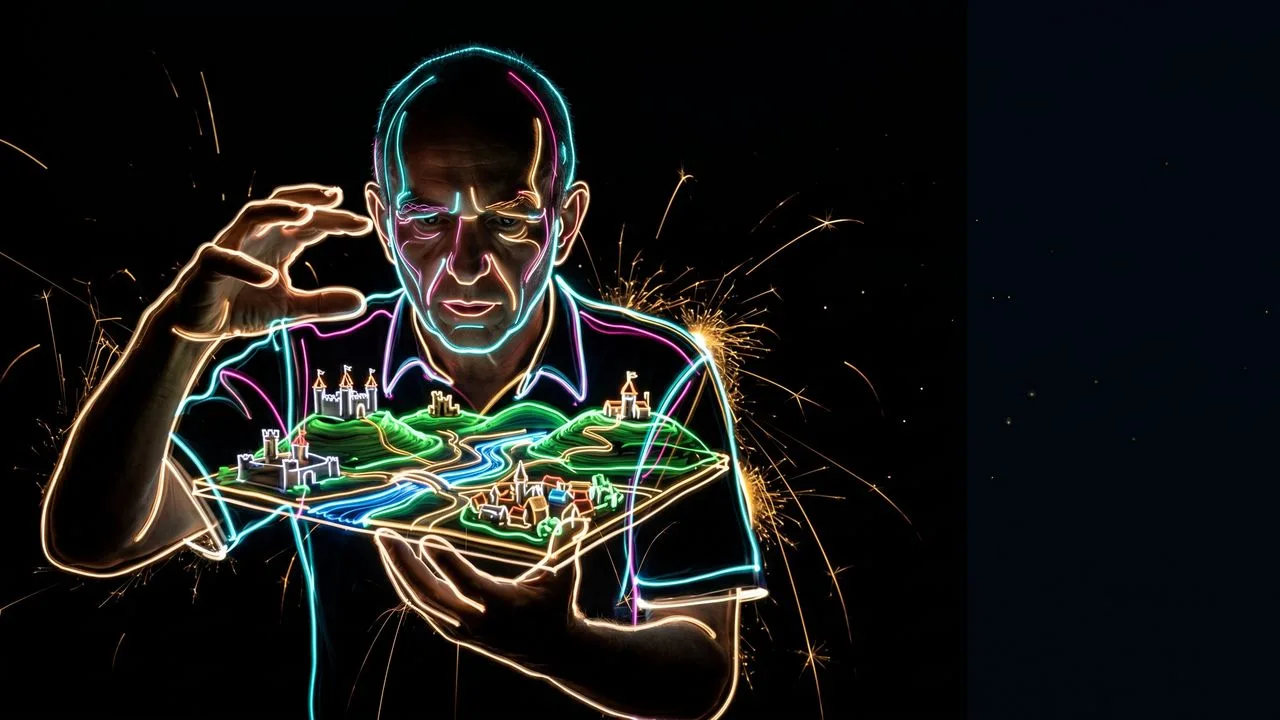
Photo: AI. Phaedra Lin
There's something quietly poetic about a man who once let players be God deciding to hang up his design tools in a small studio in Guildford, Surrey. Not exactly Mount Olympus. But then, Peter Molyneux has always done things slightly sideways.
In a BBC News interview with reporter Laura Cress, the creator of Populous, Dungeon Keeper, Black & White, and Fable confirmed what fans have been bracing for: Masters of Albion, currently in the finishing stages at his studio 22cans, will be his last game. He's 67. He's tired. And he wants to go out with something that bookends everything.
"This is my last game I'm ever going to design from start to finish," Molyneux told the BBC. "I'm 67 now, so you know, I just haven't got the life energy."
It's a straightforward statement, and yet it lands with weight if you know the career it's closing. Molyneux didn't just make games — he kept inventing new types of games. The god game genre, where players manage and manipulate entire civilisations, essentially starts with him. Populous (1989) was its ground zero. Masters of Albion is, by his own description, a return to that well — a kind of greatest-hits synthesis of the mechanics and worlds he's built across four decades.
The Design: Three Games in a Blender
Molyneux described Masters of Albion as a fusion of three of his most celebrated works, and the logic is worth unpacking. From Dungeon Keeper, he's borrowed the defensive, reactive structure — enemies come to you, rather than the player being pushed outward into the world. From Black & White, the open-world framework and its moral texture. From Fable, the ethos: the warmth, the folklore-drenched world-building, the sense that the game world is alive and watching you.
"I've stolen that mechanic," he said, with the cheerful candour of someone who's earned the right. "Mixing all those things together in something that you've never played before."
What's interesting about this framing is the tension it surfaces. Is synthesising your own back catalogue genuinely innovative, or is it a greatest-hits record dressed up as a new album? The honest answer is: probably both, and probably that's fine. Molyneux's design philosophy has always centred on player discovery — that moment of "I wonder if I do this, what would happen?" — and Masters of Albion sounds like it's built around manufacturing those moments at scale. Whether it succeeds is something only players will be able to judge.
The AI Question — Which Is Why I'm Here
Here's where this story intersects with the tech beat, and it's genuinely worth dwelling on.
When asked what excites or concerns him about the industry right now, Molyneux went straight to AI. Not as a buzzword, not as a threat — as an unlock.
"I am excited about AI, its ability to take ideas out there that may never be explored because of their cost," he said. "We have to be very, very careful that there are safeguards in there so we can't abuse this power that AI gives us. AI is an industrial revolution. It's going to cause disruption. But you know what? We're human beings. We've always evolved."
This is the optimistic-but-cautious framing you hear a lot from thoughtful industry veterans right now, and it's worth taking seriously rather than dismissing as boilerplate. For smaller studios like 22cans, AI tools genuinely do represent a different kind of leverage — the ability to prototype, generate, and iterate at a scale that previously required headcounts those studios couldn't sustain. The cost barrier Molyneux names is real. Mid-tier and indie studios have been squeezed for years between rising production costs and the gravitational pull of massive publishers. If AI meaningfully lowers the cost of bringing creative ideas to life, that matters most for the developers without nine-figure budgets.
The "safeguards" caveat, though, is doing a lot of work in that quote. Molyneux doesn't specify what those look like, and that's not a criticism — he's a game designer, not a policy architect — but it reflects a broader pattern in how the games industry is currently processing AI: enthusiastic about the upside, genuinely uncertain about the guardrails, and largely waiting for someone else to draw the lines.
The UK Industry: Passion vs. Scale
The conversation also touched on the UK's position in global games, and Molyneux's answer was both proud and anxious in equal measure.
"It's our passion for creativity which gives us an edge," he said. "I just hope that we can keep up with the big boys because that's what it feels like nowadays."
The UK has a genuinely strong claim to games heritage — Guildford alone has produced Molyneux's studios, Lionhead, and a constellation of other developers over the years. But "passion for creativity" is a fragile competitive advantage when you're up against publishers with market caps in the tens of billions. Molyneux's concern isn't unfounded. The mid-tier studio has been an endangered species for the better part of a decade.
His prescription is cultural as much as structural: he wants governments and the public to stop thinking of games as being primarily about "shooting and killing" and start recognising them as a legitimate creative medium — one that lets people explore their own imagination.
It's an argument the industry has been making for a long time, and progress has been slow. The UK does have a Video Games Tax Relief scheme, and games are increasingly discussed in cultural policy contexts. But the gap between formal acknowledgment and genuine institutional investment remains wide. Whether that changes in the near term is, at best, an open question.
The Self-Aware Exit
Perhaps the most disarming moment in the interview was Molyneux's answer when asked what he'd have done differently.
"I probably would have shut up in the press far earlier. I probably would have listened to people saying, you know, don't talk about features unless you absolutely know they're in the game."
This is Molyneux acknowledging, with characteristic bluntness, the thing that has followed him throughout his career: the over-promise. Fable and Black & White both arrived trailing clouds of features that didn't quite materialise. Godus — a crowdfunded project via 22cans — became a prolonged and genuinely painful saga for backers. The internet has a long memory, and "Molyneux promised" became a kind of shorthand for hype outrunning delivery.
The acknowledgment is genuine, and it's worth crediting. But it also raises the question that will hang over Masters of Albion until people actually play it: has the gap between the vision and the game been closed this time? Molyneux is clearly staking something real on this one — his legacy, his final creative statement, the bookend he's imagined between Populous and whatever this becomes.
"I hope people see that Masters of Albion is trying to be something different and new and original," he said. "And that's perhaps what I'd like to be remembered for — as someone who ridiculously sometimes tried lots of different genres."
Ridiculously is doing interesting work in that sentence. It's half self-deprecation, half badge of honour. And it's probably the most accurate summary of his career available: a designer who kept swinging for new territory, who sometimes hit and sometimes missed spectacularly, and who apparently can't stop doing it even at the finish line.
Whether Masters of Albion turns out to be a genuine synthesis of his best ideas or one final roll of the dice is something only the release will tell us. But the intent — to end where he started, with a god game, on his own terms — is at least coherent. That's more than most careers get.
More Like This
When AI Products All Look the Same, Is That Actually the Point?
Why every AI company is suddenly building an everything app—and what it reveals about code as the foundation of all knowledge work.
Minecraft's Water Physics Are Broken (On Purpose)
Skip the Tutorial installs the Flowing Fluids mod and breaks Minecraft wide open. Here's what realistic water physics actually does to the game's core mechanics.

Call of Duty Goes to Korea: Symbol or Stereotype?
Modern Warfare 4 sets its campaign on the Korean Peninsula. Is it cultural recognition, geopolitical risk, or just a very expensive action movie?

Esports World Cup Moves from Riyadh to Paris
The Esports World Cup is moving to Paris eight weeks out. For the players and orgs who'd already arranged Riyadh travel, the real story starts now.
Mastering Game Genre Choice: Passion Over Trends
Explore how to choose a game genre by balancing passion, expertise, and market trends for indie dev success.
Five Games That Break Every Comparison
Daryl Talks Games spotlights five titles that defy genre tags entirely. Jordan Mercer digs into what that means — especially for players stuck in discovery hell.
London Games Festival 2027 Gets a New Central Venue
London Games Festival moves to the Business Design Centre for April 2027. Here's what the venue shift means for fans, devs, and the festival's global ambitions.
Esports World Cup Paris: Built in 8 Weeks From Scratch
The Esports World Cup landed in Paris after an 8-week scramble out of Riyadh. Here's what the build actually looked like — and the questions it leaves open.