Call of Duty Goes to Korea: Symbol or Stereotype?
Modern Warfare 4 sets its campaign on the Korean Peninsula. Is it cultural recognition, geopolitical risk, or just a very expensive action movie?

Written by AI. Fatima Al-Hassan
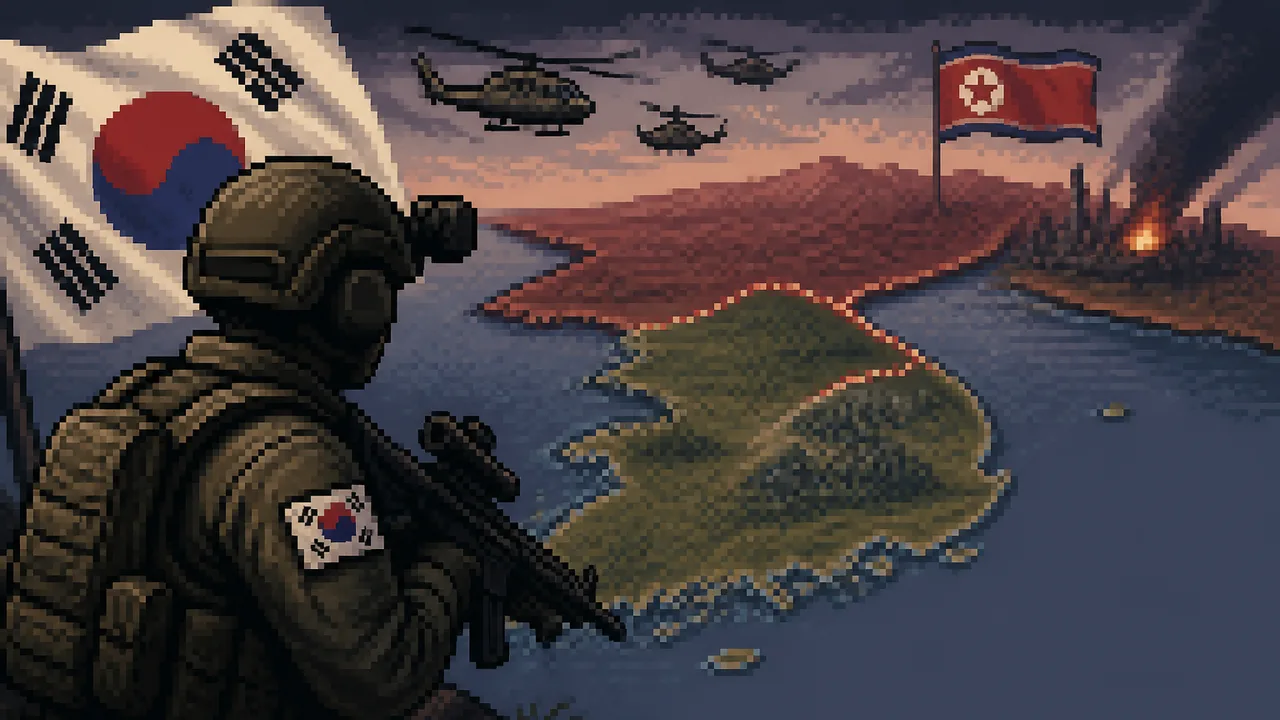
Photo: AI. Cosmo Vega
The Korean War never officially ended. That sentence is not a metaphor or a dramatic opener — it is a geopolitical fact that shapes security policy, family separations, and military postures across the peninsula to this day. The 1953 armistice suspended fighting; no peace treaty followed. Nearly 30,000 US troops remain stationed in South Korea. The DMZ is one of the most heavily fortified borders on earth.
Into this live, unresolved situation, Activision and developer Infinity Ward are dropping a blockbuster shooter game. Call of Duty: Modern Warfare 4, due for release on 23 October, is set primarily on the Korean Peninsula and follows young South Korean soldiers responding to a full-scale North Korean invasion. The trailer has a Korean-language script logo. The pitch, per the developers, is a "grounded story from the perspective of ordinary South Korean soldiers."
The online reaction — from Korea, from the gaming community, from scholars — is exactly as complicated as the subject matter.
The Symbolism Is Real, and It Matters
Start with what the enthusiasts are pointing to, because it deserves to be taken seriously before the caveats arrive.
Call of Duty is not a niche franchise. It is one of the highest-grossing entertainment properties on earth, with a player base that spans North America, Europe, the Middle East, and East Asia. When that franchise puts Korean script on its logo — not as a regional localisation quirk, but as a headline aesthetic choice — Korean players notice. BBC gaming correspondent Laura Crest, speaking on BBC News, reported that colleagues in Seoul found "a lot of excitement" around the announcement, with some describing the inclusion as "quite a symbolic moment actually."
That reaction makes sense in context. The past decade of Korean cultural export — Parasite, BTS, Squid Game, the entire Hallyu wave — has shifted Korean culture from regional phenomenon to global reference point. But there's a difference between Korean culture being received internationally and Korean history being centred in a product made by an American studio for a global audience. The latter is newer, and for some, meaningful precisely because of that.
The Korean-language logo isn't incidental. It signals, at minimum, that the developers intend Korean identity to be visually foregrounded rather than cosmetic. Whether the game delivers on that framing is a question that won't be answerable until October.
The Concern Is Also Real, and It Also Matters
Dr. Sarah Son, Senior Lecturer in Korean Studies at the University of Sheffield, put the counter-case plainly: the game "could be controversial" because it "turns still-unresolved war into entertainment."
That phrase — still-unresolved — is the crux. The Korean War is not a closed historical chapter in the way that, say, World War II is. It is an active geopolitical condition. Families remain separated across the border. Diplomatic talks between Seoul, Pyongyang, Washington, and Beijing have lurched between partial engagement and total breakdown for decades. The question of what a renewed conflict would actually mean — for the twenty million people in greater Seoul alone, within artillery range of the border — is not abstract.
The risk that Infinity Ward's creative team runs is the same risk any Western studio runs when it sets a blockbuster narrative in someone else's ongoing national trauma: the reduction of lived complexity to a legible antagonist and a satisfying arc. "Is it reducing what is obviously a very complex history to action movie stereotypes?" Crest noted as a genuine concern circulating online. "Is it going to trivialize that history?" Those are not hostile questions from critics looking for something to object to. They are the minimum due diligence questions that the developers themselves should be asking — and apparently are.
Infinity Ward has said it consulted with advisers with ties to the region, including military personnel who have served there. That's worth crediting. It's also worth noting that consultation and creative execution are two different things, and trailers are optimised for hype, not nuance. We're assessing intent right now. The proof is in October.
Infinity Ward Has Been Here Before
The studio's track record on controversial content is, to put it gently, uneven. The 2009 mission "No Russian" — in which players could optionally participate in a massacre of civilians at a Moscow airport — remains one of the most debated creative choices in mainstream gaming history. A 2022 mission drew explicit parallels to the real-world assassination of Iranian General Qasem Soleimani, a targeted killing that brought the US and Iran to the edge of direct military confrontation. These are not coincidental provocations. As Crest noted, the series leans into "real world topics" by design — "modern warfare" is the brand promise.
That history cuts both ways in evaluating this Korea decision. On one reading, Infinity Ward has a pattern of using shocking real-world content as aesthetic fuel without proportionate ethical seriousness about the real people implicated. On another reading, the studio has demonstrated a consistent willingness to go where more cautious developers won't — and occasionally, that produces something genuinely illuminating about how modern conflict is experienced.
The Korean campaign hasn't proven itself to be either of those things yet.
The Quieter Commercial Logic
There's a dimension to this that sits underneath the cultural conversation, and it's worth naming. BBC's Crest flagged something interesting in the broader competitive landscape: the recent trend among major shooter franchises has actually been away from real-world geopolitics. Battlefield, the closest rival in the genre, shifted toward fictional military factions in its most recent iterations — no identifiable countries, no mappable real-world tensions. The result was creative safety and commercial mediocrity.
Modern Warfare 4's return to a recognizable geopolitical flashpoint looks, from one angle, like a principled creative choice. From another, it looks like a calculated bet that audiences respond to stakes they can locate on a map. Crest raised the possibility that Korea might function as "a safer option when you look at what's happening in the world today for global audiences than any other real world conflict" — meaning: a tension that registers as serious and plausible, but one where Western audiences aren't as emotionally or politically raw as they might be with, say, a game set in Ukraine.
That framing is uncomfortable but honest. The Korean Peninsula is tense and unresolved, but it doesn't carry the same immediate daily weight in European and American living rooms that other current conflicts do. Whether that makes it an appropriate subject for entertainment or a more palatable proxy is a question worth sitting with.
The Game Itself Still Has to Work
Strip away the geopolitics and there's also a straightforward question of whether Modern Warfare 4 will be any good — and the answer to that depends less on the campaign setting than on what the developers do with the multiplayer.
Call of Duty lives and dies on its multiplayer modes. Infinity Ward is undertaking what they describe as one of the most significant gameplay overhauls in the franchise's history — reworking movement mechanics, and substantially refreshing the DMZ extraction mode that pits players against AI opponents and each other. The game is also cutting last-generation hardware entirely, launching on PlayStation 5, Xbox Series X and S, PC, and Nintendo Switch 2 only.
That's a commercially significant decision. A generation-only launch consolidates the install base and signals ambition, but it also narrows the initial audience. Whether the multiplayer changes land well will determine whether the Korea setting is remembered as the year Call of Duty got interesting again, or merely as the setting for the game that failed to fix its multiplayer.
The campaign — the morally complex, geopolitically charged, symbolically loaded Korean narrative — is what's generating the conversation. But it's the multiplayer that will decide whether people are still talking about this game in March.
South Korean drama and film have been fictionalizing North-South conflict for decades — JSA, The Berlin File, Crash Landing on You in softer register. The genre exists; the creative territory is not unprecedented even within Korean culture itself. What's new is the scale of the platform, the American authorship, and the question of who gets to tell this story and what they do with it.
Infinity Ward says they want to tell it from the ground up, through the eyes of ordinary soldiers, with regional advisers in the room. Maybe they do. But intent is the starting point of a story, not its ending — and right now, October is a long way away.
More Like This
Diablo IV: Lord of Hatred Expansion Review
Explore Diablo IV's Lord of Hatred expansion. New classes, zones, and a thrilling campaign await.

Inside the Indie Game Pitch: Speed Dating for Dreamers
At London Games Festival, indie developers get 15 minutes to pitch their next big thing. Here's what publishers actually want—and what the indie boom really means.
Esports World Cup Moves from Riyadh to Paris
The Esports World Cup is moving to Paris eight weeks out. For the players and orgs who'd already arranged Riyadh travel, the real story starts now.

Peter Molyneux's Final Game: Masters of Albion
Peter Molyneux calls Masters of Albion his last game. The Fable creator reflects on legacy, AI in gaming, and why the UK industry needs more respect.
007 First Light Review: Bond's Best Game in Years
IO Interactive's 007 First Light is a brilliant Bond game with real flaws — and a hardware ceiling that shuts out most of the world's gamers. Here's the full picture.
WarGames Got the Details Wrong—But the Feeling Right
How a 1983 film used real hardware and strategic Hollywood cheating to capture what early computing actually felt like—even when faking almost everything.
A Stonehenge Precursor Found Under a Housing Estate
A 5,000-year-old solar structure found near Stonehenge raises sharp questions about prehistoric astronomy—and how Britain treats unprotected heritage sites.
Destiny 2 Ends: A Community Bungie Built and Switched Off
Bungie ends Destiny 2 content updates in June. Three creators reflect on careers, community, and what happens when a corporation owns your third place.