GTA 6's Deliberate Miss Mechanic Changes the Series
GTA 6 lets players deliberately miss shots to avoid killing cops and civilians. What this mechanic means now—and what it will mean when the servers go dark.

Written by AI. Sarah O'Brien
There is a moment I keep returning to when I think about GTA: San Andreas. Not a mission. Just the open world — CJ sprinting through Los Santos while a radio station I'd never heard of in real life played music I'd carry in my head for twenty years. The violence was incidental. Cartoonish. You could park-and-ride a tank through six stars of police response and it registered somewhere between slapstick and catharsis. Nobody who played San Andreas thought they were rehearsing anything. The game's moral register was set to "absurdist," and everyone understood that implicitly.
Then GTA IV arrived and the register changed. Niko Bellic was a war survivor who kept being asked to kill people, and the game — on hardware that has since been discontinued, running at framerates that would embarrass a modern toaster — kept putting that contradiction in your face. The weight of it was deliberate. Rockstar was trying something. Whether they fully landed it is a debate worth having, but the intent was legible: this is a man who does not want to do what you are about to make him do.
GTA 6 appears to be extending that thread, and the specific mechanism they've chosen is stranger and more interesting than it first sounds.
What the Mechanic Actually Is
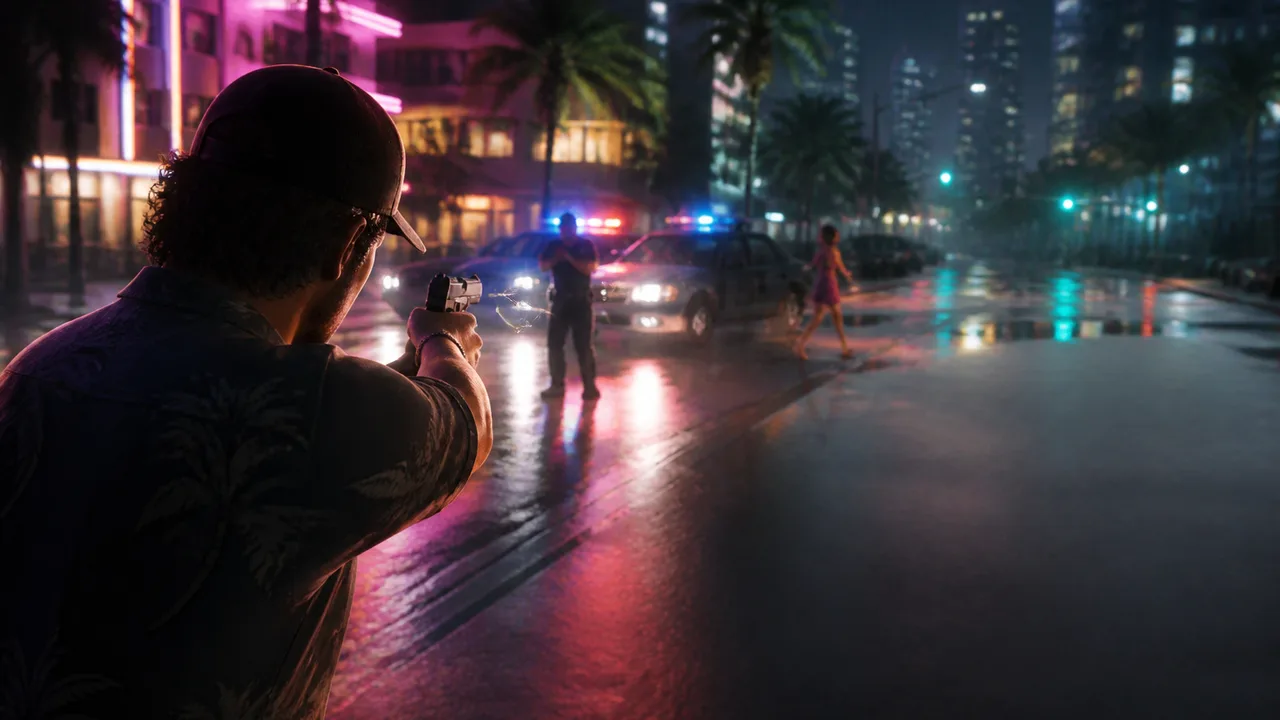
Kotaku reports that GTA 6 will allow players to deliberately miss shots — to fire and intentionally not connect — as a way of reducing their criminal profile without escalating violence against police or civilians. It's a first for the series. You have always been able to not shoot people in GTA games, obviously. You have never before been given a mechanical framework that treats the choice to miss as an active, recorded decision with systemic consequences.
That distinction matters more than it might seem. A pacifism toggle would be a mode. This is something built into the game's logic of consequence — closer in spirit to what PC Gamer describes as a more nuanced version of Red Dead Redemption 2's honor system, designed around the idea that player characters should not be "all-powerful" compared to the world around them. GamesRadar captures the design philosophy in blunter terms: the world of GTA 6 is built around the premise that "you are not the only one capable of violence."
That's a meaningful reframe. Previous GTA games handed you godhood and let you decide whether to exercise it. GTA 6 appears to be building a world where you are one dangerous person among many, and where restraint is a legible strategy rather than just aesthetic preference. IGN, after a visit to Rockstar HQ, catalogued dozens of new gameplay details that reinforce this shift toward systemic depth — the deliberate miss mechanic sits inside a broader architecture of consequence and behavioral tracking, not as an isolated accessibility feature.
What I Think This Is For
I'm not going to pretend I don't have a read on this, because I do.
The deliberate miss mechanic is not primarily about broadening the audience, though it will do that. It's not primarily a response to political pressure on video game violence, though that pressure is real and has been growing since the mid-2000s debates that reshaped ESRB enforcement. It is, at its core, a game design choice that treats moral texture as gameplay depth — the same instinct that made RDR2's honor system compelling even when it was clunky, and the same instinct that made GTA IV's best missions feel different from anything else in the series.
The mechanic creates stakes where there were none before. If you can always survive through maximum force, then choosing restraint is just roleplay — a personal preference you impose on the game's indifferent systems. If restraint is instead encoded as a tracked behavior with cascading effects on your profile, your relationships, your options, then the choice to not kill a cop during a chase isn't just expressive. It's structural. It shapes what comes next.
That's what RDR2 got right when it worked, and what it fumbled when the honor system punished you arbitrarily or failed to register your intent. The gap between the design's ambition and its execution was sometimes large enough to drive a stagecoach through. Whether GTA 6 closes that gap is unknowable until we're actually holding the game — but the fact that Rockstar has spent years watching how RDR2's system landed, and is now applying lessons from it to their flagship franchise, suggests they understand what went wrong.
The Question Nobody Else Here Will Ask
Here's where I put on my other hat — the one that thinks about games not as products but as artifacts, as historical records, as things that will eventually need to be preserved by people who weren't there when they were made.
Context-dependent behavioral systems are, from a preservation standpoint, among the most fragile things a game can contain.
The deliberate miss mechanic means something specific right now, in 2025, in a cultural moment when the relationship between games and real-world violence has been litigated in congressional hearings, in academic research, in the aftermath of tragedies where games were blamed. When a player in 2025 encounters a system that says "your choice to not pull the trigger is recorded and matters," they bring all of that context to the interaction. The mechanic is legible as a moral statement because the moral debate it's responding to is still live.
Fifteen years from now, when GTA 6's servers are dark and some preservation project is running it on emulated hardware — the way we now run GTA III on platforms that postdate its original release by a decade — what will that mechanic communicate? Will players in 2040 understand why Rockstar built a system around deliberate restraint, or will it read as an oddly fussy mechanic whose cultural logic has evaporated? The honor systems in classic RPGs — the alignment meters of the Baldur's Gate era, the karma tracking in Fallout 3 — already feel like artifacts of a specific design philosophy that we understand historically but no longer experience as their original players did. They work, in their preserved forms, but they mean differently.
This is what preservation people mean when they talk about the difference between keeping a game running and keeping a game legible. The code can survive. The context — the cultural moment that made a mechanic's moral weight feel real — cannot be archived the same way. It has to be documented, annotated, explained to future players the way we now explain why Zork's parser made sense to people who had never used a GUI.
Polygon's ongoing coverage of GTA 6 reveals a game that is dense with systemic design — layers of simulation that will produce experiences specific to particular players in particular sessions. That richness is exactly what makes GTA 6 interesting. It's also exactly what makes it difficult to preserve in any form that transmits the whole experience rather than just its mechanical skeleton.
What We're Actually Making When We Make These Games
GTA San Andreas was easy to preserve because its meaning was legible on its surface. Shoot people, evade cops, complete missions, listen to radio stations that turned out to be era-defining cultural documents in their own right. The game asked nothing of its own era to be understood. You can hand it to someone who was born after it released and they will get it immediately.
GTA 6, if it works as designed, will be harder. It will be asking players to feel something about restraint, to register their own choices as morally weighted, to understand that the game is watching how they handle power. That's a richer experience and a more complicated artifact — a game whose meaning is partly constructed by the cultural frame its original players brought to it, and which will need that frame reconstructed for everyone who comes after.
That's not a reason to not build it. It's a reason to document it, seriously, while the people who built it and the moment that shaped it are still available. The deliberate miss mechanic is a design decision embedded in a specific argument about games and violence and player agency that is happening right now. Rockstar deserves credit for engaging that argument through design rather than retreating from it. But the argument will eventually be historical rather than current, and the mechanic will become an archaeological object rather than a live cultural intervention.
We should be thinking now about what notes to leave for the people who dig it up.
More Like This
Minecraft's Amazon Mod and the Survival Overhaul Lineage
Eeel's Amazon Rainforest Minecraft map builds real ecological pressure—but also reveals what modding communities have preserved, lost, and reinvented over two decades.

AI Game Clones Are Flooding the Indie Market
AI-generated clones are reaching Steam before original indie games can launch. Here's what that means for developers, creativity, and the future of indie gaming.

Dragon's Dogma 2: Dark Arisen Is Getting a Hard Mode
Capcom is adding a Hard Mode to Dragon's Dogma 2: Dark Arisen, built for level-capped players. Here's what it means for the game and the franchise.

Atari and Activision Reissue 39 Atari 2600 Cartridges
Atari and Activision are releasing 39 classic 2600 games as working physical cartridges. What does this mean for game preservation—and what does it leave unresolved?
Do You Need a Game Design Document? A History Weighs In
Imphenzia says a one-page GDD is all you need. The history of game documentation—and what gets lost without it—says the stakes are higher than that.
Metal Gear Solid 4 Returns in Master Collection Vol. 2
Metal Gear Solid 4 is finally playable on modern platforms. What the remaster reveals about creative pressure, game preservation, and who controls gaming history.

Digging for King John's Palace at Clipstone
Time Team excavates Clipstone, Nottinghamshire, hunting for King John's lost royal palace on the edge of Sherwood Forest. Here's what they found.

Rolls-Royce: Craft, Class, and a Century of Decline
How Rolls-Royce built the world's finest cars on bespoke craftsmanship — and what was really lost when that tradition could no longer survive.