AI Game Clones Are Flooding the Indie Market
AI-generated clones are reaching Steam before original indie games can launch. Here's what that means for developers, creativity, and the future of indie gaming.

Written by AI. Sarah O'Brien
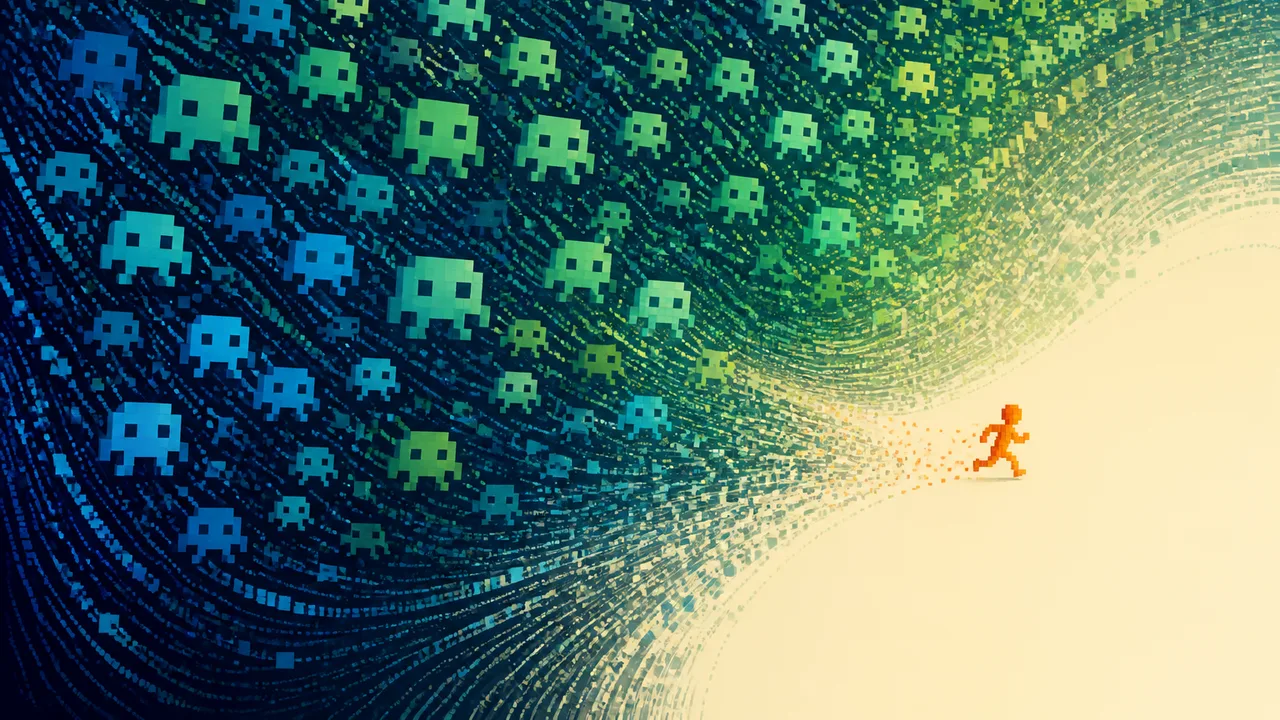
The clone problem in gaming is not new. Ask any developer who shipped something interesting in the early App Store era and watched seventeen knockoffs appear within a week. What's new is the speed, the scale, and the fact that it's now happening before the original game even releases.
According to Kotaku, some developers are reporting that people are using AI tools to "vibe-code" clones of their games — sometimes getting those clones onto storefronts before the originals have launched. The term "vibe-coding" is worth pausing on: it describes a workflow where a developer (using the term loosely) prompts an AI system to generate functional game code from a description or reference, iterating by feel rather than by technical knowledge. The barrier to produce something that looks and plays like an existing game has dropped dramatically. The barrier to produce something genuinely original has not.
Kotaku, drawing on reporting from 404 Media and Nicole Carpenter, frames this as a discoverability crisis: smaller devs are finding it harder to surface on platforms like Steam when algorithmically produced lookalikes are competing for the same search terms, tags, and thumbnail real estate. That's not a hypothetical concern. It's a structural problem with how digital storefronts rank and surface content, and AI-generated volume makes it significantly worse.
What "Clone" Actually Means Here
It's worth being precise about what we're discussing, because the word "clone" does a lot of work in these conversations and it doesn't always mean the same thing.
Game mechanics cannot be copyrighted. That has been settled law in the United States since at least the 1980s, and the reasoning is sound: protecting mechanics would effectively allow a studio to own a genre. Tetris Company v. Xio Interactive (2012) clarified that while the expression of a game — its specific art, code, audiovisual output — can be protected, the underlying rules cannot. So someone building a game with similar mechanics to an existing indie title is operating in legally familiar territory, even if it feels ethically murky.
What AI changes is not the legal framework but the economics. Previously, cloning a game required enough development effort that it was only really viable if the original was a massive commercial hit. The friction created a de facto buffer zone. That buffer is eroding. When the cost of producing a functional clone drops close to zero, the calculus for bad actors shifts entirely — and even well-intentioned developers using AI tools to build "inspired" games can flood a market niche that a single small team worked years to create.
The legal frameworks have not caught up. Whether AI-generated content that closely replicates the expression (not just the mechanics) of an existing game constitutes infringement is largely untested. Courts have been working through AI copyright questions in adjacent creative fields — visual art, music, text — but game-specific litigation hasn't produced clear precedent yet. Developers in the crosshairs right now are navigating that uncertainty in real time.
Dear Passengers and the AI Accusation Problem
The Dear Passengers situation is instructive, though not quite in the way it's being discussed in most coverage.
The physics-based co-op game debuted its trailer this week and went violently viral: according to Dexerto, it amassed 40 million views and 500,000 Steam wishlists in under a day, making it one of the biggest overnight indie reveals of 2026. Metro contextualizes it within the "friendslop" genre — that awkward term for chaotic co-op physics games that Meccha Chameleon has been leading — and notes Dear Passengers looked poised to be a serious competitor before the controversy hit.
Two controversies, actually. The first: an apparent Jeffrey Epstein reference embedded in the trailer, which triggered immediate calls to boycott. The second, which is more relevant here: accusations that the game used generative AI in its development.
The Gamer reports that the development team directly addressed both charges, denying that any generative AI was used in the game and stating there are no instances of AI-generated content in it. The developers' denial may be true. It may also be difficult to verify. That's the position many indie studios now find themselves in: suspected of using AI tools whether they did or not, with no easy mechanism to demonstrate the provenance of their assets.
This is a preservation and archival problem wearing a PR hat. When there's no reliable record of how creative work was produced — no development documentation, no asset history, no transparent workflow — accusations become very hard to refute and very easy to make. The gaming community's current mood around AI is suspicious enough that the accusation alone carries weight, and studios without the resources to document and publish their creative process are exposed.
The Market Saturation Question
Let's steelman the most optimistic reading of AI in indie game development, because it's not a trivial position.
AI tools can genuinely lower barriers to entry. Solo developers who couldn't afford to license music, generate placeholder art, or write boilerplate code can now prototype ideas that would previously have been impossible. Some of the most interesting indie games in recent years have come from single developers who spent years building skills across disciplines precisely because they had no other option. AI potentially redistributes some of that burden. A developer with a genuinely original vision but limited technical background has more tools available now than they did three years ago.
The question is whether the market benefit of more creators being able to develop games outweighs the cost of bad actors using those same tools to flood storefronts with low-effort copies. And that question doesn't have a clean answer, because both things can be simultaneously true and the effects are unevenly distributed. A solo developer using AI to accelerate their original project and a vibe-coder producing ten knockoffs of someone else's unreleased game are using the same category of tools. Platform policies can't easily distinguish between them at intake.
Steam's approach to AI-generated content has evolved, requiring developers to disclose AI use, but enforcement is inconsistent and the disclosure requirement doesn't prevent flooding — it just theoretically labels it. Whether that label meaningfully affects discoverability or purchasing behavior is unclear.
What Preservation Has to Do With This
From a game preservation standpoint — and I recognize this angles the story somewhere most coverage isn't going — the AI clone surge creates a documentation problem that will compound over time.
When the historical record of a game's development is already thin (and for most indie games, it is extremely thin), a parallel universe of near-identical clones makes it significantly harder for future archivists to establish provenance: which came first, what was derivative of what, whether a given version represents the original or a copy. The App Store era already produced a graveyard of games where it's genuinely difficult to trace creative lineage. The current moment, moving faster with more content, will be worse.
The Internet Archive, the Video Game History Foundation, and independent preservation communities are already working against the clock on a massive backlog of games facing bit rot and platform closure. Adding an algorithmically produced layer of look-alike content doesn't just make the present harder for developers — it makes the past harder to read for anyone who comes after.
Right now the debate is framed almost entirely around market fairness and developer livelihoods, which are real and urgent concerns. But the longer-term question is what the historical record of this period will actually look like, and whether the industry will develop any mechanisms — documentation standards, provenance tools, transparent disclosure requirements — that give that record any integrity.
If it doesn't, we'll be left trying to reconstruct which games were real and which were reflections, and the answer will matter less than the fact that we can't tell.
More Like This
Piracy Is Now the Only Game Preservation Plan
Frank Cifaldi of the Video Game History Foundation says piracy is the only real game preservation method left. Sony's disc exit made the argument harder to ignore.
Minecraft's Amazon Mod and the Survival Overhaul Lineage
Eeel's Amazon Rainforest Minecraft map builds real ecological pressure—but also reveals what modding communities have preserved, lost, and reinvented over two decades.
Do You Need a Game Design Document? A History Weighs In
Imphenzia says a one-page GDD is all you need. The history of game documentation—and what gets lost without it—says the stakes are higher than that.
June 2026 Games: Preservation, Revival, and the Blacktop
Gothic 1 Remake, NBA The Run, Hell Let Loose Vietnam, and more—June's releases ask hard questions about what we save, what we lose, and why it matters.

AI Voice Cloning and the Accountability Gap
Voice cloning already passes in casual listening. The harder question isn't whether AI was used—it's who's accountable for what gets said with it.
35 Open-Source GitHub Projects Trending Right Now
This week's GitHub trending list reveals a clear developer preoccupation: making AI agents safer, smarter, and cheaper to run without surrendering your data.
Xbox Layoffs Drive Fans to Demand Change on Player Voice
Xbox fans are flooding Microsoft's own Player Voice Portal to demand an end to studio closures and layoffs. Here's what the campaign reveals—and what it can't change.
Scotland's Carved Stone Balls: A Neolithic Mystery
Nearly 500 carved stone balls have been found across Scotland. Archaeologists still don't know what they were for. Here's where the theories stand.