Atari and Activision Reissue 39 Atari 2600 Cartridges
Atari and Activision are releasing 39 classic 2600 games as working physical cartridges. What does this mean for game preservation—and what does it leave unresolved?

Written by AI. Sarah O'Brien
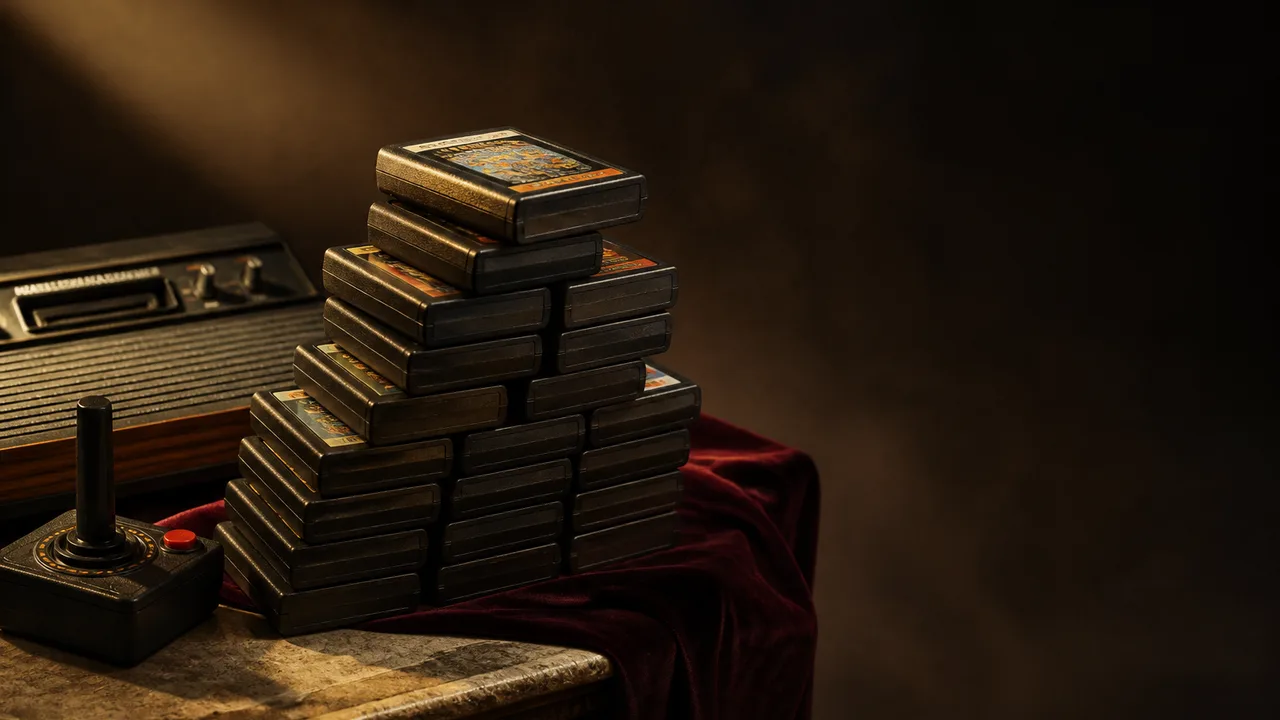
There is a specific kind of corporate announcement that lands differently depending on who's reading it. For collectors, it's a preorder event. For preservation advocates, it's a complicated question. For the industry historians watching from the back of the room, it's—at minimum—interesting.
Atari and Activision have announced a collaboration to rerelease 39 classic Atari 2600 games as working physical cartridges, according to IGN. The collection reunites two companies whose relationship goes back to the late 1970s—a history that, as GamesRadar notes, spans 48 years. Activision was famously founded by disgruntled Atari developers in 1979, which means this reunion carries the weight of one of gaming's defining corporate ruptures. The announcement, covered by Polygon, frames the collection as a response to the growing retro gaming resurgence—and as a deliberate counterweight to the industry's drift toward digital-only distribution.
The Escapist flagged that the reveal landed exactly as predicted after Atari teased "something big"—which tells you something about how legible this kind of move has become. Physical rereleases of 2600 cartridges aren't a surprise. They're almost a genre now.
What this actually is
Let's be precise about what's being offered here, because the preservation conversation hinges on specifics.
These are working physical cartridges for the Atari 2600—or its modern-day hardware successors. They are not ROM dumps on a flash drive. They are not digital downloads with a cardboard sleeve. They are cartridge-shaped objects that physically plug into hardware and run games that originally shipped in the late 1970s and 1980s. That is genuinely different from a lot of what gets marketed as "physical media" in retro gaming circles.
For the 39 titles included, the Activision back catalog on the 2600 is exactly what you'd expect: Pitfall!, River Raid, Kaboom!, Pitfall II, Enduro, and others that defined what third-party development looked like when it was a radical concept. GamesRadar's coverage reflects a view shared by a lot of people who've been around this space—the list is solid, maybe even sentimental, but it raises the immediate question of what's not there. The writer is holding out for more than Pitfall. That's a fair position to take. Thirty-nine titles from a catalog that runs much deeper means choices were made, and those choices aren't yet fully explained.
The preservation question, stated carefully
Here's where I want to resist two easy framings.
The first easy framing: this is preservation. It isn't, exactly. Preservation, in the archival sense, means ensuring that software and its context survive in a form that can be accessed by future researchers, historians, and players regardless of hardware availability or corporate continuity. Physical cartridges are lovely, and there is genuine value in being able to hold the object in your hand—but a limited-run commercial rerelease tied to proprietary hardware is not an archive. If Atari folds again (and Atari has folded before), these cartridges don't automatically become more accessible. They become collector's items.
The second easy framing: this is cynical nostalgia exploitation with no preservation value. That's also wrong. Physical media outlasts servers. A cartridge sitting in someone's drawer in 2045 is recoverable in ways that a delisted digital title simply isn't. The fact that these games will exist as physical objects, in quantity, in private hands, matters. Bit rot is real. Server shutdowns are real. Every copy of a game that exists in the physical world is a hedge against institutional failure.
The honest position is that this release does something useful and something incomplete simultaneously, and those two things coexist without canceling each other out.
Why the Atari-Activision reunion matters historically
The 48-year gap that GamesRadar references isn't just a trivia datum. Activision's founding in 1979 was a direct challenge to Atari's policy of not crediting or compensating developers. The four original founders—David Crane, Alan Miller, Bob Whitehead, and Larry Kaplan—left Atari specifically because they wanted recognition for their work. Jim Levy joined as CEO. Atari sued Activision almost immediately, arguing that third-party development violated their licensing agreements. They lost. That loss established the legal precedent for the entire third-party software industry.
So when Atari and Activision put their names on the same cartridge box in 2026, they're not just doing a nostalgia collab. They're collapsing one of the foundational conflicts in the industry's legal and creative history into a retail product. Whether that's meaningful or ironic or both is genuinely up to the reader. But the context deserves to exist in the same sentence as the announcement.
The collector market and what physical means now
The retro gaming collector market has been running hot for years. Sealed copies of rare NES titles have sold at auction for amounts that require several decimal places. The secondary market for original 2600 cartridges is active, if not stratospheric. Into this market, Atari and Activision are dropping 39 new-old physical objects.
This creates an interesting tension. Collector value is partly a function of scarcity. New pressings of classic cartridges—if produced in sufficient quantity—could flatten the secondary market for original copies of the same titles. They could also pull new buyers into the hobby, expand the community, and ultimately raise all boats. Which of those effects dominates depends on production run sizes, pricing, and distribution, none of which are fully public as of this writing.
What's clear is that the decision to go physical at all is a statement. In a market where Nintendo has repeatedly shuttered digital storefronts without warning and where Sony's PS3 store closure became a preservation rallying point, physical media is increasingly understood not just as a format preference but as a stance on permanence. Polygon's framing of this release as "a push against digital-only trends" is accurate, though it's worth noting that Atari and Activision are also, presumably, making a business decision they expect to be profitable. Those two motivations aren't mutually exclusive, but they're not the same thing either.
What's still unanswered
The record is genuinely thin on some specifics that matter. Production numbers aren't confirmed in any of the sources available. Pricing hasn't been detailed. The precise hardware compatibility—which Atari consoles and which modern clones will run these cartridges—is something IGN touches on but doesn't fully enumerate. For buyers trying to decide whether this is worth their money, those details are load-bearing, and they're not yet public.
The question of what happens to the other Activision 2600 titles—the ones not in this 39—is also open. A physical rerelease of the best-known titles doesn't address the preservation status of the rest. Games that weren't hits in 1982 are exactly the games most at risk of disappearing entirely, because corporate incentive to preserve them is lowest. Licensed titles from that era are particularly precarious, tangled in rights holders who may not even know they hold the relevant rights.
Thirty-nine titles is a meaningful number. It's also a fraction of what exists and what's at risk.
The reunion of Atari and Activision on a physical cartridge in 2026 is a good story. Whether it's a preservation story, a collector story, or a business story depends on which part of it you're watching—and the industry's track record suggests that watching carefully, rather than celebrating early, is usually the more defensible position.
More Like This

Pokémon Go at Ten: AR's One Durable Success Story
Pokémon Go turns ten this week. A look at what it actually got right—and why the AR industry it was supposed to launch mostly didn't follow.
Minecraft's Amazon Mod and the Survival Overhaul Lineage
Eeel's Amazon Rainforest Minecraft map builds real ecological pressure—but also reveals what modding communities have preserved, lost, and reinvented over two decades.

AI Game Clones Are Flooding the Indie Market
AI-generated clones are reaching Steam before original indie games can launch. Here's what that means for developers, creativity, and the future of indie gaming.
Do You Need a Game Design Document? A History Weighs In
Imphenzia says a one-page GDD is all you need. The history of game documentation—and what gets lost without it—says the stakes are higher than that.
ESO's Leadership Purge Is a Preservation Crisis
Xbox layoffs gutted ZeniMax Online's leadership after 200+ cuts. For ESO's 11-year history, the real loss may be institutional knowledge no one wrote down.
Dark Castle Returns to PC 40 Years Later
Dark Castle and Beyond Dark Castle just dropped on Steam as faithful 1-bit replicas—plus a new sequel is teased. Here's why this Mac classic still matters.

Rolls-Royce: Craft, Class, and a Century of Decline
How Rolls-Royce built the world's finest cars on bespoke craftsmanship — and what was really lost when that tradition could no longer survive.
Fallout Season 3 Is Filming, and the Franchise Has Come Far
Walton Goggins confirms Fallout Season 3 is filming. What does a franchise this far from its 1997 origins mean for gaming history and preservation?