Dark Castle Returns to PC 40 Years Later
Dark Castle and Beyond Dark Castle just dropped on Steam as faithful 1-bit replicas—plus a new sequel is teased. Here's why this Mac classic still matters.

Written by AI. Derek "D-Block" Washington
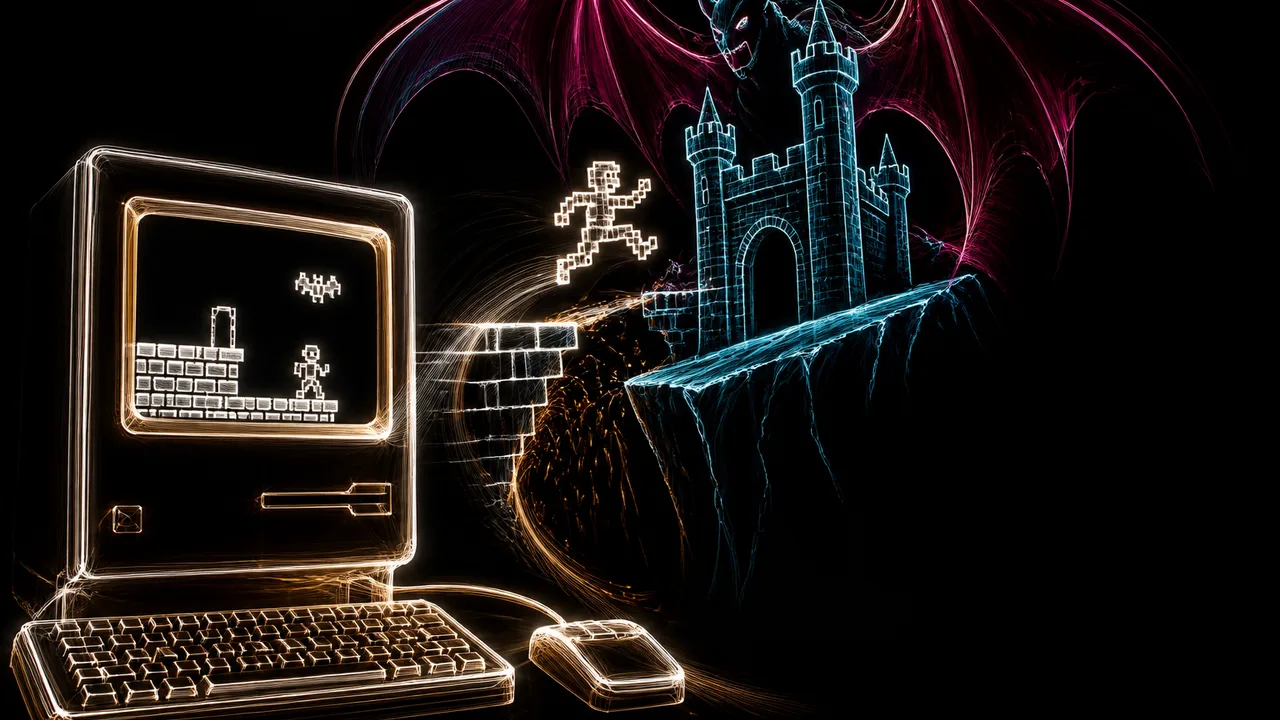
Duncan—the game's hooded protagonist—just dropped onto Steam without much fanfare. No marketing blitz, no influencer embargo, no countdown clock. According to Time Extension, it was essentially a surprise release. One day Dark Castle and its 1987 sequel Beyond Dark Castle weren't on Steam, and then they were. That's actually kind of perfect for a game that spent 40 years living in the specific memory of people who had a Mac in 1986.
Here's what we're talking about: Dark Castle is a precision platformer — the Steam page calls it exactly that, "a faithful re-release of the 1986 precision-platformer that defined the genre" — where you control Duncan through a monster-infested castle, chucking rocks at things and perfectly timing jumps in what the listing describes as a "beautiful, brutal, and darkly funny 1-bit adventure." The developers at the time, according to Kotaku, were explicitly trying to see what the Apple Macintosh could actually do. The 1-bit black-and-white aesthetic wasn't a limitation they worked around — it was the canvas they worked with, and the result was something atmospheric enough that people still remember it four decades on.
The port itself, handled by Ludit in partnership with Indigo Matrix, is not a remaster. Let's be real clear about that. Dread Central describes both games as "exact replicas" landing on modern Windows, macOS, and Linux. COGconnected confirms the same. Faithful replicas. Not redrawn sprites, not a reimagined soundtrack, not a UI redesign with quality-of-life additions. What existed in 1986 and 1987, running on your 2026 machine.
I'll be honest with you: that's the thing I'm sitting with. Because my instinct is to respect it and also immediately want something more. The no-save-states, no-hand-holding reality of a faithful 1986 replica is going to body a percentage of players who came in curious and leave them frustrated before they ever get the thing that made this game matter. I've watched that happen with other brutal-but-beloved classics. The game itself doesn't become more accessible just because it's now available — availability and accessibility are totally different problems.
But here's where I have to check myself: the argument for a pure replica is actually strong, and I don't think it's just nostalgia talking. The 1-bit aesthetic of Dark Castle is not incidental. It was a deliberate artistic and technical statement about what a Macintosh could produce. When you start adding save states and modernized controls to something like that, you're not just making it easier — you're changing the context that made the experience meaningful in the first place. The difficulty is the design. The commitment to finishing the run is part of what the game asks of you. That argument is real and I feel it. I'm just also a person who will absolutely bounce off a platformer if I have to redo the same five screens seventeen times without a checkpoint, so I'm holding both things at once.
What's telling is how the Steam reviews and retro community spaces are already fracturing along exactly those lines. You've got the people who had a Mac in 1986 treating this like a reunion, and you've got newcomers showing up with modern platformer expectations who are going to get absolutely cooked. Neither group is wrong about their own experience. The split just makes visible something that was always true: "faithful preservation" serves one audience really well and leaves another one out in the cold.
The bigger news — and the thing that turns this from a pleasant nostalgia story into something actually worth watching — is buried in the Time Extension piece: there's a new sequel being teased. That's the moment where the whole conversation shifts, because a sequel can't hide behind the replica defense. It's going to have to make choices — about difficulty, about accessibility, about who it's actually making the game for — and those choices will define whether Dark Castle becomes a living series or a preserved artifact.
This is where Shovel Knight is the reference I keep coming back to. When Yacht Club Games released that in 2014, it wasn't just "NES-style platformer." It was a game that understood why the NES-era design worked and rebuilt those principles for people who didn't grow up with the reference. The punishing difficulty was there, but so were mid-level checkpoints. The retro aesthetic was intentional, but it was built in a modern engine with modern control responsiveness. It didn't talk down to the classics it was drawing from — it absorbed them and made something that could stand on its own. What Shovel Knight figured out, and what the Dark Castle sequel is going to have to grapple with, is that reverence for the source material and playability for a new audience aren't actually opposites. The design challenge is making them coexist without flattening either.
The studios that get that right don't make "old games for new people." They make games that contain the original design logic, translate the feeling of it, and let players arrive at the same place through a door that's actually unlocked for them. That's harder than a faithful replica and harder than a full remaster. It requires understanding what made the original matter at a level beyond "it was hard and atmospheric."
Whether Ludit and Indigo Matrix have thought about that for the sequel, I genuinely don't know — the tease doesn't give us much to work with yet. What I do know is that landing two faithful replicas on Steam and immediately signaling a new entry is a smart sequence. Let the people who remember remind everyone why this series has fans at all. Let the Steam reviews fill up with "this game is exactly what it used to be." And then, when there's enough ambient awareness that Dark Castle exists and means something, drop a sequel that has the room to make different choices.
Dark Castle getting a proper PC home after 40 years — across Windows, macOS, and Linux, covering all the platforms where its original audience now lives — is genuinely worth celebrating. This is a game that could have just... disappeared, the way a lot of Mac-exclusive software from that era did, living only in emulation and memory. Instead it's on Steam, officially, in 2026. That matters.
The question is what they do next with it. A sequel that just replicates the original's difficulty without interrogating it will age out fast. A sequel that grasps why the original worked — the atmosphere, the precision, the weird darkly funny brutality of it — and builds something that can transmit that feeling to someone who was born after the iMac G3? That's the version worth making.
Duncan's been in that castle for 40 years. It's past time he got somewhere new.
More Like This
Star Fox 2026 Review: Great Game, Wrong Ambition
Skill Up reviews the 2026 Star Fox remake: gorgeous, fun, and built exactly like a premium mobile game — which is both its strength and its ceiling.
Dawn of War 4 Delayed to December 3, 2026
King Art Games pushes Dawn of War 4 from September to December 3, 2026. Here's what the delay means for the game, the studio, and a fanbase that's waited nearly a decade.
Knytt Classic Returns Free After 20 Years
Knytt Classic is out free on Steam and GOG for its 20th anniversary—but who actually built it, and who pays the cost of preservation?
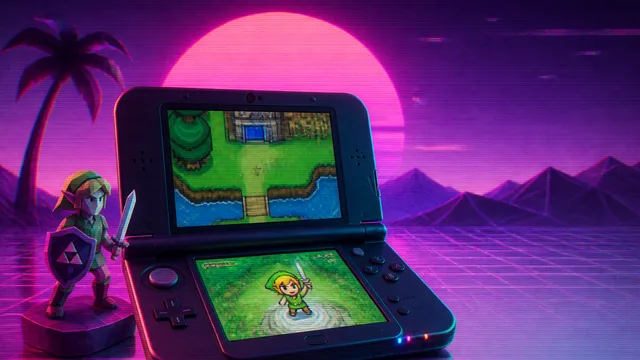
Fan-Made Zelda Ports Bring Dual-Screen Life to 3DS
A homebrew developer has ported Zelda: A Link to the Past and The Minish Cap to the 3DS with native dual-screen support—no emulation, no Nintendo involvement.
WoW Gold Farming Strategies From ElonCS's Midnight Stream
ElonCS breaks down lumber farming, cross-realm flipping, and abundance runs in a recent WoW Midnight stream. Here's what actually holds up under scrutiny.
Dune: Awakening Adds Single-Player Mode for Console Launch
Funcom is adding a full single-player mode to Dune: Awakening alongside its September 22nd console launch. Here's what that actually means for the community.
Fallout Season 3 Is Filming, and the Franchise Has Come Far
Walton Goggins confirms Fallout Season 3 is filming. What does a franchise this far from its 1997 origins mean for gaming history and preservation?
Epic Games Settles Fortnite Collaboration Leaks Lawsuit
Epic Games settled its lawsuit against former contractor Hayden Cohen, aka AdiraFN, permanently barring further leaks of Fortnite's confidential collaboration plans.