Star Fox 2026 Review: Great Game, Wrong Ambition
Skill Up reviews the 2026 Star Fox remake: gorgeous, fun, and built exactly like a premium mobile game — which is both its strength and its ceiling.

Written by AI. Jordan Mercer
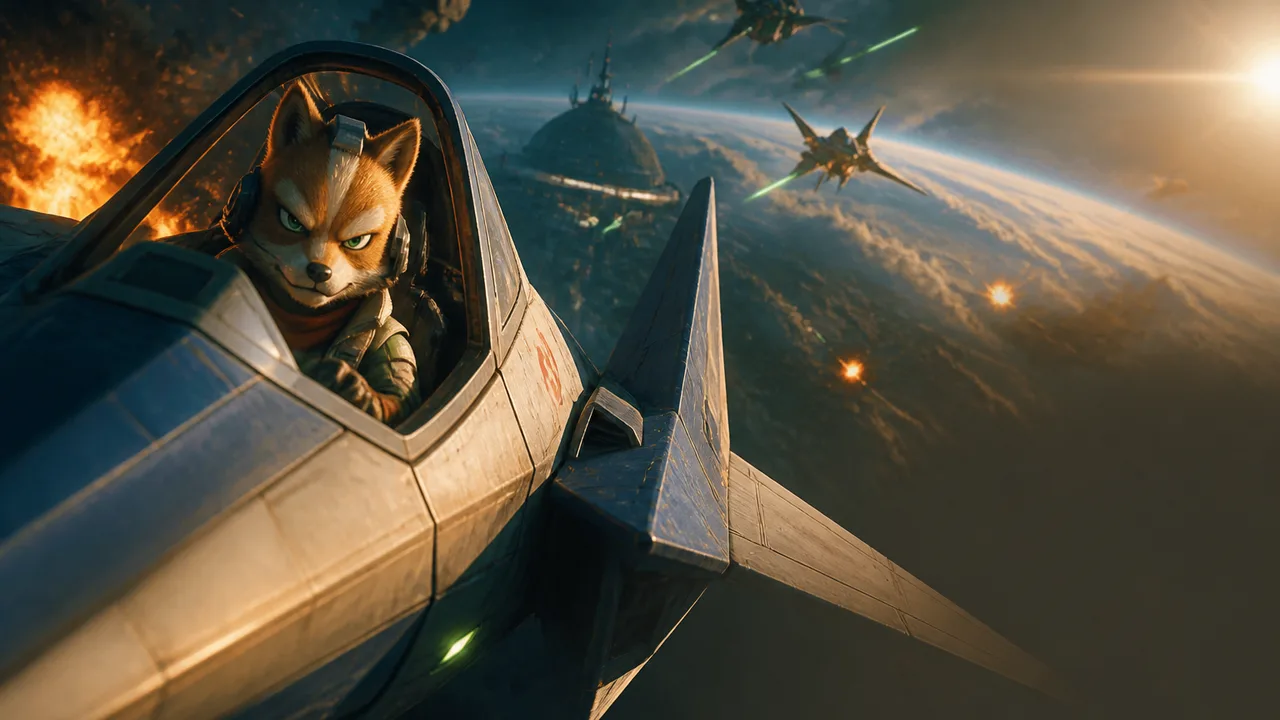
Photo: AI. Astrid Lehmann
Let me tell you what Star Fox 2026 actually is, because the discourse around it is going to be built almost entirely on what people want it to be, and those two things are very different.
Skill Up's review — nearly 21 minutes on the remake developed by Villain Studios — lands on a qualified recommendation. The core gameplay holds up. The orchestral soundtrack slaps. Villain Studios clearly loves this IP. But the review keeps circling a tension that I find genuinely interesting from where I sit: Star Fox 2026 is structurally, philosophically, and functionally a premium mobile game that happens to cost Switch 2 money. That's not an insult. That's actually the most clarifying thing you can say about it.
And Nintendo still played it safe anyway.
If you've never touched Star Fox 64, here's your orientation
Star Fox 64 came out in 1997 — about 29 years before this remake. It was bundled with the Rumble Pack, which was Nintendo's first mainstream haptics implementation. (Next time you appreciate the DualSense's adaptive triggers, pour one out for Fox McCloud.) It was an on-rails arcade shooter: you fly an Arwing through linear levels, barrel roll through enemy fire, hit objectives, and branch into different mission paths depending on your performance. Seven missions per run, around 16 total across the branching structure — so a full run clocks 60 to 90 minutes, and the whole mission pool takes multiple playthroughs to see.
That's the game. That's always been the game. Villain Studios has now rebuilt it with modern visuals, a fully orchestral score, expanded cutscenes, couch co-op, and a 4v4 multiplayer mode with capture-the-flag that Skill Up calls "surprisingly cool." The core design — the mission structure, the level layouts, the objectives — is essentially untouched.
If you're coming in fresh with no nostalgia in your bones, here's what you need to know: this is the mobile session-game philosophy executed at a premium level, with zero monetization attached. Missions run three to six minutes. A full run takes about 90 minutes. The game asks you to replay it, get better, chase medals, unlock challenge modes, find alternate paths. There's no battle pass. No energy timer. No gacha. Just the game.
Skill Up puts it bluntly: "To hell with Candy Crush, this is the [stuff] you should be playing on the toilet." Delivered as a compliment, and honestly? Accurate. The design DNA of Star Fox 64 — short sessions, immediate feedback, replayability through mastery rather than content drip — is exactly what mobile gaming has been chasing for 15 years. Most mobile games dress that loop in garbage monetization. Star Fox just... does it cleanly.
The thing that actually works
The Arwing controls are the foundation, and Skill Up is emphatic that they still sing. Boost, brake, bank, barrel roll — responsive, snappy, immediately satisfying. "To see Star Fox is to want to grab the controller and play it. That was true 30 years ago, and it's still true today."
What's easy to miss just watching footage is how densely the mission design is packed. It looks like you're flying in a straight line shooting stuff. You're not. Hit every radar sensor in a stealth infiltration mission and you unlock a completion path; miss any of them and the game reroutes you. Fly through a specific set of arches in the opening mission and Falco opens a secret path. The all-range mode dogfights — where the Arwing has full 360° freedom in an open space — are routinely the highlight missions, with AI that's reportedly genuinely good at hunting you down.
The visual and audio refresh is real. Villain Studios had more creative latitude here than anywhere else, and the fully orchestral soundtrack in particular is the kind of glow-up that makes you realize how much a 1997 digitized score was holding back the atmosphere.
Nintendo played it too safe, and that's a strategic problem
Here's my actual take, and I'm not softening it: Nintendo's conservatism on this remake isn't a quirk of the development brief. It's a content strategy decision, and it was the wrong one.
Skill Up identifies the clearest symptom: the Arwing is too fast and too maneuverable for how narrow the linear levels are. You hit invisible screen edges constantly. The all-range mode missions show you what the Arwing can do with real space, and then the game immediately puts it back in a corridor. The review's proposed fix is elegant — keep the same missions, same objectives, same beats, but widen the arteries. Add optional routes. Give the ship room to breathe. The original experience stays protected; every level just has more in it.
That's not a radical suggestion. That's a remake doing what remakes are supposed to do.
But Villain Studios apparently had strict marching orders on the core design. So the Area 6 all-range mission — which Skill Up describes as essentially flying in a circle hitting static targets — ships unchanged. In 2026. On hardware that could do more.
The cost of that conservatism is audience reach. Skill Up is direct about this: longtime fans are going to love it, full stop. Parents looking for accessible co-op with kids? Great fit. But for anyone without Star Fox nostalgia, the value proposition requires a genuine buy-in to the mastery-based replay philosophy — and in 2026, that's a harder sell than it used to be. Skill Up compares it to Resident Evil's "short game meant to be replayed" defense, then notes that even RE games give you 8-10 hours on the first pass, which is enough for most people to feel satisfied without a second run. Star Fox gives you 90 minutes before the replay loop kicks in.
I cover mobile. I know this loop works — when it's designed to work. The best mobile games built on short sessions and mastery progression are genuinely compelling. But they also tend to layer something — not monetization, but discovery — into each run to keep the cold-start problem from freezing out new players. A wider level design, some new missions with modern flourishes, a few surprises that the 1997 version couldn't have pulled off — any of that would've given newcomers a reason to run it twice.
The character thing is a genuine own goal
The storytelling overhaul is where the remake gets philosophically confused. Villain had real creative freedom on the cutscenes, and they used it to make Fox McCloud a mercenary who's entirely motivated by his paycheck and Falco a straight-up jerk. Skill Up's read: "I don't like this Fox McCloud. I think he kind of sucks. And I definitely don't like this Falco."
The goal was presumably a more "mature" tone. What they got was a crew that's harder to root for. Skill Up draws the comparison to the Mario movie's Fox McCloud design — warm, huggable, instantly charming — versus the new design, which apparently reads as vaguely threatening. Given that one of Star Fox 2026's strongest use cases is couch co-op with kids, making the protagonists feel cold and mercenary is a curious choice.
The saving grace: General Pepper gets significantly expanded dialogue, the branching cutscenes do meaningful work contextualizing your mission choices, and the overall production quality of the new animated scenes is high. The storytelling infrastructure is better. The characterization sitting inside it is a step sideways at best.
So should you buy it?
If you played Star Fox 64 and loved it: almost certainly yes. If you have kids and want a genuinely great co-op game with zero predatory monetization: yes, this is exactly that. If you're a player who gets deep satisfaction from mastery, high scores, and medal hunting: yes.
If you're new to Star Fox, don't have nostalgia driving you, and you're used to games that expand their content over time rather than asking you to run the same 90-minute campaign until you've perfected it — Skill Up is honest that this might just not be your thing. The design philosophy is real and it works, but it demands a specific kind of player engagement that not everyone brings to a $60 Switch 2 purchase.
What nags at me is the opportunity cost. Villain Studios clearly has serious craft. The bones of this franchise are stronger than Nintendo's willingness to actually use them. A bolder remake — wider levels, new missions designed with current-era sensibilities, characters who don't feel like corporate edgy rebrands — could've introduced Star Fox's session-game brilliance to a generation of players who've been trained by mobile gaming to actually want exactly this kind of loop.
Nintendo had a shot at that audience. They chose the museum piece instead.
Whether there's a sequel in the pipeline that cashes in on whatever character-arc groundwork this Fox-and-Falco-are-dicks setup is laying — that's the question worth watching.
More Like This

Diablo IV: Lord of Hatred Expansion Review
Explore Diablo IV's Lord of Hatred expansion. New classes, zones, and a thrilling campaign await.

Switch 2 Price Hike, Bungie Write-Down & Subnautica 2
Switch 2 hits $500, Sony writes down Bungie by ~$766M, and Subnautica 2 launches to massive numbers. Here's what it all means for players.

Forza Horizon 6 Review: Beautiful Map, Frozen Formula
Forza Horizon 6's Japan map is stunning, but its stale progression and hollow storytelling reveal a franchise too scared to evolve. Here's where it stands.

AC Black Flag Resynced Is Ambitious—But Is It Worth $70?
Skill Up went hands-on with AC Black Flag Resynced in Singapore. Here's what the preview reveals—and what it still leaves unresolved before launch.

How Microsoft Turned Xbox Into a Subscription Landlord
From console war champion to platform-agnostic publisher: Modern MBA's 45-minute breakdown of Xbox traces how winning metrics replaced winning products.
How to Pick the Right Art Style for Your Indie Game
Imphenzia's framework for choosing an indie game art style covers 15+ options and four must-pass tests. Here's what it gets right — and what it leaves open.
Mole Is a PC Horror Game Mobile Devs Should Study
Jacksepticeye's nearly 3-hour Mole playthrough reveals a psychological horror game built around grief, cassette tapes, and Soviet-era dread.
VanossGaming Plays Backrooms Escape Together
VanossGaming and crew tackle Backrooms Escape Together's horror-supermarket mashup. Here's what the co-op chaos actually demands from its players.