How to Pick the Right Art Style for Your Indie Game
Imphenzia's framework for choosing an indie game art style covers 15+ options and four must-pass tests. Here's what it gets right — and what it leaves open.

Written by AI. Derek "D-Block" Washington
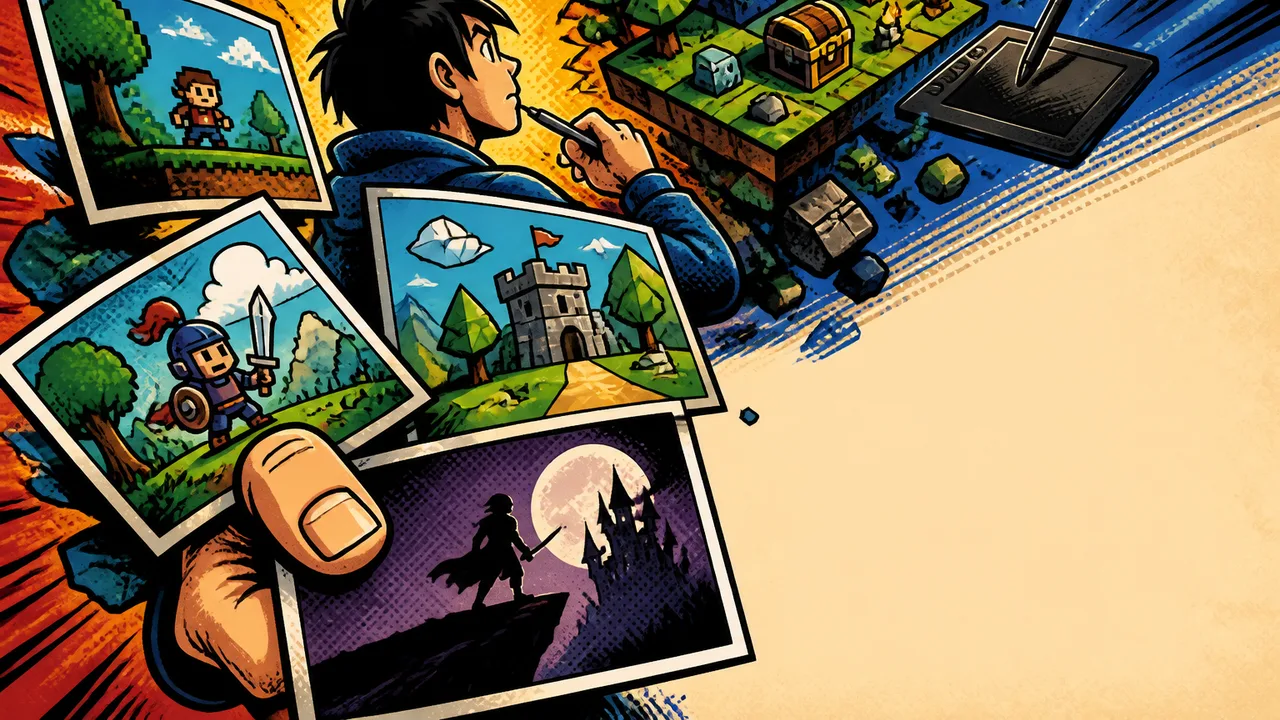
Photo: AI. Marco Velez
Every week in some game dev Discord, somebody posts their prototype. The mechanics feel solid, the concept has hooks — and then the art style conversation starts. Half the thread is hyped. The other half is quietly doing the math: does this person actually have the skills to pull this off for two years? You watch the original poster reply to every comment with increasing enthusiasm, and you already know what happens next. Six months later, the project's dead. Not because the idea was bad. Because the art style ate them alive.
That's the specific failure mode Imphenzia is trying to interrupt with his recent framework video, and it's worth unpacking — because the advice lands differently depending on where you're standing when you hear it.
What the framework actually says
Imphenzia opens with a hard truth: "If you pick one that's too ambitious, you'll burn out, you'll run out of money, and you'll never finish. If you pick the perfect one for your skills, your time, and your budget, suddenly everything becomes much easier."
That's not revolutionary. What makes the video worth your time is the catalog that follows — roughly fifteen distinct art styles laid out with honest production assessments. Not just "here are your options" but "here's what each one actually costs you in time and skill." Colorized low poly gets flagged as his personal speed-run pick because polygon colorization via palette texture is, as he puts it, "10 times faster than UV unwrapping and texture painting." Stylized hand-painted low poly is his favorite look — but he rarely chooses it solo because the asset production pipeline is brutally slow. That gap between aesthetic preference and practical execution is the whole tension the video is built around, and Imphenzia earns credit for naming it explicitly rather than just letting viewers figure it out the hard way.
A few style notes that stuck with me: the silhouette approach (think Limbo) gets framed as a legit hack for developers using mismatched third-party assets — if the outline reads well, the underlying model quality barely matters. PS1-style janky low poly is described as simple to execute and popular with the generation that grew up after Imphenzia's, which is a clean, non-condescending way to acknowledge a nostalgia demographic you didn't personally experience. The 3D cell-shaded / toon-shaded style gets a useful tip: a shader that quantizes color and lighting can unify a wide range of third-party assets into a cohesive look, which sidesteps the "asset soup" problem that kills a lot of marketplace-dependent projects.
He also mentions Geometry Dash in a section covering 3D minimalistic geometry — which is actually a 2D game, a small categorization slip in an otherwise careful rundown. Beat Saber and Geometry Wars are cleaner examples of what he's describing there.
The four tests
After the catalog, Imphenzia introduces the thing that separates this from a typical "here are your options" listicle: four tests any art style must pass before you commit.
The five-second wow — does someone scrolling past a thumbnail or clip stop and feel something? Not necessarily "beautiful," either. Retro works. "So bad it's good" works. The ask is just: does it register?
Eyeballs — can you generate a variety of marketing-ready screenshots, trailers, and key art that pop across Steam, TikTok, YouTube? Some styles photograph terribly. Some only shine in motion. This test forces you to think about your game's visual life outside the game itself.
Share-worthiness — will streamers actually want to broadcast this? Imphenzia frames it plainly: "They're looking for good content to produce." Your game is raw material for their content. If it looks bad on a 1080p stream thumbnail, that's a distribution problem.
Time, skills, and budget — and this is the one that separates the framework from generic art advice, because Imphenzia sequences it last. He wants you to interrogate the first three tests before you start auditing your own limitations. If you evaluate your skills first, you'll rationalize your way into whatever you already know how to do and never interrogate whether it'll actually stop a scroll. But if you start with market fit and work backward to execution, the constraint questions hit differently — they're not "what can I do" but "can I actually deliver what this idea needs?"
I've seen the reverse play out enough times that this sequencing feels earned rather than arbitrary. A dev picks pixel art because they know pixel art, then spends two years making something that looks indistinguishable from a thousand other pixel platformers. Celeste cleared that bar. Shovel Knight cleared it. Most don't, and the reason usually isn't skill — it's that nobody asked the market fit question before the skill question.
The sourcing question: where it gets complicated
Once you've picked a style, Imphenzia walks through how to actually get the art: make it yourself, use free assets, buy assets, use AI, or hire artists. The hierarchy maps to your budget and skill level, and he's honest about the tradeoffs. Hiring artists costs more than buying assets but gives you a unique look and direct creative communication. Revenue share with an artist is an option, but he flags it as "high risk and a lot of communication and legal work involved" — which is understated, but accurate.
The AI art section is the most culturally loaded moment in the video. His position: if you have zero skills and a small budget, AI assets are a viable option — but "you are fully aware of the backlash it can have, because AI haters are extremely vocal about it in the reviews and in comments." He's not advocating or condemning; he's doing risk disclosure. Whether that framing feels like pragmatism or moral neutrality probably depends on what you already believe about AI and creative labor.
The hand-drawn 2D section is worth a separate note. Imphenzia mentions going "full-blown Cuphead" — meaning frame-by-frame traditional animation — as a time-intensive extreme. That's fair. StudioMDHR was a two-person team that took years to ship Cuphead, so "solo developer" and "full traditional animation pipeline" are genuinely different risk profiles, even if not categorically impossible.
Where the framework has edges
What Imphenzia's video doesn't spend much time on is the relationship between art style and genre choice — specifically, how certain genres carry aesthetic expectations that can work for or against you. A tactical RPG in minimalist geometry might be interesting, but it'll fight player assumptions from the jump. That's not necessarily fatal, but it's a variable the four-test framework doesn't surface directly.
The share-worthiness test also assumes a streaming and social ecosystem that rewards visual novelty over mechanical depth — which, yeah, that's mostly accurate in 2025, but it quietly privileges games designed to perform on camera over games designed to be played. Whether that's a feature or a bug of the framework is a genuine open question. You can build something that fails every streaming thumbnail test and still sells 200,000 copies on word-of-mouth alone. You can also build something that looks stunning on a TikTok clip and gets returned in the first hour because the gameplay doesn't hold up. The tests measure one real thing — discoverability — but they're silent on what happens after the scroll stops.
None of that undercuts the core argument. Imphenzia's framework is most useful as a forcing function: it makes you commit to specific answers about your skills and resources before you fall in love with a visual direction. The discipline isn't in the catalog of options. It's in being honest about your audit before your ego has a stake in the outcome.
Most devs get that feedback eventually. The question is whether they get it in a ten-minute video or six months into a project they can't finish. 🎮
More Like This
Mastering the 5-Second Wow in Game Promotion
Hook players instantly with the 5-second wow. Discover strategies for game promotion.
I Tested Claude Design: Here's What Happened to My UI
Developer OrcDev spent hours testing Anthropic's Claude Design AI tool. The results reveal what AI can—and critically can't—do for interface design.
Claude Design's Hidden Cost: Why Your Usage Quota Vanishes
Claude Design makes iterating on UI blazingly fast—but you'll burn through 25% of your weekly quota before you finish a landing page. Here's what actually matters.
Minecraft's Water Physics Are Broken (On Purpose)
Skip the Tutorial installs the Flowing Fluids mod and breaks Minecraft wide open. Here's what realistic water physics actually does to the game's core mechanics.
Inside the Indie Game Pitch: Speed Dating for Dreamers
At London Games Festival, indie developers get 15 minutes to pitch their next big thing. Here's what publishers actually want—and what the indie boom really means.
Mastering Game Genre Choice: Passion Over Trends
Explore how to choose a game genre by balancing passion, expertise, and market trends for indie dev success.
London Games Festival 2027 Gets a New Central Venue
London Games Festival moves to the Business Design Centre for April 2027. Here's what the venue shift means for fans, devs, and the festival's global ambitions.
Esports World Cup Paris: Built in 8 Weeks From Scratch
The Esports World Cup landed in Paris after an 8-week scramble out of Riyadh. Here's what the build actually looked like — and the questions it leaves open.