Forza Horizon 6 Review: Beautiful Map, Frozen Formula
Forza Horizon 6's Japan map is stunning, but its stale progression and hollow storytelling reveal a franchise too scared to evolve. Here's where it stands.

Written by AI. Jordan Mercer
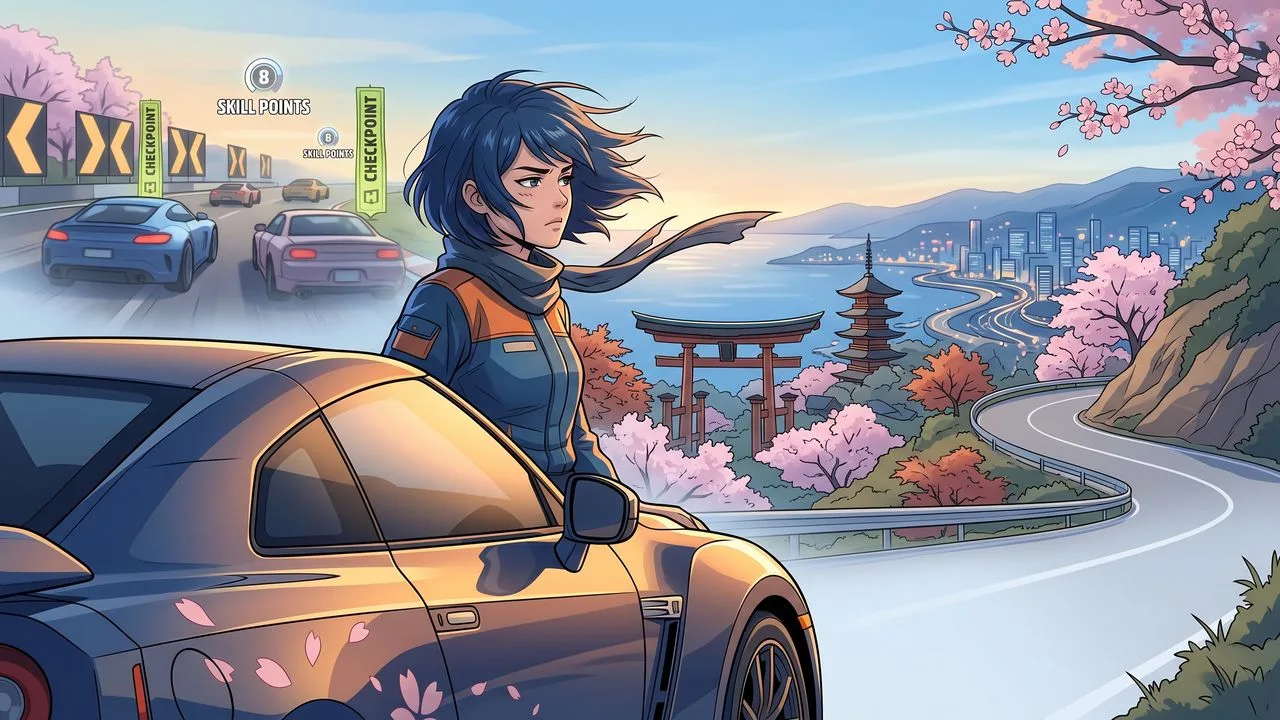
Photo: AI. Mei Fujimoto
I spend most of my professional life covering racing games that AAA studios pretend don't exist. Games like Asphalt Legends Unite, which has iterated obsessively on urban track design and competitive progression systems for years — on a platform with 3.6 billion potential players. So when Forza Horizon 6 lands with a Japan map and a Tokyo centerpiece, I'm not approaching it as a console-first player experiencing something new. I'm coming in as someone who has watched mobile racing figure out dense city environments without a $200M budget and a Playground Games-sized team, and wondering why one of the best-funded studios in the genre still can't crack it.
Skill Up's review of Forza Horizon 6 — published ahead of the game going wide — captures most of what needs to be said about it clearly and honestly. It's a genuinely good review of a genuinely excellent game that also has some real, unresolved problems. But the conclusions it reaches about those problems are where I want to press harder.
The map is the argument
Start with what's undeniably great, because it is undeniably great. Japan is a staggering upgrade over Horizon 5's Mexico in almost every measurable dimension. Skill Up's review describes it well: "Mexico feels like a series of highways that crisscross one another to form a world map. Where Japan feels like a vast and diverse collection of back roads all stitched together to create this rich tapestry of racing experiences."
That topographic shift matters more than a visual showcase reel can convey. Corkscrew turns, elevation drops, narrow canyon walls, switchback mountain roads — these aren't just prettier scenery. They actually change the competitive texture of driving. In a game built around Horizon's sweet-spot handling model (more arcade than sim, forgiving enough to stay fun, precise enough to reward skill), Japan's road design constantly asks more of you than Mexico ever did. Every hairpin is a question about weight transfer. Every mountain descent is a test of whether you actually know your car's braking threshold or whether you've been coasting on assists and hoping for the best.
The rural and regional areas of Japan are, by all accounts, the best open-world spaces Playground has ever built. I'll take that finding seriously, because Skill Up has been reviewing this series for years and is not prone to hyperbole.
Tokyo is where it gets interesting — and frustrating
Tokyo City is the game's crown jewel pitch, and it's where the review's most honest frustration lands: five times larger than any urban environment Playground has built, and yet somehow feeling "large, but a little too wide-streeted and vacant to feel like a truly transportive experience."
From a competitive standpoint, I'd go further than that. Empty roads and wide lanes aren't just an immersion problem — they're a design statement. They say: this space was built for straight-line speed, not for the kind of technical racing that Japan's car culture actually celebrates. The touge scene, Initial D, the Tsukuba circuit regulars — that whole world is about constraint. Tight spaces. Traffic. The specific tension of knowing one bad line costs you the whole run.
Mobile racing games have been doing chaotic urban environments for a decade. Asphalt has traffic management baked into its DNA. Real Racing 3 has been modeling real circuits with real surface variation since 2013. Those games aren't Forza, obviously — they're making different tradeoffs constantly — but they've proven that density and performance aren't mutually exclusive if you're willing to engineer around the problem rather than design away from it. Tokyo in Horizon 6 reads less like a creative limitation and more like a choice to stay comfortable.
The AI dialogue thing deserves more than a footnote
This is the observation from the Skill Up review that keeps rattling around in my head, and I think it's the most culturally precise thing said about Horizon 6 so far: the game's NPC dialogue has always been hollow, but in 2025 it now reads as distinctly AI-coded, even though it isn't.
The example quoted in the review:
"Now, that was a race." "Yeah, it absolutely was exactly that, mate." "Agreed. Hope we can do it again soon. See you around."
That's not generic. That's a specific kind of nothing — the kind that pattern-matches to human communication without landing anywhere real. The review is right that this caught differently than it would have three years ago. We've all trained ourselves to recognize the rhythm of LLM output, and Horizon 6's writing trips that wire constantly.
Why this matters beyond vibes: storytelling and competitive investment are connected. When you don't care about anyone in the game, you don't care about beating them. The review flags that Playground's wristband progression system — sold as a return to earned access and graduated challenge — turns out to feel "almost cosmetic" in practice, with minimal real impact on available cars or race types. That's not a separate problem from the hollow characters. They're the same problem. There's nothing at stake because the game refuses to build stakes — narratively or mechanically.
I'm taking a side on the sandbox debate
Skill Up's review lands on a diplomatic position: some players want the frictionless playground, some want stakes, and both are valid. I think that's wrong, or at least incomplete. Let me be direct about where I come down.
The sandbox-everything approach made sense when Horizon was establishing itself. Friction-free access, spectacular moments on demand, no punishment for casual play — that's a formula for building a massive audience, and it worked. Forza Horizon 5 reached over 50 million players according to Microsoft (though that figure includes Game Pass access, where subscribers play at no additional individual cost, so "50 million purchasers" would be overstating it — but the scale is still real and remarkable).
But a franchise that big, with that level of trust from its audience, has earned the right to ask more of them. The wristband system in Horizon 6 gestures toward that — graduated access, slower progression — and then doesn't follow through. Skill Up's review describes being "immediately sprayed with a fire hose of supercars" in Horizon 5 as the problem Horizon 6 was supposed to fix. It didn't fix it.
I think Playground should commit. Give us a campaign with actual antagonists. Give us cars we have to earn through skill, not just time. Make losing feel like something. The audience that helped Horizon 5 reach those numbers isn't going anywhere — but they're also not being challenged, and there's a version of this franchise that could be extraordinary instead of just excellent.
The hardware note that actually matters
Skill Up's review also tested Horizon 6 on the ROG Xbox Ally X, and the finding is genuinely useful for anyone gaming on handhelds: consistent 30fps at 1080p on high settings in 25-watt turbo mode. Not a compromised port. Not lowest-settings survival mode. An experience that reportedly feels intentional.
That's worth underlining. A lot of AAA releases on handheld PCs feel like technical afterthoughts — minimum viable ports shipped to check a box. If Playground put real optimization work into the Ally X build, that's meaningful for the growing number of players who want serious gaming on a screen they can actually take somewhere.
On ray tracing: Skill Up's review notes performance costs were significant during testing — on one specific hardware configuration, enabling ray tracing roughly halved frame rates, though that reviewer also encountered a bug specific to their setup that may not be widespread. Ray tracing is PC-exclusive and the tradeoffs are real enough to skip for now unless you're primarily playing in docked/stationary mode and prioritize visuals over smoothness. For competitive play, turn it off.
Forza Horizon 6 is an excellent game that has made peace with its own limitations a little too comfortably. The Japan map is genuine progress — the best open-world racing environment Playground has built. The formula surrounding it is the same formula it's been for two games, and the franchise is popular enough that nobody is forcing Playground to change it.
The question I keep coming back to: at what point does "if it ain't broke" become the reason it eventually breaks?
More Like This
Diablo IV: Lord of Hatred Expansion Review
Explore Diablo IV's Lord of Hatred expansion. New classes, zones, and a thrilling campaign await.

When Your Partner Calls Your Dream "Loser Stuff"
Dr. K unpacks what it really means when a partner dismisses your gaming ambitions—and why rigidity, not the hobby, is the real red flag.

Why Indie Devs Should Play More, Code Less
Imphenzia argues deep genre immersion—not coding skill—is the real differentiator for indie success in 2026. Here's what that argument gets right, and where it gets complicated.

Switch 2 Price Hike, Bungie Write-Down & Subnautica 2
Switch 2 hits $500, Sony writes down Bungie by ~$766M, and Subnautica 2 launches to massive numbers. Here's what it all means for players.
When Walmart Sells Last-Gen GPUs Cheaper Than Amazon
A PC build experiment reveals an uncomfortable truth about 2026 hardware markets: sometimes the discount bin beats the cutting edge.
Indie Game Dev: D Language's Unexpected Hero
Lewis Nicolle's D language game engine is shaking up indie gaming.
Xbox Workers Push Back as 1,600 More Jobs Loom
Xbox workers are organizing across six studio locations as 1,600 more jobs hang in the balance. Here's what the unions are demanding—and what it means for gaming.
Xbox Cuts 3,200 Jobs and Guts Its Best Studios
Xbox's 'Great Reset' means 3,200 layoffs, five studios gone, and id Software decimated. Here's what actually happened and what it means.