Fan-Made Zelda Ports Bring Dual-Screen Life to 3DS
A homebrew developer has ported Zelda: A Link to the Past and The Minish Cap to the 3DS with native dual-screen support—no emulation, no Nintendo involvement.

Written by AI. Sarah O'Brien
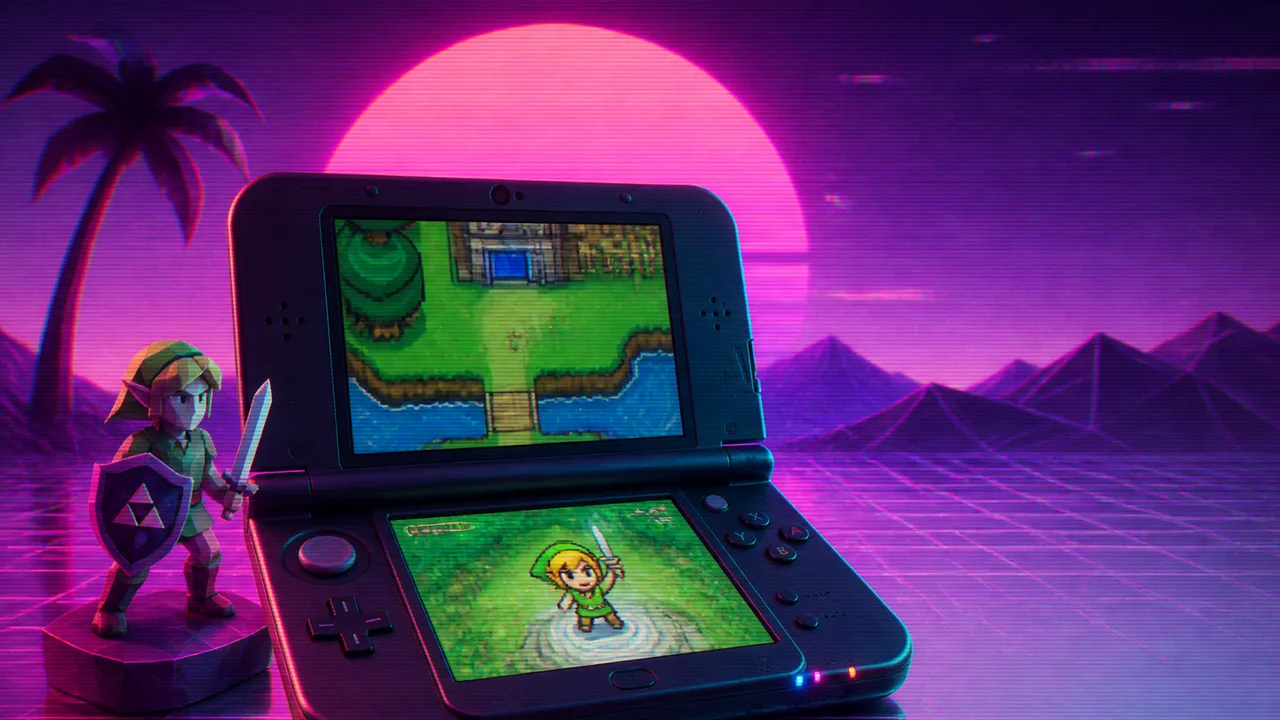
Nintendo didn't do this. That's the first thing worth getting straight.
The story circulating under headlines about "enhanced Zelda ports arriving on 3DS" is not a Nintendo announcement, a Virtual Console release, or any kind of official product. It's the work of a single homebrew developer operating under the handle estebanpdn, who has built native 3DS ports of The Legend of Zelda: The Minish Cap and The Legend of Zelda: A Link to the Past from the ground up—complete with features the original hardware releases never had. Polygon first surfaced the news, describing the ports as arriving with "additional bells and whistles and better performance." That framing is accurate as far as it goes, but it understates what makes this technically interesting.
What estebanpdn Actually Built
The distinction between emulation and a native port matters enormously, and it's easy to collapse the two in coverage that just calls something a "port." Emulation runs original code inside a software interpreter that mimics target hardware. A native port means the game has been adapted to run directly on the destination system—in this case the New Nintendo 3DS—using that hardware's actual capabilities.
estebanpdn's ports are the latter. According to a90skid.com, the developer has released native 3DS versions of both The Minish Cap and A Link to the Past with features specifically designed around the handheld's dual-screen layout. Console-classics.com described the Link to the Past port as taking "full advantage" of the hardware rather than being "your average, run-of-the-mill emulation job."
For A Link to the Past, Screen Rant reported that the port adds "proper dual-screen support to take advantage of" the 3DS's two displays—a feature the 1991 Super Nintendo original obviously couldn't have contemplated and that no official re-release has implemented. For The Minish Cap, originally a Game Boy Advance title from 2004, Screen Rant reported that estebanpdn confirmed on X/Twitter that the native dual-screen port for the New Nintendo 3DS is now complete.
Both games getting this treatment is a considered choice. A Link to the Past is one of the most studied game designs in the medium's history, and The Minish Cap—often cited as an underappreciated entry in the series—is a game that has been effectively unavailable on modern platforms for years without emulation or expensive used-market hunting. The 3DS, according to Factually, sold approximately 75.94 million units worldwide over its lifespan. That's a substantial installed base of hardware that can now run these games natively, better than they ran on original hardware.
The Preservation Angle No Headline Mentions
Here's where the story gets complicated in ways the "enhanced ports" framing doesn't capture.
This work is technically impressive and preservation-adjacent, but it exists in a legal gray zone that Nintendo has historically shown little patience for. The 3DS homebrew scene operates on modified consoles, and distributing ports of Nintendo-owned games—even technically transformed ones—exposes the developer and anyone hosting the files to legal action. The history here is not ambiguous. Nintendo has pursued fan projects with cease-and-desist letters and, in some cases, litigation. Decompilation projects targeting Super Mario 64 have drawn exactly this kind of response; the doldecomp project targeting Super Mario Sunshine (documented at github.com/doldecomp/sms) exists in the same contested space. Fan developers who build impressive things in Nintendo's IP sandbox do so knowing the sandbox can be bulldozed without notice.
That context matters for how we read what estebanpdn has done. The ports are real, the technical achievement is genuine, and the dual-screen implementation appears to be thoughtful hardware-native work rather than a quick compatibility layer. But they're also not something most people can simply download and install without understanding what they're running on and why.
The preservation irony at the center of this story is one the industry hasn't figured out how to resolve: the people doing the most technically sophisticated work to keep old games playable are precisely the people most exposed to legal risk for doing it. Nintendo holds the copyright on A Link to the Past and The Minish Cap. It has the right to determine how those games are distributed. It also has a documented history of letting games fall out of availability rather than maintaining them—The Minish Cap has no current official path to play it on modern hardware without the company's own aging Virtual Console infrastructure, which itself has been discontinued.
What "Enhanced" Actually Means Here
The dual-screen implementation is the genuinely novel element, and it's worth pausing on what that means in practice. The 3DS's form factor—two screens, the bottom one touch-capable—creates design possibilities that GBA and SNES cartridges couldn't exploit. A map on the bottom screen while gameplay runs on top, inventory management without pausing, interface elements that don't crowd the play area: these are real quality-of-life improvements that change how the games feel to play, not just where they run.
108game.com echoed Polygon's framing about the added "bells and whistles and better performance," though the sources don't enumerate every specific feature in granular detail. What's documented is the dual-screen architecture as a design commitment, which is a different ambition than simply getting the ROMs to boot.
For players who grew up with both of these games and own a New Nintendo 3DS, that design commitment makes the ports worth attention on their own terms. For players who never played The Minish Cap in particular, this represents a more accessible entry point to a game that the industry has quietly made harder to reach with every passing year.
The Question Nintendo Won't Answer
The official channels for playing A Link to the Past and The Minish Cap in 2026 are thin. Nintendo Switch Online's Game Boy library launched with fanfare and has grown, but neither of these titles is currently in the official rotation. A Link to the Past appeared on Nintendo Switch Online + Expansion Pack via the SNES library, so it has an official modern path—though one gated behind a subscription tier. The Minish Cap has no such option.
That gap is where fan developers like estebanpdn fill in. And the uncomfortable question the industry never quite confronts directly is whether that gap is a market failure, a policy choice, or both. Nintendo controls an extraordinarily deep catalog. The commercial logic for keeping every title officially available at all times doesn't always pencil out. But "doesn't pencil out commercially" and "should be allowed to disappear" are not the same thing, even if current copyright law effectively treats them as equivalent.
The ports estebanpdn built will almost certainly outlast whatever official infrastructure Nintendo maintains for either game. They'll circulate in the homebrew community, get updated, and keep two significant pieces of game design history playable on hardware that tens of millions of people own. Whether Nintendo chooses to view that as a threat or a service to its own legacy is, as ever, entirely up to Nintendo.
More Like This
Pokémon Go at Ten: AR's One Durable Success Story
Pokémon Go turns ten this week. A look at what it actually got right—and why the AR industry it was supposed to launch mostly didn't follow.
Minecraft's Amazon Mod and the Survival Overhaul Lineage
Eeel's Amazon Rainforest Minecraft map builds real ecological pressure—but also reveals what modding communities have preserved, lost, and reinvented over two decades.
Zelda Ocarina of Time Remake: Confirmed and Coming
Nintendo confirmed an Ocarina of Time remake for Switch 2 in 2026—but the rumor cycle that got us here reveals something about how gaming communities process hope.
Star Fox 2026 Review: Great Game, Wrong Ambition
Skill Up reviews the 2026 Star Fox remake: gorgeous, fun, and built exactly like a premium mobile game — which is both its strength and its ceiling.
Do You Need a Game Design Document? A History Weighs In
Imphenzia says a one-page GDD is all you need. The history of game documentation—and what gets lost without it—says the stakes are higher than that.
Sam Neill's Final Role Is in the Zelda Movie
Sam Neill filmed a secret role in Nintendo and Sony's live-action Legend of Zelda before his death in July 2026. Here's what that means for the production.
California's Channel Islands Hold 13,000 Years of History
From pygmy mammoths to the Lone Woman of San Nicolas, California's Channel Islands preserve one of North America's deepest human records — if we bother to look.
Netflix Is Making a Live-Action Persona Series
Netflix is developing a live-action Persona series with Sega and Atlus. Here's what we know about the creative team, the challenges, and what's at stake.