NASA Expands Lunar Infrastructure Plans Beyond Landers
NASA is backing lunar cargo deliveries, orbital transfer, surface systems and a proposed nuclear rover. How could the pieces support repeated trips to the Moon?

Written by AI. Mei Zhang
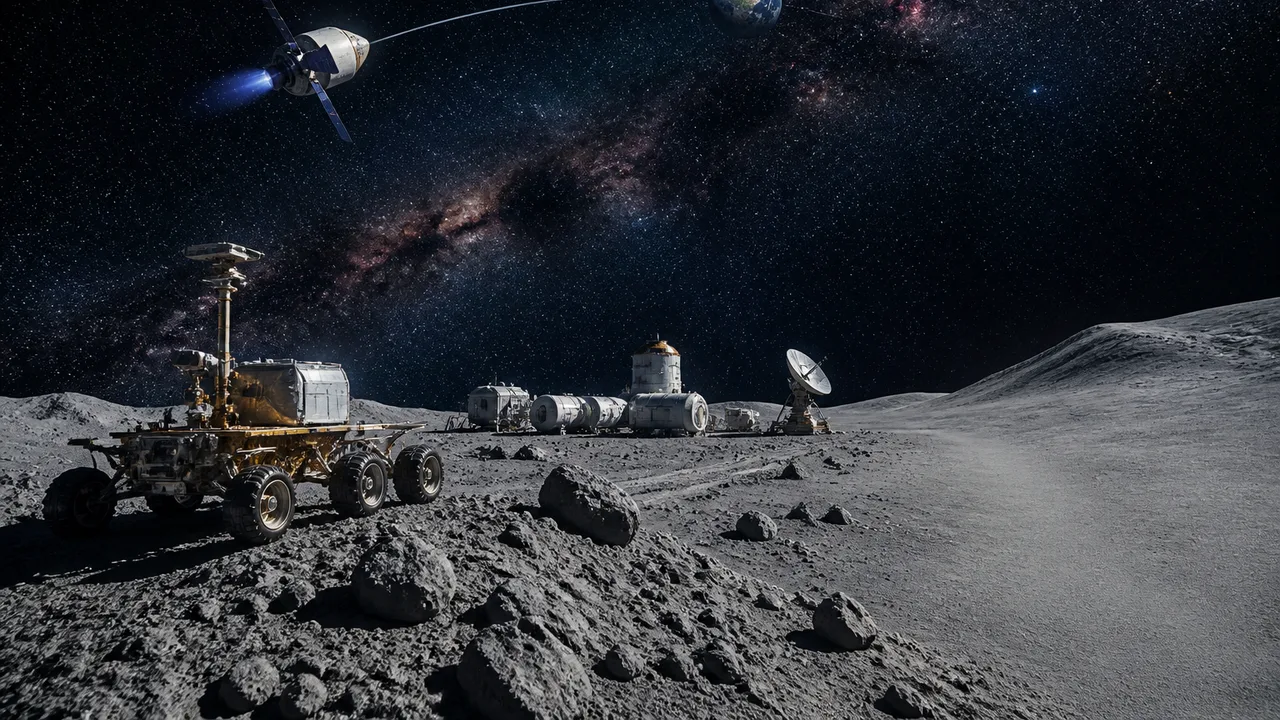
NASA has put commercial cargo deliveries, orbital transfer and a proposed nuclear-powered rover on its lunar infrastructure agenda. Those are unglamorous words compared with “Moon base,” but if people and instruments are going to make repeated trips to the lunar surface, somebody has to solve the delivery problem before anybody can worry about the décor.
The agency’s lunar project announcement brings together awards and mission updates spanning robotic deliveries, launch and orbital-transfer services, surface infrastructure, science and a rover called PROMISE. NASA describes work meant to enable future operations, while leaving award amounts, technical readiness assessments and firm schedules for the portfolio unspecified in the announcement. The practical question is how these pieces might eventually connect.
A single lunar mission can bring much of what it needs and leave when the work is done. Repeated activity changes the shopping list. Scientific instruments need rides; equipment needs a place to operate; cargo must get from Earth toward the Moon and then down to a usable location. A rover can explore farther than a stationary instrument, but only if it arrives, works in lunar conditions and can support a scientific task. “Infrastructure” is the name for those dependencies when nobody can fit them in one backpack.
The Moon Needs a Delivery Chain
Think of a lunar instrument as a cake with an unusually expensive delivery address. Building it is one job. Getting it onto a rocket, moving it through space and placing it safely on the surface are separate jobs, each with its own chance of spoiling the order. Commercial robotic deliveries could give NASA ways to send instruments and supplies without designing a dedicated transport system for every payload. Launch and orbital-transfer services could address other legs of the trip.
That division of labor has an appealing logic. If a transport service works reliably, multiple science teams or technology projects could use it. NASA could plan a series of deliveries around capabilities that already exist rather than treating each flight as a fresh expedition. Companies, meanwhile, might have a reason to improve a service they can offer more than once. The strongest case for this portfolio rests on that possibility: repeatable transport makes more ambitious surface work easier to organize.
It also creates coordination problems. A spacecraft may be able to carry a payload that a lander cannot accommodate. A successful landing may still put equipment far from the place where another mission needs it. A surface system designed for one delivery schedule may have to wait for another project to catch up. These are the lunar equivalents of ordering a refrigerator before checking the doorway, except the return policy involves a trip through space.
Earlier lunar lander plans help put the new emphasis in perspective: hardware for individual deliveries and a plan for many landings point toward a campaign, but the value of each landing depends on what it enables next. A sequence of arrivals becomes useful infrastructure when payloads, destinations and operating needs line up.
PROMISE and the Problem of Power
PROMISE draws attention because nuclear-powered rovers sound like science fiction with a procurement department. NASA’s proposal gives the rover a role in a much more ordinary engineering problem: sunlight can be scarce in the lunar places and periods that researchers want to study. A rover that can keep operating without depending solely on sunlight could give mission planners more options for where and when to work.
The Moon’s environment makes that flexibility attractive. Earth has a thick atmosphere to soften temperature swings and weather away some disturbances. The Moon offers neither protection nor an easy cleaning service. Dust can complicate machinery, and illumination varies sharply with location and time. Near the poles, areas of persistent shadow pose a particular challenge for equipment that relies on solar power. A machine capable of moving and working under those constraints could reach scientific targets that are harder for a sun-dependent rover to investigate.
The PROMISE rover concept involves considering a spare Mars rover for lunar use. That sounds like using leftovers wisely, but a Mars machine still has to meet the Moon’s operating requirements. “Nuclear-powered” also leaves an important engineering question for readers: the announcement’s label alone does not tell us what power system PROMISE would use or what performance it would deliver. Those details determine what the rover could do, for how long and under which conditions.
Power is only one ingredient. A rover needs a way to arrive, communicate and carry instruments suited to its destination. Its operating plan must also fit alongside other surface projects. Otherwise NASA could end up with an excellent mobile machine whose most ambitious proposed tasks depend on systems that arrive later.
Who Benefits from Shared Lunar Services?
For scientists, a dependable delivery network could change the questions they can ask. An instrument that takes a reading at one site tells one story; a series of deliveries or a mobile rover might allow comparisons across locations and over time. That is a potential advantage of repeated operations, not a result already banked. Researchers would still need to choose experiments that justify the transport and coordinate them with the missions carrying their equipment.
Commercial providers have a different calculation. A one-off lunar delivery can demonstrate a capability; recurring missions offer the possibility of refining it. Yet a service becomes dependable only after vehicles and operations prove themselves through testing and flights. NASA must decide how much commonality it wants among projects while leaving companies room to develop different solutions. Too little coordination risks equipment that cannot work together. Too much could limit the variety of approaches the agency hopes to encourage.
Public investment raises another question: who gets access once transport becomes a service? A research group with a small instrument may have a compelling experiment but little control over a lander’s destination or timetable. Larger payloads and better-funded missions may shape those choices. Shared infrastructure could lower barriers to lunar science, or its capacity could remain scarce enough that competition for a ride determines which questions get asked. The design of the system includes those decisions, even if they never appear in a rover rendering.
Nuclear power adds its own layer of responsibility. The appeal of operating with limited sunlight has to be weighed alongside the safety and oversight questions that accompany launching nuclear material and operating it away from Earth. The appropriate assessment depends on the eventual design. Treating those questions as part of mission development, rather than an awkward footnote, would make it easier for the public to judge the proposal on its actual merits.
From Projects to a Working System
NASA can now track progress on several fronts: whether individual projects pass design reviews and tests, whether missions receive funding and fly, and whether their capabilities fit together once they do. Those are separate hurdles. A working lander proves a landing capability; a rover that survives and performs useful science proves something else. Repeated lunar operations require the two achievements to meet at the right place and time.
That makes this portfolio an interesting bet on connections. A cargo delivery can carry an instrument. A transfer service can help move a spacecraft toward its destination. Surface equipment can make the next arrival more useful. PROMISE could extend work into places where sunlight constrains other machines. None of those links happens automatically, and each offers a concrete test of NASA’s approach.
The next lunar milestone may look less like a flag planted beside a finished base and more like a delivery that lets another piece of equipment do its job. If NASA’s projects start producing those handoffs, the Moon will begin to look less like a series of isolated destinations and more like a place where the next mission can build on the last.
More Like This

Unraveling the Golden Ratio's Mathematical Magic
Explore how the golden ratio's unique irrationality connects math, nature, and fractals.
How Maxwell Unified Electricity and Magnetism
A compass needle twitched in 1820 and set off a chain of discoveries that now powers every wireless signal in your life. Here's the physics behind it.

August's 96% Blood Moon Lunar Eclipse Explained
A 96% partial lunar eclipse turns the moon deep red on Aug. 27-28. Here's when to watch, why it happens, and what's threatening our view of it.

SpaceX Rocket Team Wins First Neil Armstrong Prize
SpaceX's Falcon 9 landing team won the first Neil Armstrong Space Prize, spotlighting reusable rocket engineering, costs, climate and access to orbit.

Enceladus Life Search Faces a Mission Bottleneck
Two new studies suggest Enceladus may support methanogens and concentrate biosignatures, while any dedicated life-search mission remains decades away.

NASA’s Starliner Return Depends on More Than a Test Flight
NASA plans an uncrewed Starliner flight before a 2028 crewed target. The test can check thruster changes, but more repairs and certification remain ahead.

Astronomers May Have Found a Starless Galaxy
Astronomers are investigating a potential starless galaxy, a dark matter-rich structure with no stars. Here's what it could mean for how galaxies form.
NASA's Swift Telescope Will Crash to Earth Uncontrolled
NASA's Swift telescope will reenter Earth's atmosphere uncontrolled after a private rescue mission failed. Here's what it reveals about how we design—and don't design—for endings.