NASA's PROMISE Rover: A Mars Machine Headed to the Moon
NASA is considering repurposing a spare nuclear-powered Mars rover called PROMISE for the lunar south pole. Here's what that plan actually involves.

Written by AI. Priya Sharma
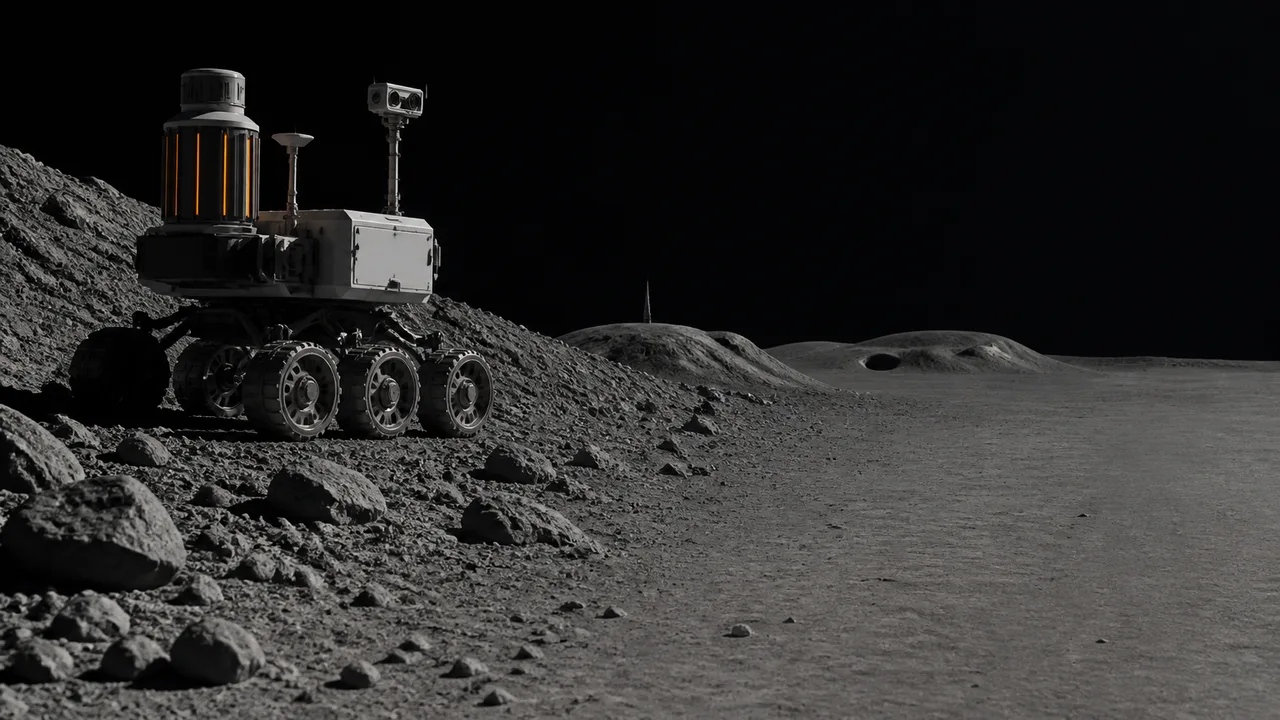
There's a rover sitting at NASA's Jet Propulsion Laboratory in Pasadena that has never left Earth. It was built to go to Mars — a full-scale engineering twin of the Perseverance rover, constructed to test systems, simulate failures, and solve problems remotely when its sibling is 100 million miles away and unreachable. That's been its quiet, unglamorous job. Now, NASA is wondering whether it has a different calling entirely.
The agency is seriously considering sending this ground-test vehicle to the Moon — specifically to the lunar south pole — under a mission it's calling PROMISE. According to the Union-Bulletin, the name is an acronym: Polar Rover for Observation, Mapping, and In-Situ Exploration. Whoever named it understood the assignment. Whether the mission lives up to it is the more interesting question.
A spare part with a résumé
To understand why PROMISE is worth taking seriously, it helps to understand what it actually is. This isn't a stripped-down prototype or a mockup. As Ars Technica reports, NASA officials confirmed they are "seriously considering" deploying the full-scale engineering model of the Perseverance rover — currently housed at JPL — to the Moon to "expedite their efforts to explore the south pole region." That word, "expedite," matters. The lunar south pole isn't just scientifically interesting; it's the site NASA has selected for its planned lunar base. Getting detailed surface and subsurface data there, before astronauts arrive, is operationally critical.
GeekWire adds context: the plan would repurpose the engineering development vehicle into an actual lunar explorer, characterizing terrain, mapping the environment, and prospecting for resources. That last task is the big one. The lunar south pole is believed to harbor water ice in permanently shadowed craters — water that could theoretically be split into hydrogen and oxygen for fuel and life support. A rover that can "prospect for resources," as iTechPost describes it, isn't just doing science. It's doing site prep.
And the power source matters enormously here. Nuclear-powered rovers don't depend on solar panels, which is the difference between functioning and not functioning inside a permanently shadowed crater. The Moon's south pole is precisely the kind of environment where solar power fails and nuclear power wins.
Jared Isaacman's "experiential" logic
NASA Administrator Jared Isaacman, in a livestreamed update that Space.com covered, framed PROMISE within a broader philosophy about the Artemis lunar return: "We didn't just jump right to..." — the quote trails off in the excerpts available, but the broader point from Space.com is clear. Isaacman's approach favors incremental, experience-building steps before crewed missions. In that framework, sending a proven rover design — one that JPL engineers already know intimately — to characterize the actual landing zone isn't redundancy. It's due diligence.
That logic has genuine weight. One of the persistent criticisms of ambitious lunar return timelines is the knowledge gap between orbital data and ground truth. We have excellent maps of the lunar south pole from satellites. We have far less information about what it's actually like to drive across it, drill into it, or operate continuously within it. PROMISE, if it goes, would close that gap before humans arrive to find out the hard way.
The lander picture is getting clearer
PROMISE doesn't operate in isolation — it needs to get to the Moon somehow, which brings the broader Artemis commercial landing architecture into focus. Scientific American reports that NASA has announced contracts with Astrobotic, Intuitive Machines, and Firefly to build lunar landers for the future moon base. These aren't science missions in the traditional sense; they're infrastructure plays. The lunar base NASA envisions by the end of the decade requires sustained cargo delivery, and the agency is building that supply chain now.
Where exactly PROMISE fits within these lander contracts — which company would carry it, on what timeline — isn't fully public yet. The sources available don't specify, and it's worth being direct about that gap. What's clear is that the lander ecosystem is taking shape around the same south polar destination PROMISE is targeting. The rover and the landing infrastructure are pieces of the same puzzle.
The soccer ball in the room
There is one detail in this story that keeps snagging my attention, and it's not the nuclear reactor. According to the New York Times, part of the broader lunar base announcement includes NASA's intention to send a soccer ball to the Moon — contingent on the U.S. winning the World Cup, as Phys.org reports. I don't know what to do with that, exactly. It lands somewhere between public engagement stunt and the most committed sports bet in history. It doesn't diminish PROMISE, but it does gesture at something worth noticing: NASA under this administration is leaning into spectacle alongside science. Whether that's a communication strategy, a morale play, or something to think harder about is a question I'll leave open.
What could go wrong, and what's genuinely unknown
Here's where intellectual honesty requires slowing down. PROMISE is currently described as something NASA is "considering" and "seriously considering" — not something that has been formally approved, funded, and scheduled. The engineering development model at JPL was built to simulate Mars conditions; adapting it for lunar deployment involves genuine unknowns. The Moon and Mars share some environmental hostility — vacuum, temperature extremes, radiation — but the south pole's permanently shadowed regions present challenges that Perseverance's twin was never designed to navigate.
The Union-Bulletin quotes one source saying the rover "is probably going to find its way to the lunar South Pole" — notably hedged language from someone apparently close to the planning. "Probably" is doing real work in that sentence. The gap between "probably" and "definitely" in NASA mission planning can span years, budget cycles, and administration changes.
The logistical challenges are real and not fully specified in the public record. How do you land a rover the size and mass of Perseverance on the lunar south pole with sufficient precision? What modifications does the engineering model require? What's the timeline relative to crewed Artemis missions? The sources available don't answer these questions, and I'm not going to paper over that with vague optimism.
What the pattern suggests
Step back from the specifics and look at the shape of what NASA is assembling: commercial lander contracts with three companies, a nuclear-powered rover adapted from proven hardware, an explicit focus on the south pole as a resource destination, and an administrator publicly framing all of this as deliberate, sequential preparation for human presence.
That's a coherent strategy with real operational logic. The question isn't whether PROMISE is a good idea in principle — repurposing existing, tested hardware for a high-priority destination is a reasonable approach — it's whether the execution will hold together under the pressure of a politically constrained timeline and a budget environment that has historically been unkind to lunar ambitions.
Every element of this plan has a predecessor that didn't quite make it. That history doesn't mean PROMISE won't — it means the optimism is earned only if the follow-through is.
More Like This

How Opponent Recognition Unlocks Cooperation in Evolution
A Rutgers physicist argues that tailoring cooperation to specific opponents—not blanket strategies—may be evolution's simplest path out of the Prisoner's Dilemma trap.
NASA Names Artemis III Crew for 2027 Moon Mission
NASA has named the four-person crew for Artemis III, a complex multi-launch test mission targeting 2027 that will rehearse docking with both Blue Origin and SpaceX landers in low Earth orbit.
Blue Origin's New Glenn Explosion: How Far Does It Reach?
Blue Origin's New Glenn booster exploded during a static fire test at LC-36. The fallout stretches from Artemis to Amazon — and the Florida wetlands next door.

Avi Loeb on Methane, Microbes, and Interstellar Objects
Avi Loeb tells Brian Keating that JWST methane data from 3I/ATLAS is puzzling enough to warrant a microbe hypothesis—and explains why a dark comet might be Soviet.

Unlocking New Skills After 50: The 'Pillar & Playground' Approach
Explore how the 'Pillar & Playground' method helps those over 50 learn efficiently, leveraging crystallized intelligence and cognitive flexibility.

Exploring Black Holes and Asteroids with StarTalk
Neil deGrasse Tyson delves into black holes, asteroids, and more in StarTalk's latest Cosmic Queries episode with Chuck Nice.

Ten Scientific Failures That Reshaped Modern Research
From thalidomide to cold fusion, ten scientific failures that caused real harm—and forced the protocols that protect us today.

Mass Extinction Risk: How Overdue Are We?
Joe Scott surveys Earth's extinction history—supervolcanoes, asteroid strikes, a 2023 Greenland megatsunami—and asks which catastrophe is statistically nearest.