Planet Labs, Orbital AI Compute, and the Chip Tax
Planet Labs CEO Will Marshall argues chip efficiency—not launch cost—will determine who wins the race to put AI compute in orbit.

Written by AI. Samira Barnes
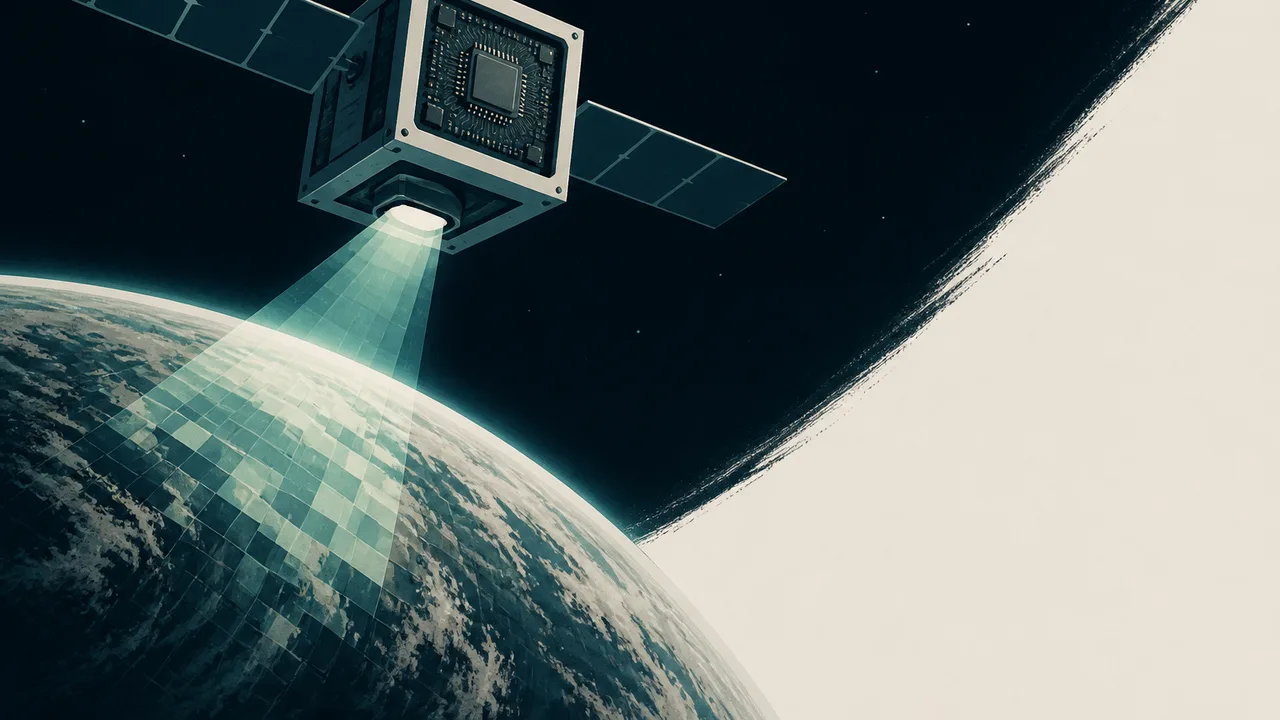
Photo: AI. Mika Sørensen
The conventional story about orbital AI infrastructure centers on rockets—who can launch the most, the cheapest, the fastest. Will Marshall, co-founder and CEO of Planet Labs, spent a recent appearance on Peter Diamandis's Moonshots podcast quietly dismantling that framing, and the argument he substituted is worth taking seriously.
Planet operates 200 satellites generating roughly 25 terabytes of imagery daily. It holds 150 petabytes of historical earth observation data—approximately 3,000 images for every point on the planet's land mass accumulated over a decade. By any measure, that archive is an extraordinary and non-replicable asset: no competitor can retroactively image the Earth, and the historical baseline is precisely what makes the data actionable for defense, agriculture, insurance, and financial markets. About 60% of Planet's revenue comes from defense and intelligence; 25% from civil government; 15% from commercial customers. That commercial slice is, according to Marshall, accelerating.
The company's current strategic bet is what Marshall calls "large earth models"—a concept that deserves more attention than the jargon might suggest. The standard critique of today's AI systems is that they are trained on text and therefore understand the world abstractly, as theory rather than as observed fact. Marshall's framing is blunter: "They're like somebody who's been stuck in a library. They've read all the books, but they've never looked out the window." Large earth models are the attempt to fix that by fusing satellite sensor data with language model architectures, so that a query about a specific farm field, flood zone, or military installation returns information about what is actually happening there—not what agronomists have written about farm fields in general. The AI companies are, by Marshall's account, converging on this problem regardless: he cites both Meta and Anthropic as having publicly acknowledged that the next generation of frontier models will need real-world grounding data.
What Planet is currently doing operationally to close the latency gap matters here. In April, the company ran experiments placing NVIDIA GPUs directly on Pelican-class satellites and processing imagery onboard rather than downlinking raw data to ground stations. The practical consequence: an airfield in Alice Springs was imaged, aircraft identified, and location and type data transmitted back in seconds rather than hours. Marshall uses the LA Palisades fires as the illustrative stakes—Planet delivered building-by-building damage analysis to the American Red Cross and Cal Fire within a couple of hours of the fires. Had onboard processing been available then, that analysis might have arrived in minutes. The question of how many lives or structures that margin represents is not rhetorical.
This is also the foundation of Project Suncatcher, Planet's longer-arc collaboration with Google to place tensor processing units in orbit. The economic logic, which Marshall says originated in a study conducted with Google roughly eight to nine years ago, runs as follows: terrestrial data centers consume water, land, and energy in ways that are becoming politically and physically constrained. At launch costs of approximately $200 to $300 per kilogram, placing compute infrastructure in orbit becomes cost-competitive on a pure economics basis. Google's Sundar Pichai has apparently stated internally that within ten years, most compute will move to space. Google's current annual compute spend—roughly $200 billion at the current run rate—is approximately equal to the entire global space industry today. If even a fraction of that migrates to orbit, the space sector's revenue profile transforms.
What makes this argument structurally interesting, and what Marshall emphasized most pointedly, is where the real competitive advantage lies. Launch cost is the threshold condition—you need it cheap enough to make the economics work at all. But once you're past that threshold, the dominant variable is chip efficiency: specifically, how many floating point operations you extract per watt of power.
"Everyone apart from SpaceX has to pay the SpaceX launch tax right now," Marshall told the Moonshots panel. "Everyone apart from Nvidia and Google has to pay the Nvidia tax. And which tax is more important? Near-term is the launch, but longer term it's the compute."
The reason is thermodynamic. Every watt of power that a chip consumes in orbit must ultimately be radiated away as heat, because convection cooling—the standard approach on the ground—doesn't work in vacuum. The radiator mass required to dump that heat becomes a significant fraction of total spacecraft mass, which drives launch costs back up. Google's TPUs are materially more efficient than general-purpose GPUs in flops-per-watt terms for inference workloads. That efficiency advantage translates directly into smaller radiators, lighter spacecraft, and lower launch requirements. If Google's TPU architecture maintains a meaningful lead over NVIDIA's GPU platform on inference efficiency—not training, inference—then by Marshall's logic, Google effectively determines the winner of orbital compute even without owning a rocket.
This is an interesting lens through which to view Eric Schmidt's acquisition of Relativity Space, now tasked with building a Falcon 9-class heavy launch vehicle and, separately, a NASA Mars orbiter mission. The thesis doing the rounds in the Diamandis orbit is that Schmidt—who was an early investor in Planet's Series A and an early investor in SpaceX—is assembling a vertically integrated orbital compute stack that does not depend on Elon Musk's launch infrastructure. Planet provides the sensor layer and is testing the orbital compute layer for Google. Schmidt's Relativity provides a second launch option. The relationships are more tangled than a clean "Google-verse versus Elon-verse" framing allows—Google is a SpaceX shareholder; Planet launches on SpaceX rockets—but the underlying incentive to reduce concentration risk in launch is visible.
The geopolitical dimensions of all this are considerably less tidy than the business case. Planet operates under NOAA's commercial remote sensing regulatory framework, which requires satellite registration and prohibits sales to a US government-maintained blacklist of countries and organizations. Beyond that, the government is, by Marshall's description, relatively hands-off about who receives data. The EU blacklist is honored separately. This is a light-touch regulatory structure governing a system with significant military applications—Planet has sold imagery actively used in Ukraine's defense, and the US intelligence community is a major customer for monitoring Chinese infrastructure activity, including data center construction.
Marshall frames this transparency function as inherently stabilizing: greater visibility reduces the information asymmetries that historically precede armed conflict. That argument has genuine merit and some historical support, but it also deserves scrutiny. The same surveillance capability that allows Red Cross workers to identify where to deliver aid in a flood zone allows military planners to identify targets. The technology is not inherently one or the other. Marshall's answer to this tension—that 400 to 500 km altitude creates an inherent resolution floor that preserves some privacy while enabling strategic transparency—is technically accurate but politically incomplete. The regulatory framework governing who gets to query a large earth model, and under what terms, has not kept pace with what the technology can now do.
China's GLM 5.2 open-weight model, also discussed in the session, adds a further wrinkle. The panel's assessment was that this model matches or exceeds OpenAI and Anthropic's top offerings in some benchmarks—in an open-weight release that anyone can run locally. The implications for satellite imagery analysis are direct: an adversary no longer needs to build or license a frontier AI model to analyze freely available commercial satellite data at scale. The combination of increasingly accessible earth observation data and increasingly accessible analytical capability is what creates the real intelligence democratization—for everyone, including actors that Planet's blacklist was designed to exclude.
Whether the regulatory apparatus governing commercial remote sensing was designed for a world in which a third party can query Planet's MCP server with a capable open-weight model and extract operationally significant intelligence is a question the framework does not currently answer.
The chip efficiency argument will determine who dominates orbital compute. The governance question will determine whether that dominance is a net stabilizing force or something more complicated.
More Like This
Design.md Files Expose a Gap in AI Regulation Standards
How a GitHub repository of design system files reveals the absence of standardization frameworks for AI-generated interfaces—and why that matters.
OpenAI's Workspace Agents: The Governance Question No One Asked
OpenAI's new Workspace Agents automate team workflows—but the real product isn't the AI. It's the permission model enterprises can actually live with.

The AI Race Nobody's Winning: 15 Models in 8 Weeks
Google, OpenAI, and Anthropic release 15 AI models in two months. The real question isn't who's ahead—it's whether anyone can keep up.

Kimi K2.6 Is Free on NVIDIA NIM—Read the Fine Print
Kimi K2.6 is now free via NVIDIA's NIM API. But who controls AI model distribution when NVIDIA becomes the default inference layer?

Who Gatekeeps AI? The Question Washington Just Made Urgent
Google posted $109.9B in revenue as the White House eyes pre-release AI vetting. The real question: who controls what gets out—and who benefits from controlling it?
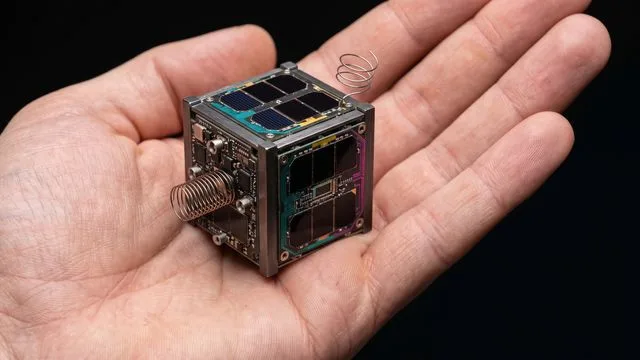
PocketCube Satellites: Earth Observation for $30K
Satellites small enough to hold in your hand can now image Earth at 6–12m resolution. But who controls the data—and who bears the cost of what orbits above us?

Perplexity Launches a Legal AI Agent Built for Law Firms
Perplexity's Computer for Counsel integrates directly into legal workflows. Here's what the product actually does—and what the broader AI agent race means for professional work.

AI Training Data: The Legal Vacuum No One Is Filling
AI companies built trillion-dollar products on data they never paid for. Courts are starting to push back—and Congress still hasn't shown up.