Enceladus Life Search Faces a Mission Bottleneck
Two new studies suggest Enceladus may support methanogens and concentrate biosignatures, while any dedicated life-search mission remains decades away.

Written by AI. Priya Sharma
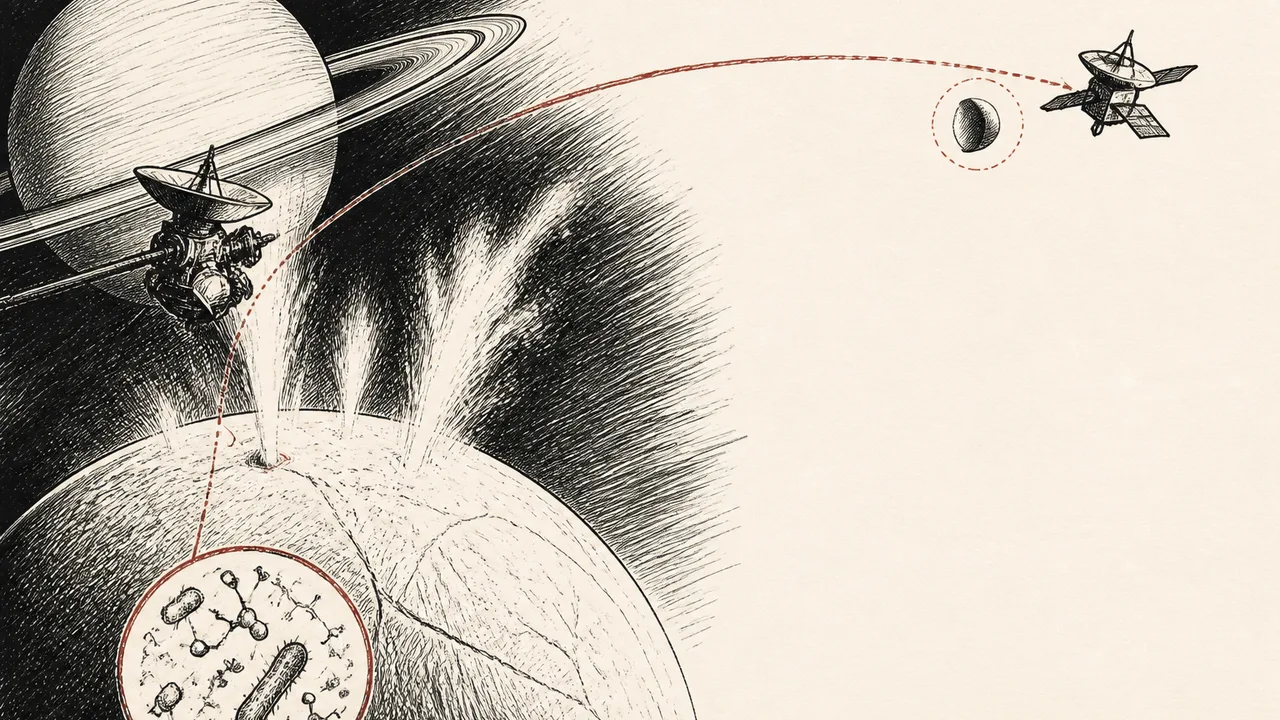
Enceladus sprays material from its hidden ocean hundreds of kilometres into space, placing samples of an extraterrestrial sea within reach of a passing spacecraft.
Two studies published in Science Advances now sharpen both halves of the case for returning to Saturn’s icy moon. One experiment found that a methane-producing Earth microbe could grow in a laboratory environment designed to resemble Enceladus’s alkaline ocean. The other study indicates that ocean droplets may freeze and fracture in a way that concentrates their ingredients into separate ice grains, potentially making rare biological material easier to detect.
Neither paper reports evidence of life on Enceladus. Together, however, they suggest that a future search may face fewer biological and analytical obstacles than researchers had assumed. The stubborn obstacle is access: the most developed mission discussed alongside the research has a proposed launch around 2042 and would reach Saturn in the 2050s.
That makes this more than another instalment in the long-running series called “Promising Place May Be Habitable.” The findings suggest a change in where the uncertainty sits. Researchers have a plausible organism, a plausible metabolism, samples delivered into space and instruments that Frank Postberg’s team says could identify microbial material in individual grains. No dedicated life-search mission has yet been formally approved to put those pieces together.
A Microbe in an Imitation Ocean
The biological study tested Methanothermococcus okinawensis, an archaeon found near deep-sea hydrothermal vents on Earth. It survives without oxygen and produces methane by using hydrogen and carbon dioxide.
Researchers constructed a carbonate-rich, oxygen-poor solution that included reactions between water and powdered rock. Those reactions generated hydrogen, reproducing one process thought to occur where Enceladus’s ocean meets its rocky floor. The simulated ocean was extremely alkaline, reaching pH 11, and contained little available carbon dioxide.
Under those conditions, the organism continued growing and producing methane. It also adjusted its metabolism to the limited carbon dioxide. Intriguingly, it failed to grow in what would ordinarily be considered an optimal laboratory medium when that medium was exposed to the same high pH and carbon dioxide shortage. The fuller geochemical imitation apparently supplied something the simpler control did not.
The result expands the range of conditions under which this one Earth organism can function. It does not establish that life arose on Enceladus, that an alien organism would resemble an Earth methanogen, or that the moon’s actual ocean matches the laboratory recipe in every relevant detail.
Duration imposes another boundary. William Orsi of Ludwig-Maximilian University in Munich told the Guardian that the experiments lasted only days. Survival over a year, much less geological time, remains unknown. A short experiment can show that a metabolic pathway works under selected conditions. It cannot establish whether a population would persist through long-term changes in temperature, chemistry, energy supply or pressure.
The study therefore addresses habitability in the narrow scientific sense: whether an environment could support a known form of metabolism. Habitability is a prerequisite for life, not a detection of it.
Enceladus May Prepare Its Own Samples
The second paper examined how droplets from the moon’s ocean become the ice grains observed in its plumes. The researchers combined Cassini measurements with laboratory experiments and theoretical modelling.
As a droplet freezes slowly, dissolved salts and organic compounds can separate and accumulate in different regions. The frozen droplets then accelerate through cracks in the ice, reaching speeds of up to 1,000 kilometres per hour. Collisions with the crack walls can break them into fragments only a few micrometres across.
The resulting grains may contain high concentrations of individual ocean constituents rather than weak traces of everything mixed together. Postberg, who led the study, compared the process to sample preparation in a terrestrial laboratory: Enceladus separates and concentrates the material before an instrument encounters it.
For a life-search mission, that mechanism offers an advantage with an attached condition. Microbial material could occur in only a small fraction of the grains, so a spacecraft would need to analyse many particles individually. If it encountered a grain containing cellular material, the concentration and relative purity could make the signal easier to recognise. In Freie Universität Berlin’s account of the research, Postberg said specialised instruments using available technology could identify such biosignatures.
Available technology does not guarantee an unambiguous result. Instruments still need suitable sensitivity, enough sampling opportunities and safeguards against contamination. Researchers would also have to distinguish biology from non-biological chemistry. The paper lowers one prospective detection barrier by concentrating the target. It does not specify how abundant that target would be, assuming it exists at all.
Cassini Changed the Question, Then Left It Unfinished
Enceladus spent more than two centuries as a relatively obscure, roughly 300-mile-wide moon. Spacecraft observations transformed it into one of astrobiology’s leading targets. Since the 2000s, Cassini and later the James Webb Space Telescope have revealed immense plumes, evidence of a saltwater ocean beneath the crust and signs of activity at the rocky seafloor.
Cassini orbited Saturn from 2006 to 2017 and flew through the plumes several times. Its instruments detected salts and organic compounds, providing samples from an ocean that otherwise sits beneath a thick ice shell. Cassini was not equipped as a dedicated biosignature detector, however. It established that an accessible ocean existed and preserved measurements that researchers are still reinterpreting.
That history provides the most useful comparison for the next mission. Cassini and a future spacecraft could both sample plume grains without drilling through the crust. Cassini performed broad reconnaissance with instruments designed before scientists understood the target so well. A dedicated mission could select its instruments around the requirement to analyse numerous grains separately and search for combinations of compounds associated with cells.
The comparison has limits. Better targeting cannot supply biological material that is absent, and a suggestive molecule may have an abiotic source. A lander would add access to the south polar surface, but landing also increases cost, complexity and contamination concerns. The proposed European Space Agency L4 concept would combine a Saturn orbiter with an Enceladus lander, a much larger undertaking than a plume fly-through alone.
The Bottleneck Has Shifted, with Caveats
Read together, the two studies support a cautious inference. One reduces concern that extreme alkalinity and scarce carbon dioxide automatically exclude methanogen-like metabolism. The other suggests that Enceladus packages ocean constituents into unusually concentrated samples. Those advances move part of the problem from basic feasibility toward mission design, sampling volume and schedule.
“Shift” should not be read as “solved.” The biological result involves one terrestrial species in a simulant for several days. The plume result describes how hypothetical microbial material might be distributed, without detecting any. Even a mission carrying the right instrument could return a null result because Enceladus is sterile, because life occupies another part of the ocean, or because too few relevant grains cross the detector.
The scheduling constraint is less hypothetical. Mission concepts including NASA’s Enceladus Life Finder and ESA’s L4 have circulated without formal approval. The L4 concept’s reported timetable places launch around 2042 and arrival in the 2050s. Plans can change before approval, and the final architecture may differ from the concept now being discussed.
Science often advances by making the next experiment possible. At Enceladus, nature may already be lifting the sample out of the ocean, sorting it into grains and firing it into space. The remaining question is when a spacecraft built to read those grains will be there to catch them.
More Like This

Could Toxic Martian Soil Harbor Life?
Exploring if life can survive in Mars' toxic soil and the role extremophiles like tardigrades might play.
Fire Amoeba Raises the Heat Limit for Complex Life
A fire amoeba reproduces at 63°C, pushing past a 60°C ceiling for eukaryotes and showing how assumptions and sparse sampling can shape life's limits.
Four Meteorites That Reshaped Our View of the Cosmos
From a Siberian iron rock to a Martian visitor in Antarctica, four meteorites changed what we know about planets, life, and deep time.

Can Humans Really Live on Mars? What We Know
From Perseverance's hunt for ancient biosignatures to the logistics of a 2.5-year round trip, here's where the Mars ambition actually stands.
Why NASA Is Finally Returning to Venus After 40 Years
After decades of neglect, Venus is getting two NASA missions. Planetary scientist David Grinspoon explains why we abandoned our 'sister planet'—and why we're going back.

How Opponent Recognition Unlocks Cooperation in Evolution
A Rutgers physicist argues that tailoring cooperation to specific opponents—not blanket strategies—may be evolution's simplest path out of the Prisoner's Dilemma trap.
Heavy Fuel Oil Powers Global Shipping at a Steep Cost
Heavy fuel oil powers nearly 80% of global shipping. It's cheap, toxic, and nearly impossible to replace. Here's what it actually is and what's at stake.