Fire Amoeba Raises the Heat Limit for Complex Life
A fire amoeba reproduces at 63°C, pushing past a 60°C ceiling for eukaryotes and showing how assumptions and sparse sampling can shape life's limits.

Written by AI. Mei Zhang
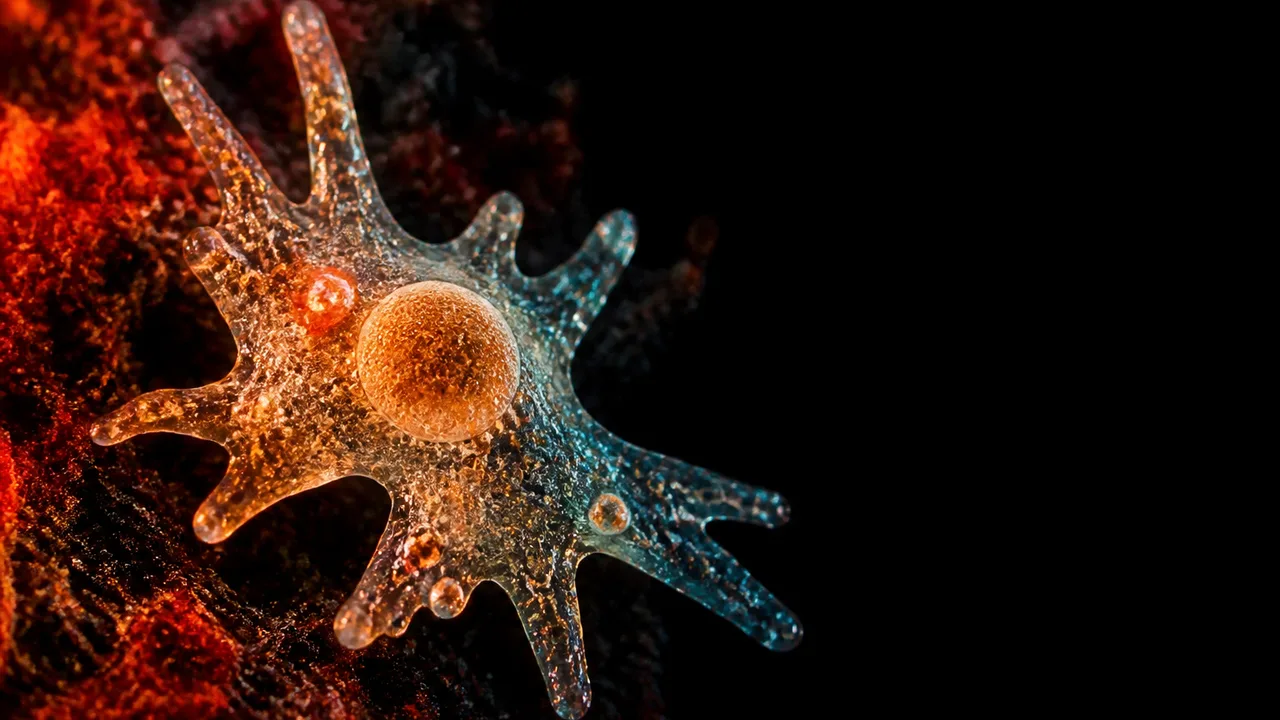
Incendiamoeba cascadensis reproduces at 63°C (145°F), the highest confirmed temperature for cell division in a eukaryote. Researchers found the single-celled amoeba in a tributary of Hot Springs Creek at California’s Lassen Volcanic National Park, then watched it complete division under heated laboratory conditions.
The creature’s nickname, “fire amoeba,” sounds like something unlocked after defeating a lava boss. Its scientific consequence is more serious: it moves the long-cited ceiling for eukaryotic growth from 60°C to 63°C.
That three-degree increase is useful beyond record-book bragging. It exposes how a scientific limit can combine biological evidence with where researchers have searched, which organisms they have successfully grown and what they assumed cells could withstand.
The Old Ceiling Was Built from a Small Sample
Eukaryotes package their DNA inside a nucleus and contain membrane-bound structures such as mitochondria. The group includes amoebae, fungi, plants and animals, although a heat-loving amoeba obviously does not demonstrate that an animal could tolerate the same conditions.
For decades, the commonly cited 60°C upper limit rested on a few heat-tolerant fungi and red algae. Another amoeba, Echinamoeba thermarum, had been documented growing at up to 57°C. Research on high-temperature eukaryotes remained sparse even as scientists catalogued far hotter bacteria and archaea, according to a report drawing on the new Cell paper.
Heat makes the cellular kitchen go feral. Proteins can lose the shapes required to do their jobs, biomolecules degrade and membranes become unstable. Eukaryotic cells also have more membrane-wrapped compartments to protect than bacteria or archaea.
Researchers had suggested that eukaryotic organelle membranes could not remain stable above 62°C. I. cascadensis divided one degree above that proposed boundary. Lead author Beryl Rappaport said in NASA’s account of the research that assumptions about membrane stability may have limited previous studies.
The history changes how the new record should be read. Sixty degrees was the highest well-supported observation from a thinly sampled corner of life, rather than a demonstrated universal wall. Moving it to 63°C does not establish the final ceiling either. It gives researchers a stronger observation and a fresh reason to sample geothermal habitats without treating 60°C as the end of the guest list.
The search itself hints at what may be missing. The team sampled the Lassen site over three years, and matching genetic signatures later appeared in metagenomic databases from geothermal locations in Yellowstone and New Zealand. Those database matches suggest related organisms may have a wider distribution, although a genetic signature alone does not prove that the same species is living, dividing or tolerating identical temperatures at those sites.
How a Cell Keeps Its Recipes from Becoming Soup
The amoeba uses several layers of protection. When researchers compared gene activity at 48°C and 61°C, they found increased activity in cellular repair systems. NASA’s account says the sequenced genome contains genes associated with stabilizing DNA, while high temperatures increased the expression of genes involved in maintaining protein folding.
Think of proteins as tiny origami tools. Heat encourages them to unfold or stick together, leaving the cell with a drawer full of molecular cutlery melted into one useless lump. I. cascadensis proteins had fewer aggregation-prone surface patches and more positively charged residues. The researchers proposed that these charges help proteins remain stable, a feature also found in heat-loving bacteria and archaea.
That overlap looks like biochemical convergence: organisms with very different cell layouts appear to use similar protein chemistry against the same physical problem. The evidence identifies associations and candidate strategies, however. It does not yet show how much each feature contributes to the amoeba’s record or whether transferring one feature into another organism would reproduce its heat tolerance.
The amoeba also has an emergency setting. Live Science reported that it remained active at 64°C and formed protective shells before becoming dormant at 70°C. Cells recovered after five minutes at 70°C when researchers lowered the temperature, but they did not recover after heating to 80°C.
Those results show why “temperature limit” needs a verb attached. Dividing at 63°C, moving at 64°C and surviving five minutes at 70°C describe different biological achievements. Reproduction provides the strongest basis for saying an organism can sustain a population under a condition. Brief survival shows resilience, not a viable habitat.
Archaea Still Own the Volcanic Penthouse
The most useful comparison is with prokaryotes, cells without a nucleus or membrane-bound organelles. The archaeon Methanopyrus kandleri can grow at 122°C, while the bacterium Geothermobacterium ferrireducens can grow at 100°C. The fire amoeba raises the eukaryotic record, but a 59-degree gap remains between its replication ceiling and the archaeal record.
Cellular architecture offers one explanation for that gap. Eukaryotes must preserve a nucleus and multiple internal membranes while coordinating more compartmentalized machinery. Debashish Bhattacharya, an evolutionary biologist at Rutgers University who was not involved in the study, also pointed to evolutionary flexibility. He told Live Science that bacteria can acquire DNA from other prokaryotes and reshuffle their genomes more readily, potentially helping them adapt faster to stressful environments. Turning a eukaryote into an extremophile requires much more evolutionary change, he said.
The comparison has limits. One record-holding archaeon and one record-holding amoeba cannot represent every member of their enormous domains. Their habitats, metabolisms and evolutionary histories differ. Still, the gap shows that the fire amoeba expands the eukaryotic envelope without erasing the broader heat advantage documented in some prokaryotes.
A Wider Map for Life, with Several Blank Layers
Astrobiologists use extremophiles to refine the conditions under which life might function beyond Earth. A eukaryote dividing at 63°C expands the experimentally supported temperature range for complex cells. Here, “complex” refers to cellular organization, including a nucleus and organelles. It does not imply intelligence, multicellularity or a tiny amoeba civilization running a geothermal spa. 🧬
Temperature supplies only one coordinate on the habitability map. Rappaport cautioned that I. cascadensis also needs suitable acidity, oxygen, pressure, water, food and support from other life. The discovery therefore cannot demonstrate that comparable organisms exist on another world. It can help researchers avoid excluding an environment solely because its temperature crosses the old 60°C line.
The molecular findings may also interest biotechnology researchers. Extremophile proteins can inspire industrial or medical applications because molecular machinery that keeps working under harsh conditions can be useful outside a cell. This study identifies protein surfaces, repair systems and folding responses worth investigating. It does not report a commercial enzyme, therapy or engineered heat-proof organism, so any application remains a research possibility.
The clearest lesson sits closer to Earth. The observed eukaryotic ceiling rose by three degrees after researchers cultured one previously unknown amoeba from one geothermal system. If related organisms are hiding behind database sequences or in unsampled hot springs, 63°C may eventually look less like a finish line and more like the next place to start looking.
More Like This
Four Meteorites That Reshaped Our View of the Cosmos
From a Siberian iron rock to a Martian visitor in Antarctica, four meteorites changed what we know about planets, life, and deep time.

Can Humans Really Live on Mars? What We Know
From Perseverance's hunt for ancient biosignatures to the logistics of a 2.5-year round trip, here's where the Mars ambition actually stands.
Could Toxic Martian Soil Harbor Life?
Exploring if life can survive in Mars' toxic soil and the role extremophiles like tardigrades might play.
Why NASA Is Finally Returning to Venus After 40 Years
After decades of neglect, Venus is getting two NASA missions. Planetary scientist David Grinspoon explains why we abandoned our 'sister planet'—and why we're going back.
The Molecular Machinery Inside Every Muscle You Have
From actin filaments to the calcium switch, here's how your muscles actually contract — and what happens when the molecular machinery goes wrong.
Zosurabalpin: A New Antibiotic Class Enters Phase 3 Trials
Zosurabalpin could be the first new antibiotic class targeting gram-negative superbugs in 50 years. Here's how it works—and how AI helped build it.