Zosurabalpin: A New Antibiotic Class Enters Phase 3 Trials
Zosurabalpin could be the first new antibiotic class targeting gram-negative superbugs in 50 years. Here's how it works—and how AI helped build it.

Written by AI. Mei Zhang
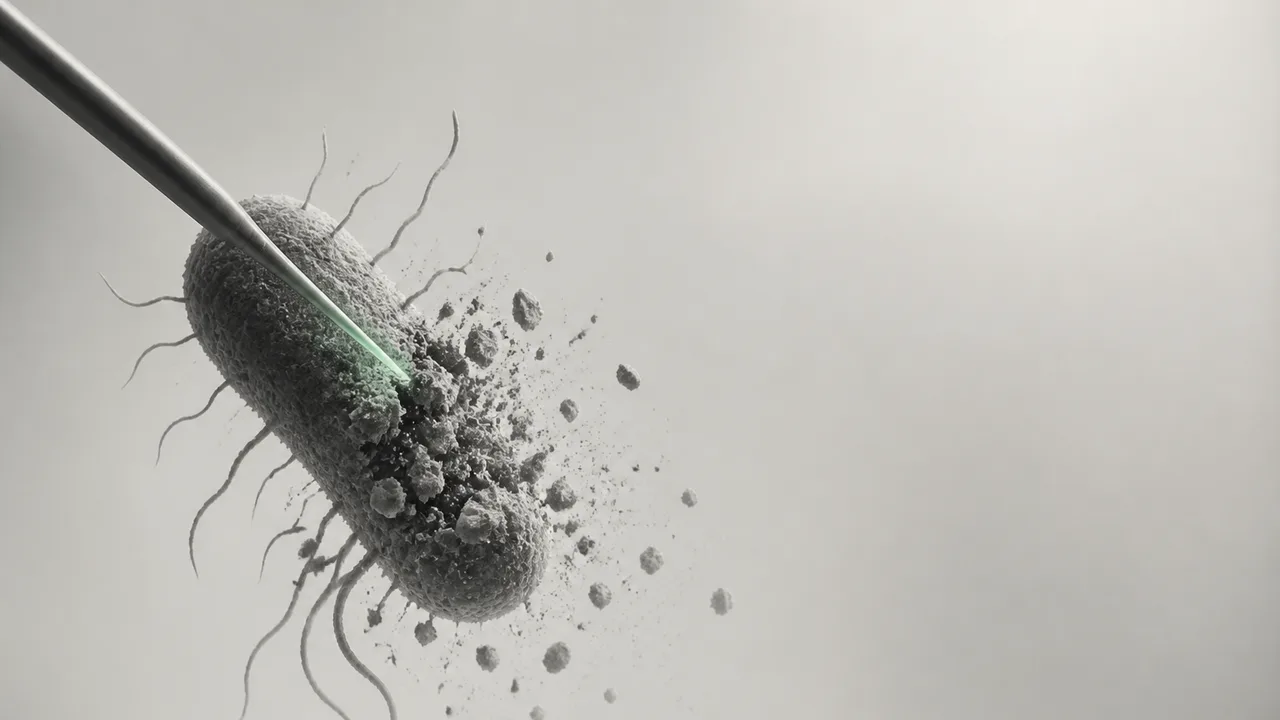
Photo: AI. Tomoko Hayashi
There's a category of scientific news that's genuinely important but gets absolutely buried—no explosion, no drama, just a quiet announcement that something hard and consequential actually worked. Zosurabalpin is that kind of news. 🧬
Developed by Roche, zosurabalpin recently cleared phase one clinical trials and jumped directly into phase three—an unusual leap that signals real confidence in early safety and efficacy data. As the Clockwork channel explained in a recent deep-dive video, this matters in a way that's hard to overstate: "This is the first time a new class of antibiotic that can actually kill drug-resistant superbugs has gotten this far in the developmental process in over 50 years."
Fifty years. That's not a typo.
The enemy it's targeting
To understand why this is a big deal, you need to meet the bug. Carbapenem-resistant Acinetobacter baumannii—CRAB, mercifully—is what happens when a gram-negative bacterium gets really, really good at surviving. It forms biofilms that cling to hospital surfaces for weeks. It exploits already-sick patients. It carries a lipopolysaccharide (LPS) coating that doesn't just block antibiotics—it actively destroys the immune cells that try to engulf it, turning your own immune response into a liability. And carbapenem, the antibiotic reserved as a last resort for severe infections, barely slows it down anymore.
The mortality numbers here aren't subtle. CRAB infections carry a 40–60% death rate once established, accounting for roughly 50,000 deaths per year globally. The WHO has it flagged as a priority-one pathogen, which is the organizational equivalent of a five-alarm fire.
The reason CRAB has been allowed to reach this level of threat connects to a broader structural failure: we've largely stopped discovering new classes of antibiotics. The existing toolkit for gram-negative bacteria has been getting patched and iterated for decades, but no genuinely new mechanism of action has made it to approval in half a century. Roche's research team didn't set out to solve this problem from scratch—what they found was arguably more interesting than an intentional breakthrough.
How zosurabalpin actually kills bacteria
Gram-negative bacteria are harder targets than gram-positive ones. You've got two membranes to penetrate instead of one, plus the periplasm between them, and then in CRAB's case the LPS coating on top of all that. Most antibiotics can't get through. Zosurabalpin, weighing in at nearly 800 daltons—almost double the mass of a typical clinical antibiotic—somehow sneaks past anyway.
Once inside, it does something elegant and a little brutal. The LPS coating that makes CRAB so formidable doesn't just appear on the outer membrane—it has to be manufactured internally and then actively transported outward by a protein complex called the LPT conveyor belt (technically the LptB2FGC complex, but conveyor belt is more fun). Zosurabalpin wedges itself into this transporter as an LPS molecule is entering the channel, bonding so tightly that the whole mechanism seizes up. The conveyor stops.
That alone would be useful—blocking the LPS shield makes CRAB more vulnerable to other drugs. But zosurabalpin doesn't need backup. Here's where it gets interesting: the bacteria have a sensor that monitors LPS levels on the outer membrane and signals the internal factory to stop producing when things are full. With the conveyor jammed, that signal never arrives. The factory keeps running. LPS accumulates in the cytoplasm with nowhere to go.
The same toxin CRAB uses to kill your immune cells ends up poisoning the bacterium from the inside.
As the Clockwork video puts it: "This LPS will build up enough to poison Acinetobacter individuals to death with their own cell wall coating." The bacteria, in essence, are killed by their own best weapon. The mechanism is described in detail across two companion papers published simultaneously in Nature: Zampaloni et al. (2024) and Pahil et al. (2024).
The machine learning chapter
Here's the part that makes zosurabalpin a story about the future of drug discovery, not just a single compound.
Zosurabalpin belongs to a category called tethered macrocyclic peptides—chains of amino acids looped back on themselves. The appeal is structural: you can theoretically mix and match amino acids in a circular chain billions of different ways, producing molecules with the targeting precision of large biologics but the deliverability of small-molecule drugs. The problem is that "billions of possibilities" doesn't narrow itself.
Roche's approach was a kind of disciplined brute force. They commissioned the synthesis of just under 45,000 unique macrocyclic peptide variants and tested them against multiple bacterial strains. That produced an enormous dataset that no team of human researchers could meaningfully sort through manually. So they didn't try.
Instead, drawing on a framework called bacterial cytological profiling—developed by Nonejuie, Burkart, Pogliano, and Pogliano at UC San Diego in 2013—Roche scanned fluorescence images of every bacterial sample exposed to every compound. The images show how bacteria respond to chemical stress through changes in how they process certain dyes: subtle structural shifts that correspond to different mechanisms of cellular disruption. A random forest machine learning algorithm then sorted those images, categorizing which macrocyclic peptides were doing something genuinely interesting versus which ones were duds.
This work was documented in a 2019 paper by Zoffmann, Vercruysse, Benmansour et al., which laid out the machine learning pipeline for phenotypic antibiotic screening. Out of 45,000 starting candidates, the algorithm identified a single cluster of promising compounds. Four stood out most. Further refinement—testing for blood plasma solubility, which matters enormously for a drug that actually has to travel through a human body—narrowed it down to the structure that became zosurabalpin.
The video is careful to note something worth holding onto here: the research team wasn't necessarily looking for an LPT conveyor belt inhibitor. They found what the machine learning pointed them toward, then figured out why it worked. That's a different mode of discovery than traditional hypothesis-driven drug design, and it raises real questions about how we think about scientific intuition versus pattern recognition at scale.
Where generative AI fits—and where it doesn't
Zosurabalpin is a product of late-2010s machine learning, and the Clockwork video is deliberate about distinguishing that from the generative AI conversation happening now. The random forest algorithm used in Roche's pipeline doesn't generate new molecules—it categorizes existing ones. That distinction matters.
The generative side of antibiotic discovery is moving fast, though. The Collins Lab at MIT recently published work—Wong, Zheng, Valeri et al. in Nature (2024)—using explainable deep learning to identify a new structural class of antibiotics active against resistant Staphylococcus aureus. And a 2025 Cell paper from Krishnan, Anahtar, Valeri et al. describes a generative model that filtered 45 million chemical fragments down to 24 synthesizable drug candidates, seven of which showed real-world antibacterial activity. Two may represent entirely new antibiotic classes.
May. That's the operative word. As the Clockwork video notes: "Right now, there's not nearly enough data to see if these two compounds are actually promising or not." The pipeline from initial AI-generated hit to clinical trial approval is long, expensive, and brutal. Zosurabalpin itself represents a decade-long technology tree rooted in 2013-era research—and it's still in phase three.
The honest picture of AI in drug discovery is that the technology is genuinely useful as a filter and a generator, but it doesn't compress the validation timeline. You still have to build the molecule. You still have to test it in cells, then animals, then humans. You still have to prove it's safe. The thing that AI accelerates is the front end—finding candidates worth testing—not the back end where most drugs actually fail.
That's worth understanding clearly, especially given how the AI-in-healthcare narrative tends to run at full gallop toward cures. The Clockwork video makes a reasonable plea here: "Check back with me in a decade to see if these things actually showed real promise."
The credit question
One thread the video surfaces that I keep turning over: zosurabalpin is the product of decades of publicly funded basic research, built into a platform by a major pharmaceutical corporation, with a discovery process enabled by academic machine learning frameworks from UC San Diego. The papers announcing its mechanism were published in Nature by teams at Roche, but the intellectual scaffolding was assembled by researchers across many institutions and funding sources.
That's not a critique—it's just how science works, and it's worth naming. The question of who benefits from breakthrough antibiotics, who can afford them, and how drug pricing structures interact with global infectious disease burden doesn't get answered by the chemistry. Those are separate problems that the biology doesn't solve.
What the biology does solve, potentially, is giving clinicians something to reach for when CRAB has backed a patient into a corner. Phase three trials will tell us whether zosurabalpin clears the bar. If it does, it won't just be a new drug—it'll be proof that the machine-learning-assisted discovery pipeline can find genuinely novel mechanisms, not just iterations on existing ones.
And if that's true, the 50-year drought may finally be ending. Whether the next 50 years look different depends on a lot more than the chemistry. 🧬
More Like This
Unraveling the Golden Ratio's Mathematical Magic
Explore how the golden ratio's unique irrationality connects math, nature, and fractals.
OpenAI's Bold Move: Profit Sharing in Drug Discovery
Exploring OpenAI's plan to share drug discovery profits and its implications for AI's role in pharma.
The Neuroscience of Discipline: Automation Over Motivation
Explore how discipline evolves from motivation to neural automation, making actions automatic and emotions irrelevant.
AI Labs Call for a Global Pause Mechanism on AI
Top AI leaders signed a letter urging synthetic biology screening, while Anthropic published a stark assessment of recursive self-improvement and why a pause mechanism matters.
Black Hole Paradox: Are Reference Frames the Key?
Exploring how reference frames might resolve the black hole information paradox.
Exploring Cosmic Time Delays and Dark Energy
Time delay cosmography may unveil dark energy mysteries, resolving Hubble tension with new cosmic insights.

Solar Orbiter Captures First Direct View of the Sun's Poles
Solar Orbiter has captured the first direct images of the Sun's poles, revealing a chaotic magnetic field mid-reversal—and what it means for space weather forecasting.

Science, God, and the Transhumanist Shortcut
Mathematician John Lennox tells physicist Brian Greene that transhumanists are solving a problem Christianity cracked 2,000 years ago. My generation might actually find out who's right.