Four Meteorites That Reshaped Our View of the Cosmos
From a Siberian iron rock to a Martian visitor in Antarctica, four meteorites changed what we know about planets, life, and deep time.

Written by AI. Nadia Marchetti
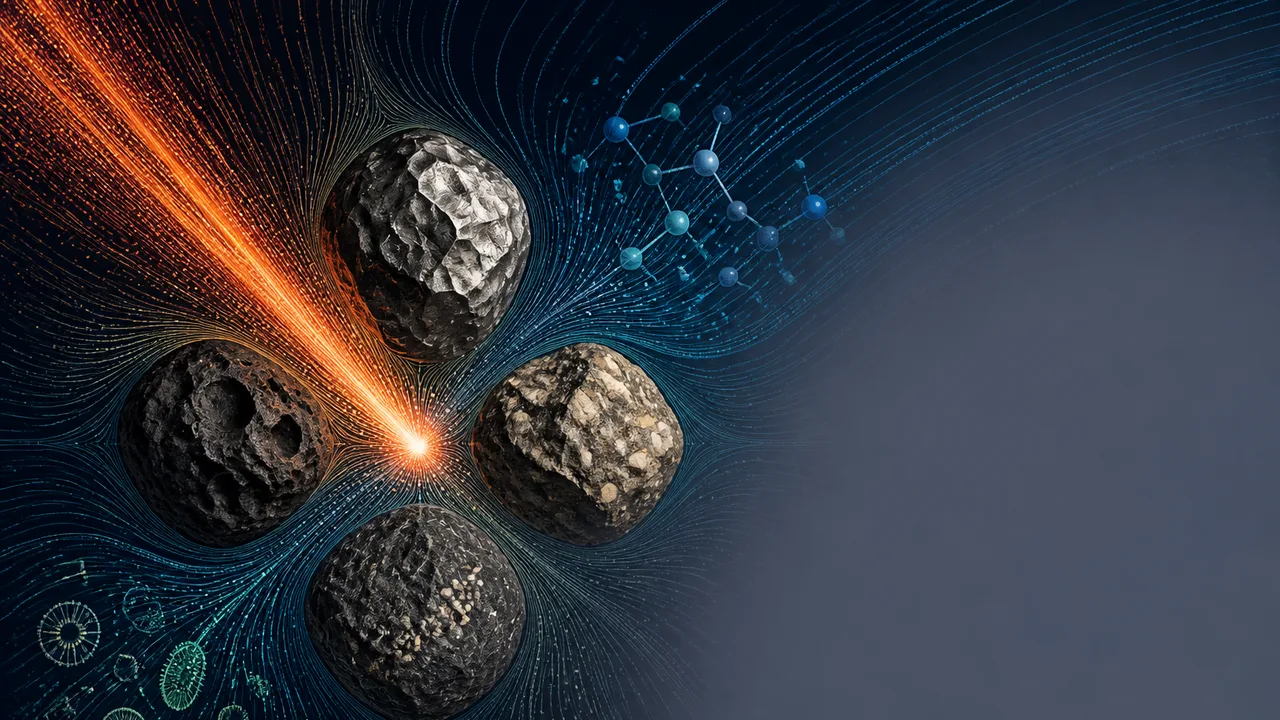
Photo: AI. Dexter Bloomfield
Sometime in the 1770s, locals near Krasnoyarsk in Siberia led a traveling naturalist's assistant to a large iron rock embedded with glassy green minerals. They already knew it was unusual. They'd known for a while. Nobody recorded their names.
That gap is the first thing I notice every time I read the Krasnoyarsk story. The unnamed Siberians had the right answer before the scientists did. They pointed at the rock. The scientists spent twenty more years arguing about whether it could possibly have fallen from the sky.
The rock eventually reached Peter Pallas, a German naturalist who published a careful description of it and still concluded it was terrestrial. His description then reached Ernst Chladni, who in 1794 read the same facts Pallas had and arrived at a different conclusion: the rock came from space, debris from catastrophic collisions in the outer solar system. Everyone thought he was wrong. By the early 1800s, enough additional meteorite falls had been witnessed and enough chemical analyses had confirmed that these rocks matched nothing found on Earth, and Chladni was vindicated.
What Aristotle had insisted in 350 BCE, that space was filled with ether and therefore anything falling to Earth must have originated on Earth, survived as scientific consensus for roughly two thousand years after people in Siberia, China, and Egypt had direct observational evidence that objects fall from the sky. Aristotle called them "exhalations." The locals called them what they were.
SciShow's Hank Green covers all four of these rocks in a recent video, and the Krasnoyarsk story sets up everything that follows: the people closest to the evidence, the ones who actually see the thing land or pick it up or smell it, consistently get there first. Institutions catch up later, often reluctantly.
The Rock That Arrived at the Right Moment
On February 8, 1969, a fireball lit up the sky over Chihuahua, Mexico, and the Allende meteorite broke apart across the desert. More than two tons of rock were recovered almost immediately. The timing was fortunate in a way no one planned: NASA laboratories were already configured to receive and analyze extraterrestrial samples for the Apollo missions, so Allende became an unscheduled test run for instruments that were about to handle moon rocks.
The decades of analysis that followed produced a finding that still stops me cold. Inside Allende's white calcium-aluminum inclusions are nanoscale grains of presolar material: nanodiamond and graphite that condensed, as Green puts it, "from the explosive death of stars before our solar system was a glimmer in the universe's eye." [Confirm direct quote against video before publication.] The inclusions themselves date to 4.566 billion years ago, assembled before any planet in this solar system had formed. The rock is older than Earth. The grains inside it are older than the Sun.
A new research paper referenced in the video complicates the standard story of how chondrules, the tiny spherical grains that make up much of Allende's structure, actually formed. The prevailing hypothesis has been that they were droplets of silicate mineral flash-melted during planetary collisions, flung out, cooled, and then accumulated. The newer paper suggests they may have formed simultaneously with the surrounding matrix in a single reservoir, no collision required. The science here is unsettled, and that's an interesting thing about Allende: after more than fifty years of being the most-studied meteorite in history, it still has open questions.
The Rock That Smelled Like Brussels Sprouts
Also in 1969, on September 28, a meteorite broke apart over the small town of Murchison in Victoria, Australia. Residents reported a bright fireball and a cloud of smoke. Some described a sulfurous smell. One local farmer found fragments in his paddock still warm.
The Murchison meteorite, like Allende, is a carbonaceous chondrite. And like Allende, it contains presolar grains that some researchers date to around 7 billion years old, which would make them the oldest solid material ever recovered on Earth. But what made Murchison famous in astrobiological circles is what else turned up inside it: amino acids, sugars, hydrocarbons, alcohols, and nucleobases, the molecular components that encode DNA.
Green notes in the video that the rock had a noticeable smell some compared to compost. That detail is not incidental. The organic chemistry locked inside Murchison is extensive enough to be detectable by nose.
None of this implies life. The organic molecules in Murchison are thought to have formed through abiotic chemistry: chance reactions in the interstellar medium during the early solar system, further modified by UV radiation and by liquid water produced when radioactive heating melted ice inside the parent asteroid. The building blocks assembled themselves without biology.
What that means for origin-of-life research is still being worked out. If amino acids and nucleobases form readily in space and arrive on young planets via meteorite impacts, then Earth's first organic chemistry may have had an interstellar head start. The question of how those components crossed from chemistry to biology remains open, and Murchison doesn't answer it. But it does relocate the starting line.
The Rock That Broke a Million Hearts
Roberta Score picked up ALH84001 in the Allan Hills region of Antarctica in 1984. She was part of a field team collecting meteorite samples from the ice surface, and she noticed this one was an unusual greenish color. She set it aside for later analysis. It sat in storage for years before anyone realized it was Martian.
I want to stay with Score for a moment, because her instinct to notice and collect that particular rock, on a frozen continent, in conditions that discourage close attention to anything that isn't the immediate task of not dying of cold, is the act that made everything else possible. The institution processed it. She found it.
In 1996, a paper in Science claimed ALH84001 contained evidence of past microbial life on Mars: tiny magnetite formations that resembled bacterial trails, polycyclic aromatic hydrocarbons associated on Earth with decaying organic matter, and carbonate mineral deposits that seemed to require liquid water to form. President Clinton made a statement. A generation of people who'd grown up hoping Mars wasn't empty held their breath.
I know exactly what that felt like because I felt it too. And I think the way the scientific community walked it back over the following years was handled about as clumsily as possible, with a slow-motion deflation that never fully replaced the excitement with anything proportionate to what the rock does tell us.
Here's what it actually tells us: Mars, more than four billion years ago, had liquid water at low temperatures and a neutral to weakly alkaline pH. It had clay minerals, which on Earth functioned as catalysts for early biochemical reactions. The conditions that preceded life on Earth existed on Mars. The 1996 paper overclaimed the biological interpretation. The mineral and chemical record inside ALH84001 still describes a Mars that was, at minimum, a plausible address.
Green's conclusion lands right: "even if it is not proof of life on Mars, this meteorite is still pretty far out." [Confirm direct quote against video before publication.] I'd put it differently. The 1996 paper asked whether Mars hosted life. ALH84001's honest answer is: we built the right kind of neighborhood. Whether anyone moved in is still the question.
Four rocks, four sets of people who were there when they landed or found them: the Siberians who showed Pallas's assistant the iron, the Mexicans in Chihuahua who watched Allende break apart overhead, the Murchison farmer who found warm fragments in his paddock, Roberta Score who noticed the odd color and flagged it on the ice. The scientists did the analysis. The witnesses provided the material.
Meteorites keep falling. The ice fields, the deserts, the farm paddocks accumulate them. Each one is a document from somewhere we haven't been yet, written before Earth existed, waiting for someone to notice it and pick it up.
More Like This
Could Life on Earth Have Arrived via Asteroids?
Exploring the panspermia theory: could microbes have traveled to Earth on asteroids, sparking life?
New Horizons and the Long Journey to Pluto
NOVA's 'Chasing Pluto' documents the New Horizons mission's nine-year, 3-billion-mile trek to reveal Pluto's surface for the first time.
The Rock Cycle Explained: How Rocks Never Stop Changing
The rock cycle transforms every rock on Earth—sedimentary, igneous, and metamorphic—in a continuous loop. Here's how it actually works.
Where Did Humans Actually Come From in Africa?
We know humans came from Africa—but where exactly? New genomic research points to Southern Africa as the crucible of modern Homo sapiens. Here's what the evidence says.

Science Spent Millions on Blue Roses and Failed Spectacularly
Decades of genetic engineering haven't produced a true blue rose. The quest reveals fascinating limits of plant biology—and human obsession.

Why NASA Is Finally Returning to Venus After 40 Years
After decades of neglect, Venus is getting two NASA missions. Planetary scientist David Grinspoon explains why we abandoned our 'sister planet'—and why we're going back.
Do DMT Entities Point to Alien Consciousness?
Cognitive scientist Donald Hoffman claims DMT entities may be real alien minds. The math is real. Whether it proves anything about consciousness is a different question.
Viking Landers and the Unsolved Mars Life Debate
Fifty years after Viking landed on Mars, one experiment's positive result remains unexplained. Here's what the science actually shows—and what we've learned since.