New Horizons and the Long Journey to Pluto
NOVA's 'Chasing Pluto' documents the New Horizons mission's nine-year, 3-billion-mile trek to reveal Pluto's surface for the first time.

Written by AI. Amelia Nwofor
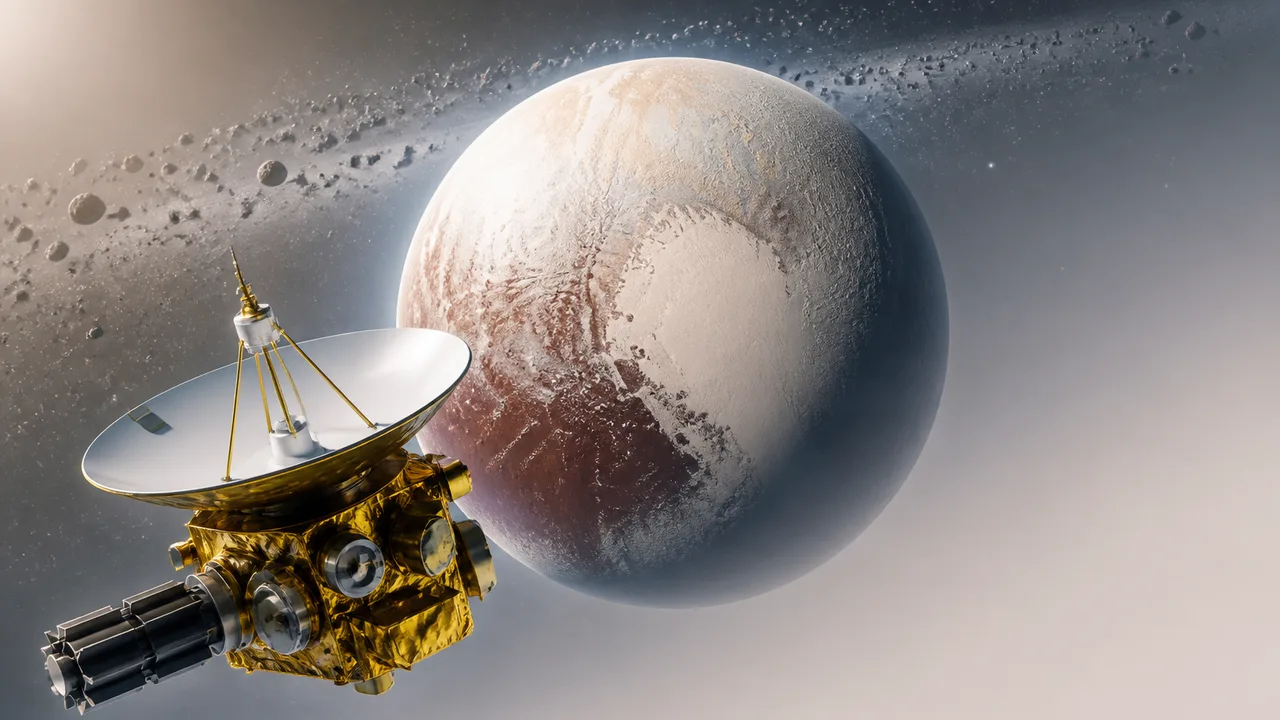
Photo: AI. Ren Takahashi
On January 19, 2006, an Atlas V rocket left Cape Canaveral at 36,000 miles per hour — the fastest launch ever recorded at the time. Nine hours later, New Horizons had already crossed the moon's orbit, a trip that took Apollo astronauts three days. And then, for most of the next nine years, it just... flew. Quietly. Through nothing.
That's the tension at the heart of NOVA's Chasing Pluto, now streaming in full on YouTube: the gap between the drama of the engineering problem and the long, almost meditative patience required to find out if you solved it. The PBS documentary aired the day after New Horizons completed its July 14, 2015 flyby, which means it's structured as something between a pre-game show and a live broadcast — and the stakes feel accordingly real.
A spacecraft the size of a grand piano
The engineering constraints on New Horizons are worth pausing on, because they're the kind of detail that gets lost when mission coverage pivots too quickly to the imagery.
At 30 times the Earth's distance from the sun, solar panels become useless — the light is simply too faint. So the spacecraft runs on nuclear power. Its seven scientific instruments, including an ultraviolet spectrometer named Alice, an infrared spectrometer named Ralph, and a telephoto imager named Lori, collectively weigh less than 70 pounds. The whole package, the documentary notes, is "not much bigger than a grand piano."
Lori's optics required a special fix of their own. A conventional telescope lens warps in extreme cold as different parts of the instrument cool at different rates, blurring the image. The solution came from bulletproof vest technology: the lens is made of silicon carbide, a compound stiff and light enough to hold its shape across wild temperature gradients. It's the kind of solution that doesn't make headlines but is absolutely load-bearing for everything that follows.
Then there's the communication lag. During closest approach, a radio signal takes four and a half hours to reach Earth from Pluto — meaning any instruction sent in response takes another four and a half hours to arrive. The spacecraft had to execute its entire science sequence autonomously, pre-programmed to the minute. As one mission team member puts it in the documentary: "If something went wrong, it would be more than 9 hours before we could tell it to do something. The most important science is happening really only over about a 12-hour period."
That's not a design flaw. That's physics. But it does mean the New Horizons team spent years building a spacecraft smart enough to run itself through the most critical window of the mission without any help from home.
The reclassification that wouldn't go away
The documentary doesn't shy away from the Pluto-demotion drama, and it's worth engaging seriously rather than treating it as a quirky sidebar.
In 2006 — the same year New Horizons launched, which gives the timing a certain irony — the International Astronomical Union voted to redefine "planet." The new criteria required an object to have cleared the neighborhood of its orbit. Pluto, embedded in a crowded Kuiper Belt filled with hundreds of thousands of icy bodies, failed that test. It was reclassified as a dwarf planet. Eight planets remained.
What the documentary captures well is that the controversy isn't really about nostalgia, even if the public protests ("Rock Pluto. You'll always be a planet to me") looked that way. The scientific tension is substantive. Alan Stern, the principal investigator for New Horizons, argues in the film that calling something a "dwarf planet" and then insisting it isn't a planet is linguistically incoherent — the designation has the word in it. His Chihuahua analogy lands as intended: "When you see a Chihuahua, it's still a dog — it has the characteristics of the canine species, just in miniature."
The counterargument, also represented in the documentary, is that taxonomy exists to communicate meaningful distinctions. Pluto's orbit is highly elliptical, tilted out of the ecliptic plane, and it shares its neighborhood with thousands of similar objects. By that logic, calling it a planet tells you less about what it actually is than calling it a Kuiper Belt object does.
Both positions are coherent. The IAU went one way. The debate hasn't fully resolved. And the New Horizons flyby, intended to study a "planet," ended up revealing something that complicated the picture further: Pluto has five moons, a seasonally shifting atmosphere of nitrogen, methane, and carbon monoxide, icy mountains 11,000 feet high, and a surface varied enough that — as the documentary notes — the only other solar system body with comparable surface diversity is Earth. That's a strange resume for something we've decided to call merely a "dwarf."
Five moons and a debris problem nobody anticipated
The discovery of Pluto's five moons, detected by the Hubble Space Telescope during New Horizons' transit, nearly derailed the mission. The moons are collision remnants — two Pluto-sized objects are thought to have collided roughly 4.6 billion years ago, leaving Pluto intact and scattering debris into orbit. Those small, irregular moons are perpetual dust generators.
At 30,000 miles per hour, even a millimeter-sized particle could punch through the spacecraft's wall. NASA ran tests at a hypervelocity gun facility, firing pellets at layered samples of the spacecraft's materials. Results were mixed: most pellets stopped at the inner wall, but some didn't. The team developed four alternate flight trajectories depending on how hazardous the debris environment turned out to be.
This is where the documentary's honesty is most valuable. It doesn't tell you the mission was safe. It tells you the team quantified the risk as best they could, then flew anyway, because the science was worth it. "The worst possible scenario," one team member says, "is it comes into the system, it starts taking images, it gets destroyed by some impact and we'll never see the images." That's not dramatic license. That was a live possibility.
What Pluto might actually tell us
Underneath the engineering story and the taxonomy argument sits the more interesting question: why does any of this matter scientifically?
The Kuiper Belt objects, including Pluto, are thought to be planetesimals — bodies that stopped growing during the early solar system's formation phase, frozen at a mid-stage of development. As the documentary puts it, they're "planetary embryos." Studying them is, in theory, reading the fossil record of how planets form. Gas giants like Jupiter and Saturn swept up most of the available material in the inner solar system; objects like Pluto got pushed to the outer edges and stayed there, largely unchanged.
There's also a more speculative but scientifically serious line of inquiry: whether Pluto harbors a subsurface liquid water ocean. Several geophysical models suggest it does. If that's right, Pluto joins a growing list of bodies — Europa, Enceladus, Titan — where the prerequisites for biology, liquid water, energy, organic chemistry, may be present. The documentary is appropriately careful here: the word "potential" gets stressed explicitly. But the implication is meaningful. Dwarf planets are the most numerous type of planetary body in the solar system. If many of them harbor interior oceans, the distribution of possible habitats for life looks very different than our eight-planet mental model suggests.
The signal that came back
Seven days before closest approach, New Horizons lost contact. The main processor had reset and switched to the backup. Mission Operations Manager Alice Bowman — known as "MOM" — reportedly slept on the floor during the recovery effort. The problem was fixed with, by one account, four hours to spare.
When the spacecraft completed its flyby and its first beacon reached Earth, Bowman ran through a systems check — RF, power, propulsion, all green — before the room allowed itself to celebrate. The images that came back the next day showed mountains of water ice rising 11,000 feet from Pluto's surface. Charon, its largest moon, had almost no visible impact craters, suggesting a geologically active history.
It will take roughly 16 months for all the data to downlink to Earth at 10 watts of transmitting power — less than a standard light bulb. Years more to analyze.
The spacecraft, meanwhile, keeps going. Through the Kuiper Belt, past the boundary of the known solar system, into whatever comes next. We built it to fly farther than anything human-made before it, and it is doing exactly that — whether or not we've decided what to call the world it stopped to photograph along the way.
More Like This

Pluto's Planet Status Debate, Explained
A 10-year-old's letter to NASA reignited Pluto's planet debate. Here's what the science actually says—and why the answer is messier than you'd expect.

Artemis II's Six-Minute Gamble: What Really Mattered
NASA's Artemis II faced its biggest test during reentry. But the mission's real significance might be what happened at a crater called Carroll.
Triton's Strange Orbit and the Ice Giants' Secrets
Triton's retrograde orbit, nitrogen geysers, and the chaotic magnetic fields of Uranus and Neptune reveal how little we understand our own solar system.
Curiosity Rover Finds Honeycomb Polygons on Mars
NASA's Curiosity rover found a vast honeycomb polygon field in Mars' Valle Grande—tiny fractures that hint at ancient wet-dry cycles and a very different planet.
Planet 9, Pluto, and the ISS: Neil Tyson Fields the Big Questions
Neil deGrasse Tyson tackles Planet 9, Pluto's demotion, galaxy shapes, dark matter, and the ISS deorbit in StarTalk's latest Cosmic Queries episode.
Webb Detects Methane on Interstellar Comet 3I/ATLAS
Webb's MIRI instrument detected methane on interstellar comet 3I/ATLAS after perihelion—a timing that hints at buried volatile layers from another planetary system.
A Black Hole Photon Ring Inspired a New Laser Design
Researchers built a laser using the light-trapping geometry of black hole photon spheres. Here's what the experiment actually shows—and what it doesn't.
Cold Spark Machines Are Hot — Just Not How You Think
Cold spark machines are marketed as safe firework alternatives, but the science tells a more complicated story. Here's what's actually happening inside those sparks.