Curiosity Rover Finds Honeycomb Polygons on Mars
NASA's Curiosity rover found a vast honeycomb polygon field in Mars' Valle Grande—tiny fractures that hint at ancient wet-dry cycles and a very different planet.

Written by AI. Mei Zhang
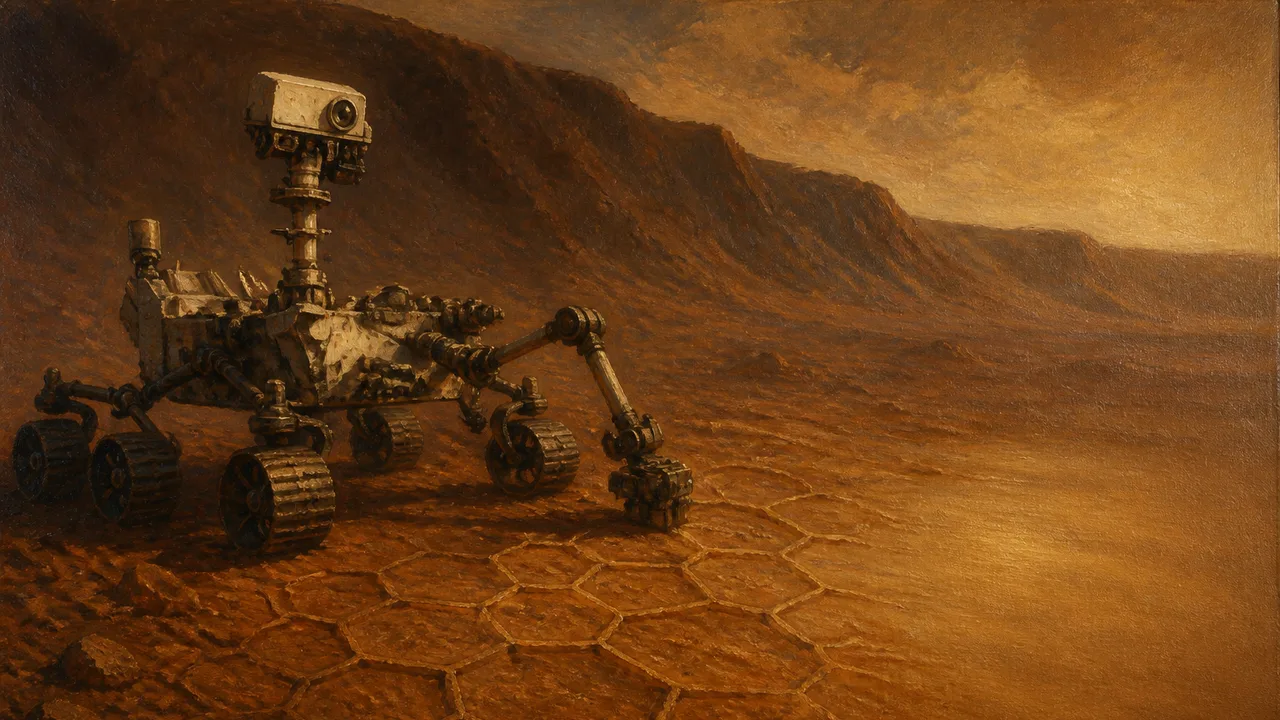
Picture cracked mud at the bottom of a dried-up lake. Now scale it to a planet, age it by a few billion years, and let it bake under an alien sun. That's roughly what NASA's Curiosity rover rolled into recently — a sprawling field of honeycomb-shaped fractures etched into the Martian ground, each cell just 1.5 to 3 inches (4 to 8 centimeters) across, according to NASA's Jet Propulsion Laboratory.
The location is a stretch of Martian valley called "Valle Grande," and Futurism reports that the landscape there is almost entirely defined by these repeating geometric patterns. On June 19 and 20, 2026 — sols 4,930 and 4,931 of the mission, per NASA Science — Curiosity captured a full 360-degree panorama of the terrain. The images are genuinely strange: a geometry lesson printed on a dead planet.
What makes a polygon on Mars?
The leading explanation, flagged by Phys.org, is mud cracking from repeated wet-dry cycles — the same basic physics that leaves geometric fractures in dried creek beds here on Earth. Wet sediment expands; dry sediment contracts; do that enough times and you get a grid. The pattern is diagnostic. It doesn't form in a single flood event or a single dry period — it needs cycling, seasons of wet and dry trading off over geological time.
That's the detail worth sitting with. Not just that Mars was once wet, which we've known for a while now. But that it was wet, then dry, then wet again — possibly many times. That's a fundamentally more dynamic planet than the freeze-dried wasteland we tend to picture.
Universe Today notes that polygonal features have been spotted elsewhere on Mars before, but this particular field in Gale Crater was a first-time observation for Curiosity. And Phys.org is careful to flag what the science actually allows here: the mud-cracking hypothesis is the leading explanation, but the origin of these specific features remains uncertain. Thermal contraction — the same process that creates polygon shapes in Arctic permafrost on Earth — is another candidate. The honest answer is that scientists are still working out which mechanism (or combination) carved this particular field.
What's not uncertain: Gale Crater is one of the most geologically interesting places on Mars, and Curiosity has been reading it like a slow-motion archive since 2012.
The butte named Miraflores and what surrounds it
Before rolling into the polygon field, Curiosity photographed a sand-capped butte the mission team nicknamed "Miraflores," imaged on June 11, 2026, according to NASA. The surrounding terrain — the approach to Valle Grande — was already showing the polygon textures that would dominate the panoramas taken a week later. In Mars exploration, the journey between waypoints is often as scientifically dense as the destination itself.
That's a rhythm the mission has settled into over its now-14-year run. Curiosity didn't go looking for polygons; it was navigating toward other targets when it rolled into this field. Discovery by traversal, not by design. The rover's cameras are always on, always reading the ground, and sometimes the ground hands you something genuinely unexpected.
Why the habitability question is harder than it sounds
Here's where the "ancient Mars was habitable" headline needs a little texture. Habitability in the scientific sense means conditions capable of supporting life as we know it — the right chemistry, liquid water, energy sources, protection from radiation. It doesn't mean life was there. And the gap between "could have supported life" and "did support life" is enormous.
What the polygon field adds is evidence for environmental variability. Life on Earth tends to show up where energy gradients exist — where conditions fluctuate enough to drive chemistry. Wet-dry cycles are exactly that kind of fluctuation. They concentrate organic molecules, drive chemical reactions, and create the kind of dynamic interfaces where, on our planet, some researchers think early life may have gotten its start.
Whether that same logic applies to Mars is a genuinely open question. The ingredients were there. The cycling was there. Whether life ever assembled from those ingredients — that's what the full Mars exploration program, across decades and missions, is trying to figure out.
The longevity question nobody talks about enough
We grew up watching the commercial space race turn into a content genre — rockets launching to feeds of millions, Mars becoming a brand. Against that backdrop, it's easy to lose track of what Curiosity actually represents: a car-sized robot that has been driving around another planet since August 2012, still functional, still making first-time observations on sol 4,931.
The rover was designed for a two-year primary mission. It is now well into its second decade. That longevity isn't just an engineering achievement — it's what makes discoveries like this possible. You can't find a polygon field in Valle Grande if you never reach Valle Grande. And you don't reach Valle Grande on a two-year mission. The science Curiosity is doing now is science that literally couldn't have been planned for at launch.
There's a version of this story that's about the hexagons. The more interesting version is about what it means to commit to slow, patient, cumulative science on a world you can't visit — science at a cadence that doesn't fit neatly into any news cycle.
The polygons in Valle Grande are one more frame in a very long film. The question that drives the whole project is whether, somewhere in the geological record this rover is slowly reading, there's evidence of chemistry that crossed the threshold into biology. Curiosity is still shooting.
More Like This
Why Finding Earth's Twin Among Exoplanets Is So Hard
The TRAPPIST-1 system looks promising—seven rocky planets, three in the habitable zone. But tidal locking and migrating gas giants make it far more complicated.
A 1.27-Billion-Year-Old Mars Meteorite Changes Everything
A dark green Martian rock found in Algeria in 2019 just filled a 1.8-billion-year blank in Mars's geological record — and it came from a region no one knew existed.
Total Solar Eclipse 2026 Dazzles Spain and Science
The August 12, 2026 total solar eclipse over Spain was a spectacle—and a rare scientific window into a solar mystery we still can't solve.
Viking Landers and the Unsolved Mars Life Debate
Fifty years after Viking landed on Mars, one experiment's positive result remains unexplained. Here's what the science actually shows—and what we've learned since.

Black Hole Paradox: Are Reference Frames the Key?
Exploring how reference frames might resolve the black hole information paradox.
Curiosity at Sol 4948: Reading Mars Like a Genome
Curiosity Rover hit Sol 4948 in Gale Crater. What its mineralogy tells us about Mars' chemical autobiography—and why that question is getting urgent.
Black Holes, Colliding Galaxies, and the Chaotic Universe
Astrophysicist Mordecai-Mark Mac Low joins StarTalk to unpack galaxy collisions, planets orbiting black holes, dark matter, and why the universe is messier than we thought.
Ten Discoveries That Rewired How We See Everything
From CRISPR to dark energy, ten scientific breakthroughs that didn't just change their fields — they changed what questions we're allowed to ask.