Black Holes, Colliding Galaxies, and the Chaotic Universe
Astrophysicist Mordecai-Mark Mac Low joins StarTalk to unpack galaxy collisions, planets orbiting black holes, dark matter, and why the universe is messier than we thought.

Written by AI. Mei Zhang
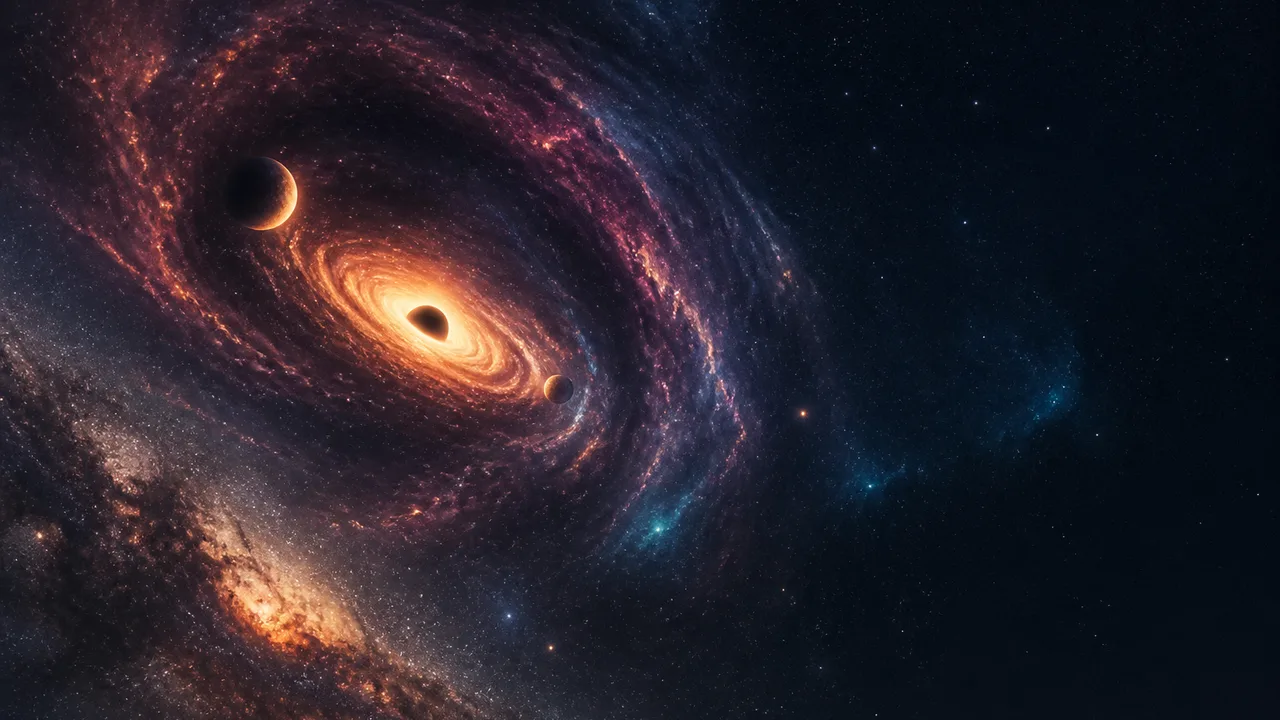
Photo: AI. Castor Belov
Every so often a conversation comes along that makes you feel genuinely small in the most delightful way. This StarTalk episode — Neil deGrasse Tyson, comic co-host Negin Farsad, and astrophysicist Mordecai-Mark Mac Low working through cosmic queries on planet formation — is exactly that kind of hour. 🧬
Mac Low's title at the American Museum of Natural History is simulationist, which sounds like a job description from a Philip K. Dick novel but is actually one of the most essential roles in modern astrophysics. He doesn't peer through telescopes. He doesn't fill blackboards with equations. He builds computer models of how parts of the universe behave — models derived from theoretical physics but capable of generating consequences that, as he puts it, would be "absolutely impossible to do with pencil and paper mathematics."
That framing matters. Because what unfolds over the course of the episode is essentially a tour of everything we've learned by letting computers run wild on the cosmos — and everything that still doesn't make sense.
When Galaxies Collide (Mostly, the Gas Does)
Start with something that sounds catastrophic: two galaxies smashing into each other. The visual your brain serves up — billions of stars detonating in some enormous celestial pileup — is almost completely wrong.
Stars are so sparsely distributed inside galaxies that when two galaxies merge, the stars largely pass each other by, tugged gravitationally but rarely actually colliding. It's the gas that makes contact. Gas is space-filling, and when gas clouds meet, you get shockwaves, new star formation, cascades of dust lighting up across wavelengths. Two hot marshmallows thrown at each other, as Tyson helpfully offered, stick together — unlike stars, which mostly ghost right past.
The payoff: those famously weird, distorted "bug splat" galaxies catalogued by astronomer Halton Arp? They're not a different kind of galaxy. They're just galaxies mid-collision. Mac Low describes the insight: a wrecked Lexus is still a Lexus. Run the simulations forward, and bug splats become smooth, featureless elliptical galaxies — blenderized disc galaxies. "That's the origin of the elliptical galaxies," Mac Low says. "Every galaxy in the universe has collided with other galaxies. That's how galaxies are made."
The Brightest Objects in the Universe Are Powered by Black Holes
Here's a cosmic paradox that should break your brain a little: black holes — defined by the fact that nothing escapes them — are responsible for the brightest objects in the known universe.
The mechanism is indirect but elegant. When gas falls toward a supermassive black hole at the center of a galaxy, there's more of it than the black hole can swallow at once. So it piles up, gets compressed, gets hot, and — because radiation output scales with the fourth power of temperature — starts blasting energy across the electromagnetic spectrum. These active galactic nuclei, or AGN, are what we see as quasars at their most extreme.
Our own Milky Way has a supermassive black hole at its center — Sagittarius A* — but it's been on a fairly strict diet lately. Mac Low noted that evidence exists for a significantly brighter outburst from Sagittarius A* around 5 million years ago, detectable as a shock wave still propagating out from the galactic center and first identified using the Fermi Gamma-ray Space Telescope — a finding that's been covered in detail by researchers studying what are known as the Fermi Bubbles (Newsweek). Compared to the biggest quasars, though, our black hole is genuinely outmatched: Sagittarius A* clocks in at around a million solar masses; the heavyweight quasars hit a billion. "We only have a million solar masses," Mac Low said with cheerful resignation. "The biggest quasars can be a billion solar masses. A thousand times bigger."
A Million Planets Around a Black Hole
This is the part of the episode that genuinely stopped me. Mac Low's team — including lead author Mishra, with collaborators Barry McKernan, Saavik Ford, and Vladimir Lyra among the six co-authors — recently had a paper accepted showing that standard planet formation theory, applied to the accretion disc of a supermassive black hole, produces not a handful of planets but millions of them.
The logic tracks once you hear it. Accretion discs around supermassive black holes are enormous and dust-rich. The same physics that builds planets in a protostellar disc — dust grains finding each other, sticking, accreting, fragmenting, accreting again — plays out at a vastly larger scale. The result: Jupiter-mass planets. Rocky ones. Silicate-dense, high-gravity worlds that Mac Low describes as "probably degenerate in the centers."
Life prospects? Grim. "There's a home center of the accretion disc glowing in X-rays and gamma rays," Mac Low noted. "It will provide plenty of energy, but it might not be in a form conducive to life as we know it." He called it "hostile to biology," though he left the door very slightly ajar for biology we don't know of yet.
What I find genuinely fascinating here is that this is the same theoretical machinery — planet formation physics — applied somewhere it was never designed to go, and it still works. The accretion disc is an accretion disc whether it's orbiting a star or a supermassive black hole. Scale changes; physics doesn't.
Dark Matter: The Gravity We Simulate Without Understanding
One of the more philosophically interesting segments comes when a viewer asks how Mac Low incorporates dark matter into his simulations. His answer is bracingly honest: any way he can.
Sometimes he adds particles that interact only gravitationally — phantom objects that behave like dark matter because the one thing we're confident about is that dark matter exerts gravity. Other times he simply imposes a gravitational field with the right distribution and skips particle tracking entirely. Either way, the point is that "dark matter" in these simulations is essentially a gravitational placeholder for something whose actual nature remains unknown.
What we do know: the bulk of the gravitational mass in galaxies isn't in the stars, planets, gas, or dust we can observe. All of that visible matter, as Tyson put it, "is the froth on an ocean." The dark matter distribution also isn't uniform — voids have very little, clusters have a lot, and the filaments connecting them form what cosmologists call the cosmic web. Galaxies, on this picture, are where gas has fallen into the dense dark matter clumps and lit up.
Mac Low acknowledged that without observational checks, simulations are just sandboxes. "If you didn't have observations to compare it to, you're just kind of presuming your results are real." This is the part of science communication that gets underplayed: computational astrophysics isn't a way of bypassing uncertainty. It's a way of generating hypotheses that then have to survive contact with actual data. The model and the telescope are in conversation; neither wins on its own.
The Universe Is a Mess, and That's the Point
By the end of the episode, co-host Farsad asks what feels like the obvious emotional question: does it bother them that the more they study the universe, the messier it gets? The textbook image — planets in stately orbits, everything in its proper place — keeps getting replaced by collisions, turbulence, chaos, feedback loops.
Mac Low's answer is worth sitting with. "The real majesty is that it's just a few laws of physics that generate all that chaos." The universe doesn't require a complexity of physics to match its complexity of behavior. Fluid dynamics — the same equations governing water in a pipe — governs gas in star-forming clouds, plasma in the sun, charged gas between galaxies. The rules are compact. The outcomes are wild.
That's not a consolation prize. That's the actual finding.
There's still a lot the simulations can't yet resolve — including whether large moons like Earth's are common or rare, a question Mac Low said the field simply doesn't have the computational resolution to answer yet. With over 6,000 confirmed exoplanetary systems and counting, the observational data is piling up fast, but spotting a moon around a planet that's already hard to see is another order of difficulty entirely.
The questions that remain open at the end of an episode like this are not a sign that the field is failing. They're a sign it's working — generating better questions faster than the answers arrive.
More Like This
Brian Keating on What Came Before the Big Bang
Cosmologist Brian Keating explains the multiverse, dark energy, string theory's fatal flaw, and why finding extraterrestrial wisdom matters more than finding aliens.
CERN's Particle Asymmetry: Cracking the Universe's Mysteries
Exploring CERN's recent findings on matter-antimatter asymmetry and their implications for understanding the universe.
When Math Invents Reality: Imaginary Numbers & More
Neil deGrasse Tyson explains how imaginary numbers, non-Euclidean geometry, and white holes reveal math's uncanny habit of predicting reality before we can confirm it.
Gravity's Strangest Effects, From Time to Cosmic Voids
From gravitational time dilation to the Dipole Repeller and LIGO's detections, here's what gravity actually does—and what it still can't explain.
Exploring Black Holes and Asteroids with StarTalk
Neil deGrasse Tyson delves into black holes, asteroids, and more in StarTalk's latest Cosmic Queries episode with Chuck Nice.
Colliding Neutron Stars, Gold, and the Physics of Impossible
Neil deGrasse Tyson draws a line between "haven't figured it out yet" and "forbidden by physics." That line matters more than most people realize.
Ten Discoveries That Rewired How We See Everything
From CRISPR to dark energy, ten scientific breakthroughs that didn't just change their fields — they changed what questions we're allowed to ask.
The Feynman Trick That Stumped a Math Competition
Richard Behiel's competition integral uses the Feynman trick to reach a surprisingly clean answer. Here's what the footage reveals about math, pressure, and access.