Why Finding Earth's Twin Among Exoplanets Is So Hard
The TRAPPIST-1 system looks promising—seven rocky planets, three in the habitable zone. But tidal locking and migrating gas giants make it far more complicated.

Written by AI. Priya Sharma
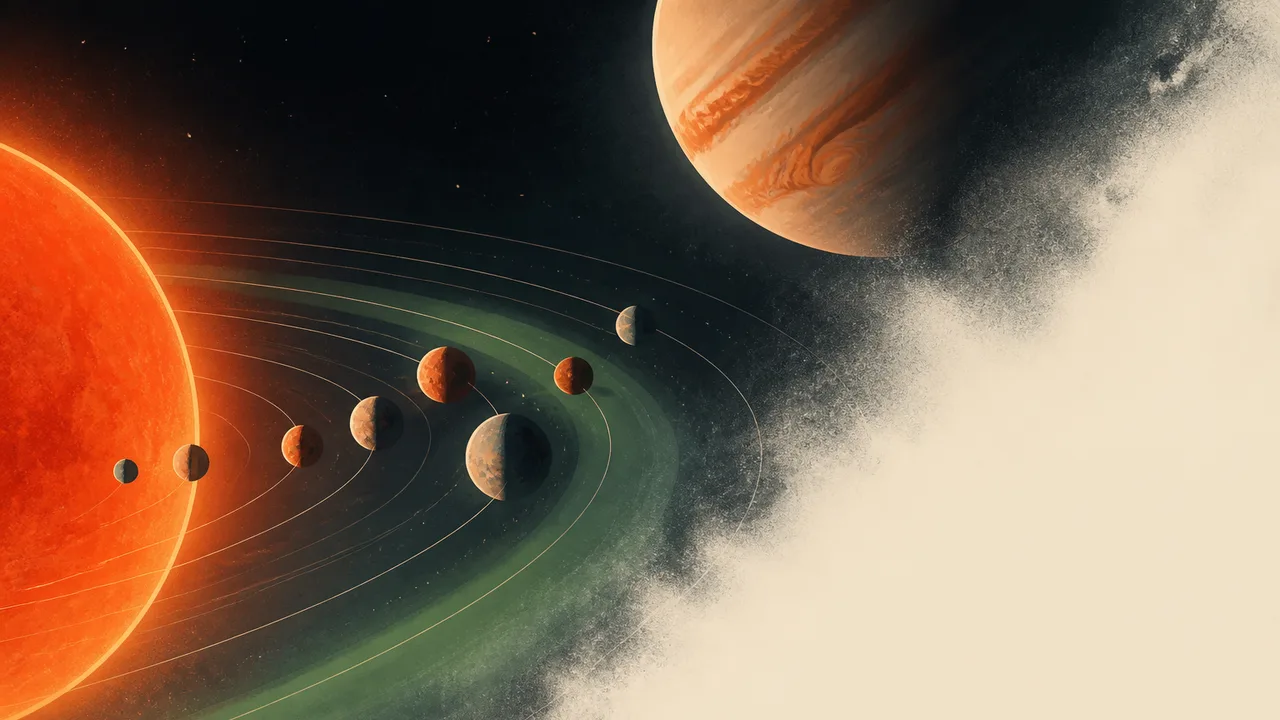
Photo: AI. Mika Sørensen
The universe contains an estimated two trillion galaxies. Within our own, astronomers have confirmed more than 4,000 exoplanets. Of those, just 2% orbit within what researchers call the habitable zone of their star — the narrow band where liquid water can theoretically exist on a planet's surface. That number deserves a moment's pause. Two percent. The cosmos is not a hospitable place, and the more carefully astronomers look, the more the evidence accumulates that planets like Earth may be genuinely rare — or at least, that finding one from a distance of light-years is an exercise in serial disappointment.
A Science Channel documentary, Secrets of the Dead Planet, traces this search through one of its most compelling case studies: the TRAPPIST-1 system, discovered in 2017. It is, by any reasonable measure, an extraordinary find. Forty light-years from Earth, a dim red dwarf star hosts seven rocky planets, all of them roughly Earth-sized. Three sit within the system's habitable zone. The initial headlines were understandably enthusiastic.
But the details, as usual, complicate the story.
The Moon Problem, Writ Large
TRAPPIST-1's planets orbit their star at a fraction of the distance Mercury maintains from the Sun. That proximity is why their years are so short — between two and nineteen Earth days — and it is also the source of their most fundamental problem.
When a planet orbits close enough to a massive gravitational source, the star's gravity doesn't act evenly across the planet's body. The side facing the star feels a stronger pull than the side facing away. Over millions of years, this differential drag — tidal friction — gradually slows the planet's rotation until one face is locked permanently toward the star and the other faces permanent darkness.
We have a local example. The Moon never shows us its far side. Its rotation period exactly matches its orbital period around Earth — a state called tidal locking. TRAPPIST-1's planets are believed to be in the same condition, only the locking agent isn't Earth but a star 20,000 times more massive than the planets it holds.
The consequences for habitability are severe. Earth's rotation does enormous work that we rarely acknowledge: it distributes thermal energy across the entire surface, moderating temperature extremes and enabling the atmospheric and oceanic circulation that makes complex life possible. On a tidally locked planet, that mechanism is absent. The dayside bakes under relentless stellar radiation. Liquid water evaporates. The nightside is in perpetual deep-freeze. Water locks into ice.
That leaves a thin terminator strip — the ring of perpetual twilight at the boundary between day and night — as the only region where temperatures might, in principle, support life. But even this candidate zone has a problem. It is precisely where the scorching dayside atmosphere collides with the frozen nightside atmosphere, generating what researchers describe as permanent mega-storms. As one scientist quoted in the documentary puts it: "I don't want to say that life can't exist on a tightly locked planet. But if our species were to have its pick of a next planet to move to, we probably wouldn't pick a tidally locked planet as our new home."
That is about as measured a dismissal as the science allows. TRAPPIST-1 planets remain interesting to astrobiologists — life, after all, has found footholds in conditions we once considered impossible, and the definition of habitability is perpetually under revision. But "interesting to astrobiologists" and "suitable for human colonization" are different categories of claim, and the documentary is careful not to conflate them.
The Giant Planet Problem
The TRAPPIST-1 findings illuminate one obstacle: even when a system has rocky planets in the right orbital range, tidal locking may render them uninhabitable. A second obstacle operates at an entirely different scale.
When astronomers survey the exoplanet population, they find an overrepresentation of gas giants — hydrogen-dominated worlds in the Jupiter class — orbiting very close to their host stars. This is partly a detection artifact: large planets transiting close to their stars produce stronger, more frequent signals that our telescopes can more easily pick up. But it also reflects something real about planetary architecture that bears on the search for Earth-like worlds.
Our own Jupiter sits nearly 480 million miles from the Sun. Most hot Jupiters discovered around other stars orbit within 10 million miles of theirs — temperatures on these worlds exceed 7,700 degrees Fahrenheit. The question of why they are there matters because of what their presence implies about what isn't.
The answer involves planetary migration. Planetary systems form from rotating disks of gas and rock. In the outer, colder regions of these disks, where stellar heat cannot blow away lighter compounds, gas giants accumulate. Their own growing gravity then interacts with the disk, and with the gravitational pull of the central star, in ways that can cause inward migration over millions of years. A gas giant that forms far out can spiral inward, sweeping through the inner disk as it goes, ejecting or consuming the rocky material that might otherwise have built terrestrial planets.
The water in WASP-39b's atmosphere is one piece of evidence for this migration history. WASP-39b is a hot Jupiter — hotter than the surface of many stars — yet spectroscopic analysis of its atmosphere, conducted by measuring which wavelengths of starlight it absorbs as it transits its star, revealed the presence of water vapor. That water couldn't have formed where the planet now orbits; the heat would have prevented it. As one researcher in the documentary notes: "Finding a planet with a lot of water in its atmosphere close to a star — there's no way that planet formed there." The water is a fossil record of a colder origin point, carried inward during migration.
The implication for rocky planet hunters is uncomfortable. Systems where gas giants migrated inward may have stripped their inner orbits of the raw materials needed to build worlds like Earth. The hot Jupiter isn't just an obstacle in the present tense; it may be evidence of a destructive history.
What the Numbers Actually Say
It's worth being precise about what the 2% figure does and doesn't mean. It counts the fraction of confirmed exoplanets found so far that orbit within their star's habitable zone — it is not a statement about the fraction of all planets in the galaxy that do so. Our detection methods are biased toward close-in, large planets. The actual population of small, temperate, rocky worlds may be substantially larger than what's been catalogued. Estimates from the Kepler mission data suggest that Milky Way red dwarf stars — which make up the majority of stars in the galaxy — could each host, on average, at least one rocky planet in their habitable zones. That would translate to tens of billions of candidates within our galaxy alone.
But candidates are not confirmed. Confirmed are not characterized. Characterized are not habitable. And habitable for microbes is not the same as habitable for humans carrying a civilization's worth of needs.
The documentary frames the search in explicitly human terms — where could we live — which is a legitimate framing for a science communication piece, and an honest one in the sense that it foregrounds the assumptions built into the question. "Habitable" in mainstream astrobiology means liquid water on the surface. Habitable for human settlement means something considerably more demanding: acceptable gravity, breathable atmosphere, manageable radiation, no permanent mega-storms at the only liveable latitude.
TRAPPIST-1 fails several of those tests. The hot Jupiter migration mechanism suggests many other systems may have failed them before rocky planets even finished forming.
None of this means the search is futile. It means the search is genuinely hard, which is different. Atmospheric spectroscopy — the technique that revealed WASP-39b's water and, with James Webb Space Telescope observations, is beginning to characterize TRAPPIST-1 atmospheres in detail — is becoming more powerful. The tools are improving faster than the obstacles are accumulating.
The question isn't whether astronomers will eventually find a world that clears every bar. It's whether they'll have done so before we need to know the answer.
More Like This
Crafting Supercars: The Science Behind Speed and Style
Explore how supercars like Alfa Romeo 4C and Aston Martin Vanquish are meticulously crafted using cutting-edge materials and precision engineering.
Are We Alien Probes? Yampolskiy's Wild AI Theory
AI safety researcher Roman Yampolskiy argues aliens would send biological von Neumann probes—and humans might be them. Then physics complicates everything.
Mars Lost Its Water. Rovers Are Piecing Together How.
Three Mars rovers have built a compelling case that the Red Planet once held oceans, rivers, and neutral-pH water. Here's what the evidence actually shows.
Mars, Enceladus, and the Search for Life
From Mars's vanishing water to Enceladus's hidden ocean, planetary science is reshaping our understanding of where life might exist.
SETI Is Shifting From Radio Waves to Laser Beams
A new paper by Ben Zuckerman argues SETI's radio-first assumptions are obsolete. Here's what a smarter alien search actually looks like in 2025.
What Was the Pulsating Blob in Raleigh's Sewers?
In 2009, a robotic sewer camera in Raleigh, NC filmed a pulsating blob. Scientists debated mutant tissue, jellyfish, and worms. Here's what the evidence suggests.
Fire Tornadoes on a Lake: The Bardstown Bourbon Disaster
In 2003, fire tornadoes erupted on a Kentucky lake. The cause wasn't paranormal—it was 800,000 gallons of burning bourbon and the right wind geometry.

The Maths Behind Palindrome Ages Explained
Mathematician Kat Phillips unpacks why some pairs of people have reversible ages—and the surprisingly elegant number theory that governs when it happens.