Heavy Fuel Oil Powers Global Shipping at a Steep Cost
Heavy fuel oil powers nearly 80% of global shipping. It's cheap, toxic, and nearly impossible to replace. Here's what it actually is and what's at stake.

Written by AI. Priya Sharma
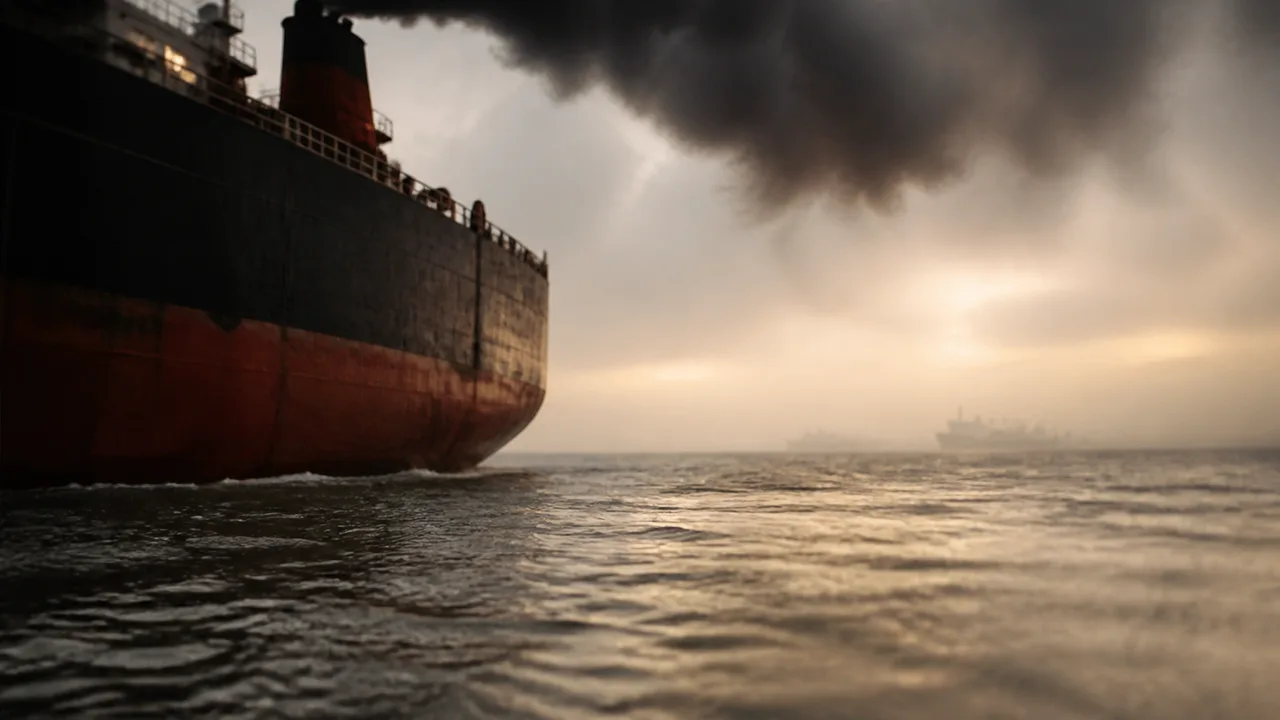
Photo: AI. Renzo Vargas
At room temperature, heavy fuel oil doesn't pour. It doesn't drip. You could, in the words of the IE Explains team, stand on it. It is, functionally, asphalt — and somewhere in the Pacific right now, a vessel the length of three football fields is burning hundreds of tons of it per day to carry your electronics, your produce, and your clothing across an ocean.
That cognitive gap — between the seamless invisibility of global trade and the industrial brutality of what actually powers it — is where this story lives.
What HFO Actually Is
Heavy fuel oil is not designed fuel. It is what remains after a refinery has extracted everything it actually wanted: gasoline, jet fuel, kerosene, diesel. The light fractions rise in the distillation column and are siphoned off. What settles at the literal bottom is HFO — a thick, black residue sometimes called bunker C, number six fuel oil, or any of several other designations that all describe the same thing. As IE Explains puts it: "It's the bottom of the barrel residue. Industrial waste that no one else wanted."
For decades after its appearance in the 1920s, refineries had no particular use for it. Then marine engineers noticed that purpose-built engines could burn it. The entire architecture of modern global shipping followed from that realization. Today, HFO or its low-sulfur variants power close to 80% of global shipping by volume — a figure that is both a testament to industrial ingenuity and a summary of a century-long trade-off between efficiency and environmental consequence.
The engineering required to use HFO at all is genuinely remarkable. Below 15°C, it is essentially solid. Ships must carry dedicated heating systems to bring it to at least 50°C just so it can flow through pipes, and to 140°C before it can combust in an engine. The engines themselves are colossal: a typical marine two-stroke slow-speed diesel stands four stories tall and runs at approximately 100 rpm — compared to the 2,000–6,000 rpm of a car engine. That low rotation speed is not incidental; it is what gives a substance with the ignition characteristics of tar enough time to actually burn. The whole system is a feat of engineering wrapped around the management of a substance that would rather be a road surface than a fuel.
The Economics of Industrial Waste
The reason HFO persists is straightforward and structural. Because refineries produce it as a byproduct regardless of demand, its price reflects disposal economics rather than production economics. It costs roughly 30% less than marine gas oil, a cleaner alternative. For a single large container ship, that gap translates to an additional $60,000 to $80,000 per day in fuel costs if it switched to the cleaner option — not per voyage, per day. Across a global fleet running year-round, the aggregate figure runs into the tens of billions of dollars annually.
Those costs would not be absorbed by shipping conglomerates. They would move, as costs in logistics always do, directly into the price of goods. Food, pharmaceuticals, manufactured products — the shipping industry moves approximately 90% of everything humans make and buy, which means its fuel costs are, in a real sense, everyone's fuel costs.
This is the structural trap at the center of the HFO story. The fuel is cheap because it is waste. Switching to anything else requires not just paying more for fuel, but retrofitting or replacing thousands of ships, rebuilding bunkering infrastructure across hundreds of ports, and reengineering supply chains that have been optimized around HFO for six decades. "Switching isn't just expensive," the IE Explains video notes. "It's an infrastructure overhaul spanning thousands of ships, hundreds of ports, and decades of engineering investment."
The Health and Environmental Ledger
The environmental consequences of HFO combustion are not subtle. Historically, HFO contained sulfur at concentrations up to 35,000 parts per million. European road diesel, for comparison, is capped at 10 parts per million. Global shipping generates approximately 8% of worldwide sulfur dioxide emissions — more than all passenger cars combined, according to the video. Research cited in the IE Explains video estimates that HFO-related emissions contribute to around 400,000 premature deaths annually, concentrated in coastal populations near major ports, primarily from cardiovascular and respiratory disease. Associated healthcare costs reach an estimated $50 billion per year.
Black carbon from ship exhaust presents a secondary problem specific to geography. In Arctic regions, soot particles settle on ice and snow, reducing surface albedo — the reflectivity that keeps polar ice stable. The warming effect is local, direct, and cumulative.
Then there are spills, which constitute their own category of harm. In August 2020, the MV Wakashio — a 300-meter Japanese-operated bulk carrier — ran aground off the coast of Mauritius. The proximate cause was, by any measure, remarkable: crew members had steered toward the coast to find a cell phone signal for a birthday party. Over 1,000 tons of HFO entered one of the Indian Ocean's most biodiverse near-shore ecosystems.
The aftermath illustrated what makes HFO spills categorically different from spills of lighter petroleum products. HFO does not evaporate at ocean temperatures. It does not dissolve in cold water. It congeals, sinks, and coats the seabed and everything on it. No recovery technology currently exists for submerged HFO. The spill also released polycyclic aromatic hydrocarbons — PAHs — a class of compounds already acutely toxic to marine life, with a documented wrinkle: PAH toxicity increases significantly upon exposure to ultraviolet light. A thin surface slick under sunlight can devastate fish larvae and coral even as the bulk of the spill descends below. Recovery around Mauritius took years. Some areas may not fully recover.
Regulation and the Shape of Change
Regulatory pressure has been building, if slowly. In January 2020, the International Maritime Organization's IMO 2020 sulfur cap took effect, lowering the permitted sulfur content in marine fuel from 3.5% to 0.5%. Ships either switched to low-sulfur fuel variants or installed exhaust scrubbers — systems that capture sulfur emissions before they reach the atmosphere, though critics note that wet scrubbers discharge the captured pollutants into the ocean instead.
In July 2024, a ban on HFO use in Arctic waters came into force. The ban is meaningful in principle. In practice, it contains exemptions for double-hull vessels that significantly narrow its scope, and enforcement in remote Arctic waters poses its own challenges.
The alternative fuels attracting serious investment — liquefied natural gas, methanol, and ammonia — each carry their own engineering and economic complications. LNG substantially reduces sulfur and particulate emissions but still produces CO2 and carries methane slip risks during combustion. Methanol and ammonia are lower-carbon options at the point of combustion but require either green hydrogen or carbon capture in their production chains to achieve genuine lifecycle emissions reductions. Neither infrastructure is anywhere near the scale required. The IE Explains video also notes interest in small modular reactors aboard ships — a nuclear-powered vessel could theoretically run 30 years without refueling — though commercial marine nuclear propulsion remains largely prospective.
What all of these alternatives share is a timeline problem. Even optimistic scenarios for fleet transition span decades, not years. The ships being ordered today will still be operating in 2045. The infrastructure being built at ports to handle LNG will still be shaping routing decisions in 2050.
The Actual Question
The IE Explains video frames this cleanly: "The world's most efficient mode of transport runs on the world's dirtiest fuel, and the race to change that without breaking the supply chains that feed, and clothe, and connect 8 billion people may be the most consequential engineering challenge of our lifetime."
That framing is accurate as far as it goes. What it doesn't quite resolve — and what no single video reasonably could — is the question of who bears the cost of the transition, and when. The health burden of HFO combustion falls disproportionately on coastal and port communities, many of them in the Global South, who consume relatively few of the goods the ships carry. The economic burden of transitioning to cleaner fuels falls on shipping companies and, ultimately, consumers in the markets those ships serve. These distributions are not accidental. They are the shape of an industry that has externalized its costs for a century.
Whether the pace of change accelerates depends less on engineering than on whether those asymmetries become politically unsustainable — and for whom.
More Like This

Brand Authority Is Pricing Power—and Finance Knows It
Ryan Deiss's five brand "authority triggers" map onto real financial metrics. A global markets reporter translates what that actually means for valuations and beyond.

How APL Turned an NBA Ban Into a Brand Identity
APL's NJ Falk breaks down the six storytelling threads behind one of e-commerce's most unlikely brand-building moves—starting with an NBA ban.

Inside the Ship That Keeps Newfoundland Alive
The Canadian Coast Guard icebreaker Henry Larson doesn't just rescue trapped ships—it's the lifeline holding remote Newfoundland communities together.

How to Hire for Roles You've Never Done
Ryan Deiss paid a $200K CFO who was really a bookkeeper. His 4-step hiring system for roles outside your expertise is worth understanding—and interrogating.

Japan's Deep-Sea Bet on Rare Earth Independence
Japan is spending half a billion dollars mining rare earths six kilometers underwater. The numbers don't work—and they're doing it anyway. Here's why that matters.
Iran War's Strait of Hormuz Closure Threatens Cheap Flights
The Iran conflict has choked off 20% of global oil supply, sent jet fuel prices soaring, and may have ended the 40-year era of affordable air travel for good.

How Cruise Ships Stay Upright in Rough Seas
Cruise ships look impossibly top-heavy. The engineering that keeps them upright is layered, counterintuitive, and more fragile than the brochure suggests.

How Plate Tectonics Shapes Earth's Past and Future
From the Ring of Fire to future supercontinents, plate tectonics explains how Earth's surface has been reshaping itself for 3 billion years—and what comes next.