Iran War's Strait of Hormuz Closure Threatens Cheap Flights
The Iran conflict has choked off 20% of global oil supply, sent jet fuel prices soaring, and may have ended the 40-year era of affordable air travel for good.

Written by AI. Jonathan Park
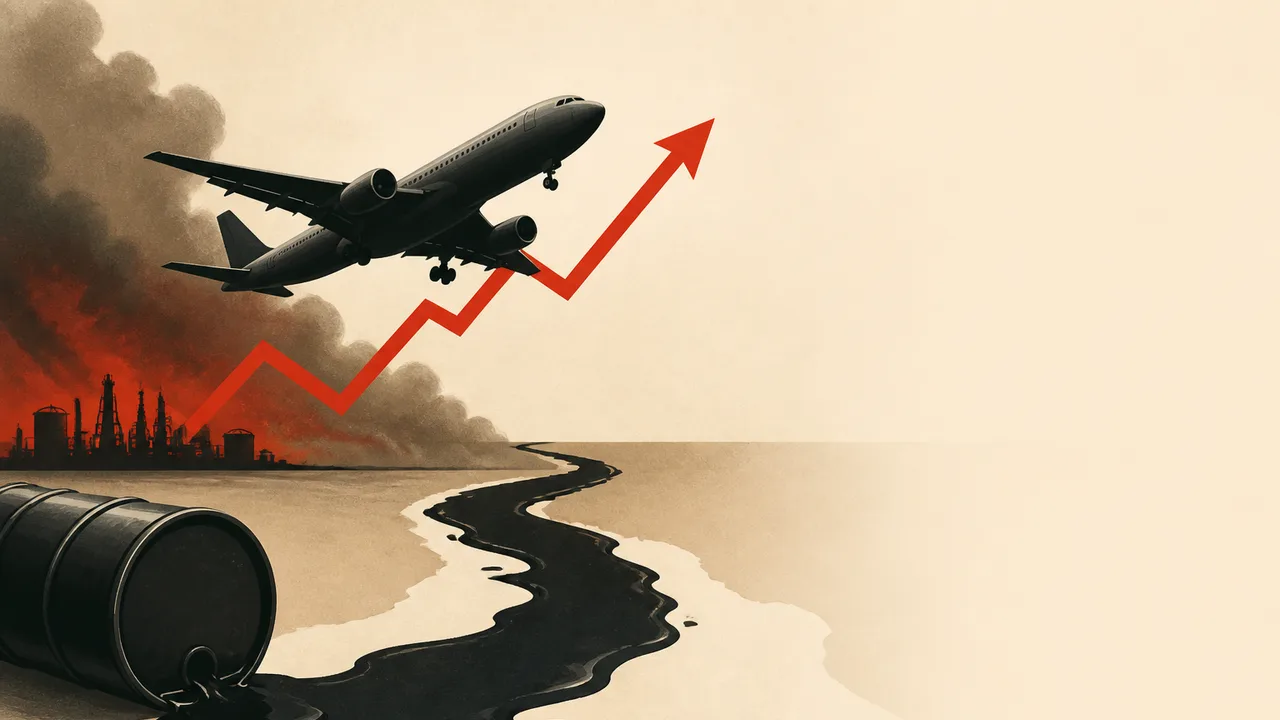
Photo: AI. Mika Sørensen
For four decades, the basic economics of flying moved in one direction: cheaper. Budget carriers undercut legacy airlines, competition opened up routes that once served only business travelers, and a round-trip ticket stopped being a financial event. That era may be ending — not because of a gradual structural shift, but because of a war.
The conflict in Iran has produced a specific, measurable chokepoint: the Strait of Hormuz, a narrow passage through which roughly 20% of global oil supply flows. With that passage closed, jet fuel prices have spiked to multi-year highs on both sides of the Atlantic. A Vox analysis published this week puts the war's running tab for the global airline industry at an additional $15 billion — and that number is still climbing.
The question worth sitting with isn't just what is happening to airfares. It's whether this crisis is accelerating a shift that was already underway, and whether airlines will use it as cover to permanently reprice flying upward.
The Fuel Math Is Brutal for Budget Carriers
Fuel is not a minor line item in airline accounting. It accounts for roughly 25% of total operating costs — which means a sustained fuel price shock hits airlines the way a rent doubling hits a restaurant with thin margins. Everyone gets squeezed, but not equally.
Delta, United, and American have structural cushions that budget carriers simply don't. Their premium cabin revenues, billion-dollar loyalty programs, and co-branded credit card partnerships generate income streams that don't move in lockstep with fuel prices. When fuel costs spike, they can absorb more of the hit before it shows up as an existential threat.
Budget carriers have no such buffer. As one analyst put it in the Vox piece: "They don't have long-haul business class to lean back on. They don't have billion-dollar-a-year loyalty programs to lean on. They don't have millions of people signing up for their credit cards every month."
Spirit Airlines illustrated this asymmetry in the starkest possible terms. The carrier, which had already navigated a failed merger attempt and mounting debt, shut down on May 2, 2026, with fuel costs cited publicly as a decisive factor in the collapse. Spirit wasn't a marginal player on a handful of routes — it was a price anchor. Wherever Spirit flew, fares fell. The mechanism is straightforward: low-cost carriers create a price ceiling competitors can't easily exceed without losing passengers. When Spirit entered a market, legacy carriers adjusted. When Spirit left, they adjusted the other way.
"When a low-cost carrier comes into a specific market, those fares almost always start coming down. When they go away, the opposite happens," the Vox analysis notes. Data from routes Spirit served confirms the pattern is already playing out: fares on those routes have risen in the weeks since the shutdown.
The Pricing Question Nobody Wants to Answer Honestly
United Airlines CEO Scott Kirby has been more direct than most executives about where this is heading. He's warned publicly that ticket prices need to rise by at least 20% to offset the additional fuel burden — and disclosed that United is absorbing roughly half the cost increase internally, passing the rest to passengers.
That's an unusually candid framing. Most airline pricing communication operates in the passive voice: fares reflect market conditions, adjustments are necessary given the environment. Kirby's phrasing names the decision for what it is.
But here's the tension the Vox piece surfaces and doesn't fully resolve: even executives who frame price increases as fuel-driven responses have little incentive to reverse course if fuel prices stabilize. Airlines were already raising prices before the Iran conflict began, ending a decades-long deflationary trend in airfares. The war gave them cover to accelerate a repricing that the industry arguably wanted anyway.
"I don't think that they're going to bring down fares. I think they're 100% going to ride the wave, bank on the fact that people are going to accept that this is the new norm as we constantly keep doing, and ride the high," one analyst told Vox.
That's a prediction, not a fact — and it's worth holding as such. Airlines do respond to competition, and if fuel prices fall, low-cost entrants could eventually put downward pressure on fares again. The problem is the timeline. Spirit is gone. Other budget carriers are reportedly on the edge. The competitive landscape that made cheap flights possible took decades to build and could take years to reconstitute.
Europe's Shorter Fuse
The U.S. fuel situation is bad. Europe's is materially worse.
In April, the head of the International Energy Agency warned publicly that Europe had roughly six weeks of jet fuel remaining if the Strait of Hormuz remained closed. Emergency reserves have since been tapped, imports redirected, and fuel cargoes rerouted — buying time through approximately the end of summer.
"They're saying we're good till August," one source told Vox. "We want to prepare for the worst, but we also don't want to panic the public or our shareholders or the stock market."
That sentence is doing a lot of work. "Prepare for the worst" and "don't panic shareholders" are goals that can coexist — until they can't. European airlines face a hard deadline that U.S. carriers don't. If the Strait remains closed past summer and emergency provisions run dry, the disruption shifts from expensive to potentially operational: not just higher fares but fewer flights.
What the Deregulation History Actually Tells Us
The Vox piece correctly grounds this in the 1978 Airline Deregulation Act, which dismantled the Civil Aeronautics Board's control over routes and fares and opened the industry to competition. The results were real: flying became genuinely more democratic over the following four decades. Working- and middle-class travelers accessed routes that previously existed only for business elites and the wealthy.
That history matters because it frames what's at stake — but it also complicates easy analysis. Deregulation produced cheap flights, but it also produced a structurally fragile industry. Airlines operate on razor-thin margins even in good times. They carry enormous fixed costs. They're acutely exposed to fuel, which they can't control and can only partially hedge. The low-cost model worked when fuel was cheap and the industry was competitive. Change either variable significantly, and the model strains.
The current moment is changing both simultaneously.
Who Gets Priced Out, and Why It Matters
There's an equity dimension to this story that tends to get treated as a human-interest sidebar. It isn't. When airfares rise sharply and budget options disappear, the passengers who lose access to flying first are those who were barely inside the tent to begin with: people who flew occasionally, chose Spirit or Frontier specifically because the fare fit their budget, and have no equivalent substitute.
A 20% fare increase across the board isn't symmetric. For a business traveler whose company picks up the tab, it's noise. For someone flying home for a family emergency or a once-a-year vacation they saved for, it's a different calculation — one that might just land on "drive" or "don't go."
"There are folks that are not going to be able to fly at all with the death of Spirit," one analyst noted. That's not rhetorical. It's a description of who the budget carrier model actually served.
The industry's biggest players are structurally insulated from this in a way that should make you skeptical of their framing. When Delta or United talks about "absorbing" fuel costs and "adjusting" pricing, they're doing it from a position where their most profitable customers — business class, premium economy, frequent flyers — are the least price-sensitive. The passengers most exposed to being priced out are the ones who barely register on the revenue per seat calculations executives actually care about.
The question that keeps resurfacing in all of this, and that the Vox analysis names directly, is whether air travel is a transportation necessity or a luxury. The answer has implications for how policymakers, regulators, and the public think about the industry — but right now, nobody in a position to act on it seems to be asking it out loud.
If the Strait of Hormuz reopens, oil flows again, and fuel prices stabilize, some version of this question gets deferred. But if the conflict drags into fall and European reserves run out and another handful of budget carriers follow Spirit into bankruptcy, the question answers itself — not through policy, but through market structure.
More Like This
Bill Ackman's Art of Finding Invisible Money
Explore Bill Ackman's strategy of finding hidden value in companies, beyond standard metrics.
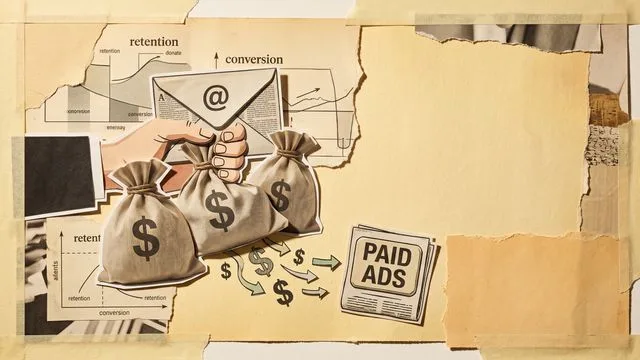
Email Isn't a Revenue Channel—It's an Ad Cost Problem
Sammy Tran argues e-commerce brands are measuring email all wrong. The real job? Making your paid ads cheaper. Here's what that actually looks like.

The World's Longest Domestic Flights, Explained
From Boston to Honolulu to Paris to Réunion, the world's longest domestic flights reveal how borders, customs zones, and sovereignty really work.

How APL Turned an NBA Ban Into a Brand Identity
APL's NJ Falk breaks down the six storytelling threads behind one of e-commerce's most unlikely brand-building moves—starting with an NBA ban.
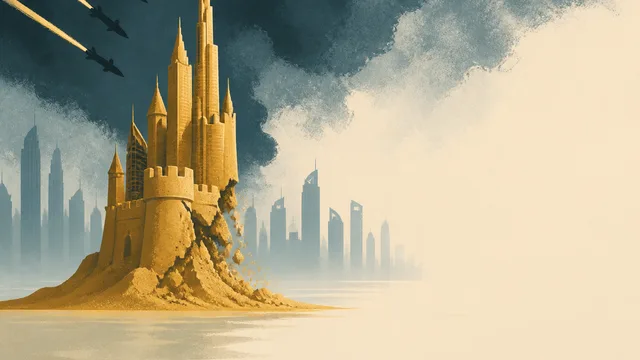
Dubai's Crisis Has a Worker Problem No One's Covering
Dubai's economic model was built on migrant labor with almost no rights. Now, with airstrikes and a blockaded strait, those workers face the worst of the fallout.
AI's Subsidy Era Is Ending—And the Real Business Begins
Token scarcity is forcing AI companies to abandon flat pricing. What happens when the era of experimentation meets the reality of infrastructure economics?

ENGO Raises €5.1M to Scale AR Sports Glasses
Grenoble startup ENGO has raised €5.1M to expand its lightweight AR glasses for athletes. Here's what the funding tells us about the wearable tech race.
China's Economy Grew 4.3% in Q2, Its Slowest Since 2022
China's Q2 2026 GDP grew just 4.3%, its weakest since the COVID lockdowns of late 2022. Here's what the numbers reveal about the structural cracks underneath.