Microbes Are Quietly Destroying World Heritage Sites
From Chaco Canyon to Angkor Wat, microbes are dissolving ancient stone, rotting wood, and flaking pigments. Here's what conservation science is doing about it.

Written by AI. Amelia Nwofor
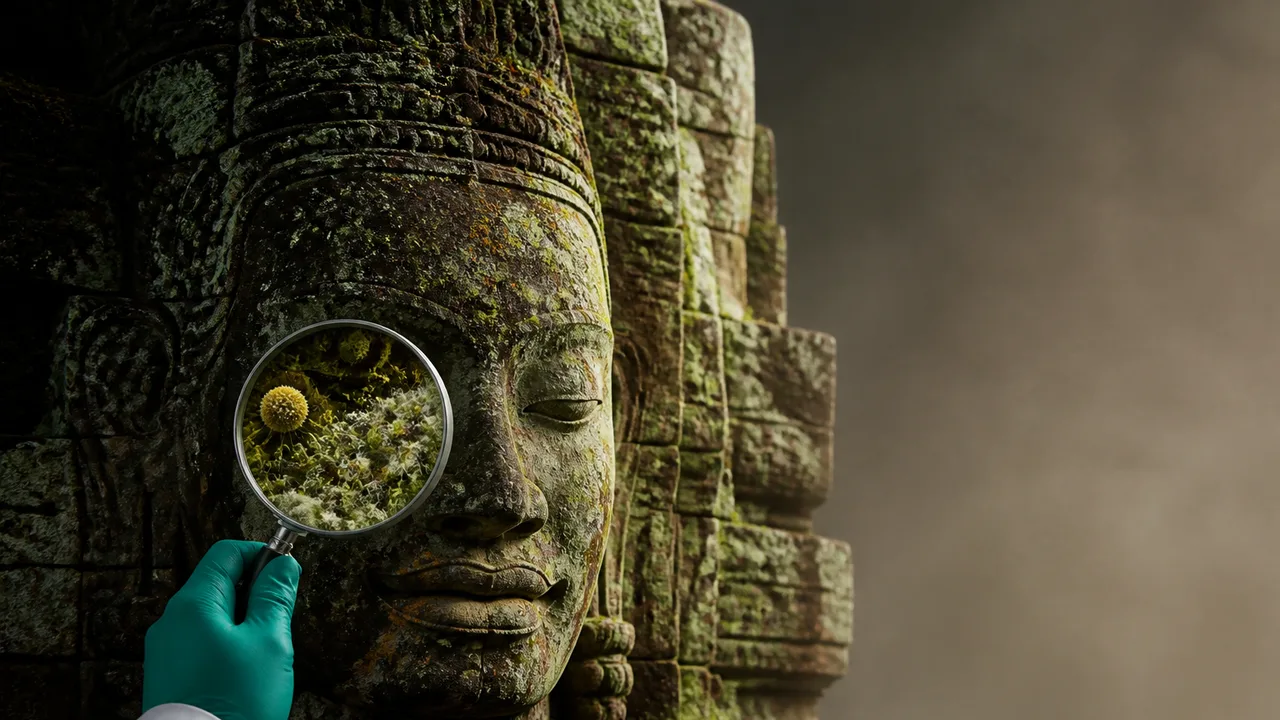
Photo: AI. Ines Cienfuegos
Roughly 1,000 UNESCO World Heritage Sites exist on paper as protected. On stone, wood, and plaster, many of them are losing a slow war to organisms you need a microscope to see.
A recent SciShow episode hosted by Savannah Geary lays out how microbes work through paintings, timber, and carved stone at sites spanning four continents. The range is striking: the Maijishan Grottoes in Gansu province, China; the wooden beams of Chaco Canyon in New Mexico; the limestone obelisks near Giza; the stone galleries of Angkor Wat. Different materials, different climates, same category of problem.
The mechanism is mundane and that's what makes it hard to stop. Microbes colonize ancient surfaces for the same reason they colonize anything: food and shelter. Tempera paint from the 4th century turns out to be a nutritionally complete substrate. As Geary explains, a cave painting's surface can contain "plant oils, egg yolk, or animal glue" in the paint layer itself, plus organic matter like straw used to smooth the wall beforehand. Bacteria and algae metabolize those compounds and excrete acids in return. Fungi extend root-like hyphae through the painting's layers and pull them apart physically. The NIH-indexed review on microbial heritage deterioration situates this precisely: bacteria, archaea, and fungi all carry biodeteriorative potential, and the review covers everything from medieval manuscripts to modern sculptures, not just ancient cave walls.
What showed up at Maijishan
The Maijishan Grottoes held paintings from the 300s CE for about 1,700 years without catastrophic loss. In 2018, white and black splotches appeared on the walls. Analysis identified a decomposing fungus dominant in the black biofilms and Cladosporium (the same mold that grows in damp bathroom grout) dominant in the white ones. Researchers aren't certain of the trigger, but the leading hypothesis involves animals sheltering from heavy rains, bringing arthropod-associated fungi inside with them. Humidity is the broader enabling factor, and climate-shifted precipitation patterns make that harder to control.
The Lascaux Caves in France offer the cautionary precedent. After rediscovery in the 1940s, visitor traffic introduced CO2, heat, and water vapor from breath. Microbes bloomed. Authorities closed the caves and spent roughly 40 years applying biocides, including antibiotics. Some microbial populations died back. The vacated ecological space was filled by a fungus that left white stains of its own. A similar cycle played out at the frescoes of St. Paul in Ephesus after disinfection attempts. Biocides operate on the microbes present, not on the conditions that invited them; new colonizers move into the cleared niche.
At Maijishan, conservators combined manual removal (soft brushes, vacuums) with targeted biocide treatment. Geary describes this as having "worked well, even though this is probably going to be an ongoing project." Ongoing means indefinitely, across limited budgets, at hundreds of sites.
Wood in a desert, and what fungi do to it
Chaco Canyon's great houses, built by ancestral Puebloan people beginning around 850 CE, survived partially because desert conditions suppress bacterial activity. Wood resists bacteria. It does not resist fungi.
Brown rot fungi attack cellulose and leave lignin behind; the wood softens and keeps its brown color. White rot fungi break down lignin too, bleaching the wood white. Soft rot looks almost identical to brown rot under the naked eye but differs at the cellular level, a distinction that matters for treatment choices. Examination of Chaco's wooden beams in the mid-2000s found both brown rot and extensive soft rot; some sections could be crushed to powder with slight hand pressure.
The conservation response at Chaco has, since the 1980s, involved reburial. Excavation exposed the beams to the moisture fungi need. Covering them back up removes that moisture. Conservationists added moisture monitors, waterproof fabric, and drainage infrastructure to keep conditions stable underground. No biocides, no replacement materials, no high-tech intervention: just controlled burial and monitoring.
"Sometimes the best option for archaeologists is to leave things alone and preserve them for the future." The logic is that current technology may be less capable than future technology, so reducing further deterioration now buys time. That's a defensible position given reburial's track record at Chaco, but it requires confidence that future intervention will actually come.
Stone is not immune
The intuition that stone is permanent doesn't survive contact with the data. A 2018 sampling campaign across Egyptian sites (tombs, obelisks, mosques, and structures at Giza) found Cladosporium and two other mold species producing black staining and physical pitting. A controlled experiment from that group applied Cladosporium to fresh stone blocks; two months later, the surface was discolored, weakened, and partially dissolved. In 2023, Megiddo was swabbed throughout the visitor route and acid-producing microbes were detected at multiple points, even without visible damage yet reported.
The ASM review on fungal biodeterioration establishes the breadth of this problem: fungi capable of degrading stone minerals are found across heritage sites globally, and their capacity to operate under low-nutrient, high-stress conditions (the extremophile end of the spectrum) means harsh environments provide less protection than expected. Limestone is particularly vulnerable because its mineral structure is soluble in the organic acids microbes produce. Salt excretion adds a second damage vector: crystallization in cracks exerts physical pressure and widens fissures over time.
For Egyptian stone, biocide testing found workable options, including synthetic antiseptics and clove oil. But the ScienceDirect review on biodeterioration of cultural monuments flags what complicates blanket treatment: moisture, temperature, humidity, and pollution interact with microbial activity in ways that vary by site and season. A biocide effective in Egypt's dry heat may perform differently in Cambodia's monsoon climate.
The protective case, and what it complicates
Angkor Wat introduces a constraint that the standard "kill the microbes" framing doesn't handle well. Scientists found that lichens on the stone buildings there appear to protect against water damage and may suppress harmful microbial competitors. Lichens are composite organisms: bacteria and algae living within a fungal matrix. Some are microscopic. Their protective function at Angkor is not universal across lichen species, and distinguishing beneficial from destructive microbial communities at a site requires the kind of detailed ecological survey that most conservation budgets don't accommodate.
More experimental is the idea of deploying beneficial microbes as active preservatives. One research group applied sulfate-eating bacteria in a gel to gypsum deposits (black, sulfate-rich crusts) at the base of Michelangelo's Rondanini Pietà. After 24 hours, the deposits were gone. The Frontiers in Microbiology review on conservation techniques positions this within a broader shift toward biological and nano-material interventions as alternatives to chemical biocides, particularly for organic artifacts where harsh chemistry creates collateral damage.
The conceptual move here is significant. Microbial communities at heritage sites aren't simply enemies to be eliminated. They are ecosystems with internal competition, predation, and chemical suppression dynamics. Some members damage stone; others crowd out the ones that do. Bacteriophages (viruses that target specific bacteria) represent another tool in early-stage research. The conservation problem, reframed this way, becomes one of ecological management rather than sterilization.
As Geary puts it: "We often talk about these sites as if they're kind of frozen in time, but in fact, they're constantly changing ecosystems."
That's the part that changes what questions conservation science is actually asking. Stopping change entirely was never a realistic goal. The question is which changes to slow, which to redirect, and which, like the lichens at Angkor, to leave in place because they're doing work we couldn't do better ourselves.
More Like This
Insects Ruled Earth for 400 Million Years Before Us
Entomologist Jessica Ware joins StarTalk to explain insect evolution, the decline of insect populations, and what happens when humans try to outsmart them.

Ancient Dogs Were Already Weird Before Victorians
A 2025 skull study of 600+ canines upends the tidy story that Victorian breeders invented dog diversity. Ancient dogs were already strange—and varied.
The Most Cited Science Papers of All Time, Ranked
From graphene to a 1951 chemistry trick, the most cited scientific papers ever aren't what you'd expect—and that tells us something important about how science actually works.
Why Onions Make You Cry: The Physics We Missed
Cornell researchers built an onion guillotine to solve the physics of why cutting onions makes you cry—and debunked a few popular kitchen hacks along the way.
Earth Microbes May Survive on the Moon's South Pole
NASA research finds common Earth microbes could survive in shadowed lunar south pole regions—raising urgent questions about contamination and planetary protection.
Ancient Pathogens That Still Live in Human Bodies
From Toxoplasma in the brain to herpes in the nerves, prehistoric pathogens still live in us. Here's what modern medicine can—and can't—do about them.

Measuring the Sun's Temperature Without Touching It
How 19th-century physicists used spectroscopy and radiation laws to calculate the Sun's temperature from Earth—no probe, no contact, no vaporized instruments required.

Could Spacetime Actually Break? The Physics of Fracture
From LIGO's gravitational wave data to Planck-scale fracture mechanics, physicists are asking what it would actually take to tear spacetime apart.