Ancient Pathogens That Still Live in Human Bodies
From Toxoplasma in the brain to herpes in the nerves, prehistoric pathogens still live in us. Here's what modern medicine can—and can't—do about them.

Written by AI. Mei Zhang
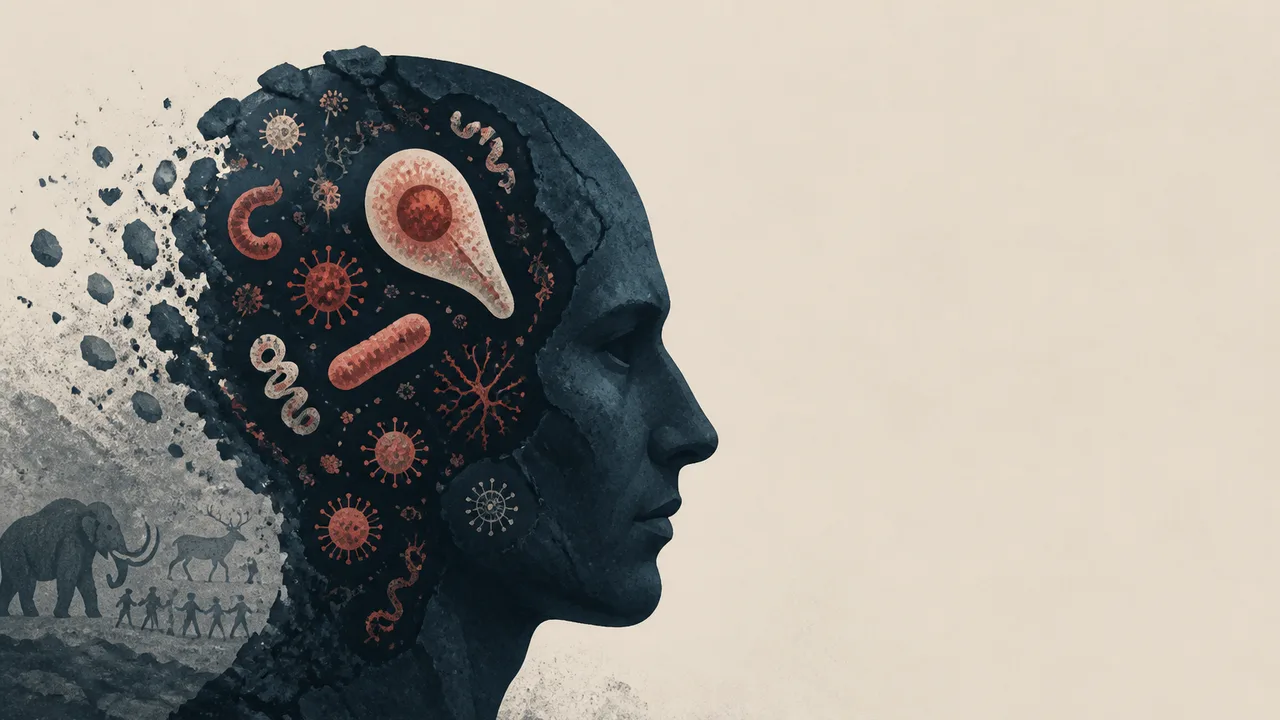
Photo: AI. Mika Sørensen
There is a parasite living in the brain tissue of somewhere between one-third and half of all adults in certain regions of the world. It has no symptoms you'd notice. It predates agriculture, language, and anatomically modern humans. And there is no drug on Earth that can remove it.
That's just number ten on the list Prehistoric Joe runs through in a recent deep-dive video — and by the time you get to number one, the cumulative picture is genuinely unsettling. Not in a doomsday way. In the way where you realize you've been thinking about infection backwards.
We tend to imagine disease as invasion: something enters, the body fights, medicine helps, the invader is expelled. Clean arc. These ten pathogens don't do that. They exploit the arc. They use our biology against our medicine so elegantly that calling it a war feels generous to our side.
The ones that hide where treatments can't follow
Toxoplasma gondii is the opener, and it sets the tone. The parasite can infect almost any warm-blooded animal but can only sexually reproduce inside cats. Everything else — including us — is, as the video puts it, "a waiting room." So Toxoplasma doesn't kill its intermediate hosts. It encysts in the brain and muscle tissue, converts to a dormant stage called a bradyzoite, and waits. Drugs can suppress the actively-dividing form during acute infection. The cysts? Untouchable. "A person diagnosed and treated is not cured," Prehistoric Joe explains. "They are stabilized."
Herpes simplex does something similar, and this is the one that genuinely got me. The visible part — the cold sore, the blister — is actually just the virus surfacing briefly. Between outbreaks, it withdraws up the nerve fiber into the trigeminal ganglion at the base of the skull, parks its genetic material inside the neuron as a closed loop, and goes almost completely quiet. Why can't we kill it there? Because nerve cells aren't replaced. The body won't destroy them — it can't afford to. The virus figured that out millions of years before we had antivirals.
This is a recurring theme: these pathogens didn't find a weakness in human defenses. They found the load-bearing walls.
The ones that aren't even alive
Wait. This one. Prion disease is where the video earns its keep.
In 1957, researchers documented kuru — a fatal neurological disease among the Fore people of Papua New Guinea. Every patient died. No bacteria, no virus, no parasite. The infectious agent survived radiation calibrated to destroy genetic material. Because it had no genetic material. Stanley Prusiner at UC San Francisco proposed in 1982 that the agent was a misfolded protein — a prion. The scientific community reacted, per the video, with "skepticism to open hostility." He got the Nobel Prize in 1997.
The thing that makes prion disease particularly hard to confront is this: the protein isn't foreign. It's yours. A normal version lives in every mammalian brain. The disease begins when one copy folds wrong and starts converting its neighbors. There's no organism to kill, no metabolism to disrupt, no replication machinery to interrupt. Every drug in modern medicine assumes a target that is doing something biological. A prion is just a shape propagating through other shapes, and there is no known way to reverse the process once it's begun.
Mortality rate: absolute. Not high. Not severe. Absolute.
The ones we made worse by getting closer
Brucellosis arrived when humans decided to domesticate animals roughly 10,000 years ago. Before that, we hunted, ate, and moved on. Then we enclosed goats and cattle and started living beside them, sleeping near them, drinking their milk unheated. Brucella crossed through that new proximity — through raw milk, through the fluids of animal birth — and it's still crossing the same way. Hundreds of thousands of new cases are recorded every year, concentrated in pastoral communities across the Mediterranean, Middle East, Central Asia, Africa, and South America.
What makes it medically stubborn is the same trick as Toxoplasma: Brucella invades macrophages — the immune cells dispatched to destroy it — and replicates inside them. Treatment requires multiple drugs in combination for six weeks or longer. Even then, relapse happens. "Relapse is not a failure of the medicine," the video notes. "It is a feature of the organism."
Schistosomiasis runs a related play, but with a structural twist that might be even more disturbing: the infection is curable. The disease is not. Praziquantel kills adult worms reliably and cheaply enough to distribute at massive scale. It does not unwind the decades of scarring that the worms' eggs left behind in liver tissue, bladder walls, and spleen. "A person cured of schistosomiasis in the strictest sense," Prehistoric Joe says, "can still die of the damage the worms finished causing years earlier." The weapon was never the worm. It was the immune system doing exactly what it was supposed to do, over and over, for years, building scar tissue around each egg that couldn't exit the body — until the organs were rebuilt from the inside out.
The malaria paragraph I can't get past 🧬
Malaria's resistance story is bleak enough — quinine, chloroquine, sulfadoxine-pyrimethamine, artemisinin-based therapies each bought time before Plasmodium evolved around them, and the interval between deployment and resistance keeps shortening. But the piece of the malaria story that genuinely stopped me is what it did to human DNA.
In 1954, British geneticist Anthony Allison demonstrated that individuals carrying a single copy of the sickle cell trait survived malarial infection at significantly higher rates than those without it. The mutation makes red blood cells a hostile environment for the parasite. So populations in high-malaria regions evolved to carry the trait in elevated frequencies — because those who lacked it died before reproducing.
The cost: two copies of the mutation produces sickle cell anemia. Blocked vessels. Organ damage. Excruciating pain crises requiring hospitalization.
A parasite rewrote human DNA to protect us from itself, and the protection came with a genetic disease attached. That's already extraordinary. Here's the part that should be in every discussion of this: sickle cell disease disproportionately affects Black communities, and for most of modern medicine's history, it was dramatically underfunded relative to its patient burden. The communities that bore the disease because their ancestors lived in malaria zones also bore the neglect of health systems that didn't prioritize finding them a cure. That's not incidental. It's the moral center of the whole malaria story.
The first CRISPR-based gene therapy approved by the FDA — Casgevy, in 2023 — targets sickle cell disease. Which means gene editing may actually be able to undo what a prehistoric parasite wrote into human genomes. Whether that therapy reaches the people who need it most, at prices they can access, is a question the biology doesn't answer. That's on us.
The ones where "too late" means something specific
Hepatitis B is the most temporally vertiginous entry. According to Prehistoric Joe's account of the research, two independent teams in 2018 reconstructed complete hepatitis B genomes from Bronze Age skeletal remains — from teeth and bones of people who died before iron tools reached most of Europe. The strains recovered sit inside the diversity of modern hepatitis B lineages. This virus has been moving with human migration for longer than recorded history exists.
The video puts the number of people currently living with chronic hepatitis B infection in the hundreds of millions — I'm attributing that figure to Prehistoric Joe's account since I haven't independently verified it against a named public health source. What's unambiguous: the chronic infection is manageable but not curable. Antivirals suppress the virus to undetectable levels. Stop the drugs and the reservoir reactivates. A vaccine exists and works brilliantly — one of the genuine wins here.
But "the vaccine arrived too late" requires a specific answer: too late for whom? Predominantly for people in sub-Saharan Africa and Southeast Asia, where decades of inadequate healthcare infrastructure meant that infection rates climbed while vaccination programs were delayed, underfunded, or unavailable. The hepatitis B vaccine has been in use since the 1980s. Chronic infection rates in high-income countries dropped. The burden concentrated where it always does.
TB follows the same pattern, harder. The video describes MDR-TB treatment accurately: two years of drugs that cause deafness and psychosis in some patients, that fail a substantial fraction of the time. XDR-TB, resistant to frontline and backup drugs both, can leave physicians with nothing but isolation to offer. What doesn't get said enough: that treatment burden falls on patients in low-income countries who are least equipped to sustain two years of a punishing drug regimen. The bacterium is ancient and global. The capacity to treat it is not.
What the record is actually telling us
The video ends with something I keep returning to. These ten pathogens are, as Prehistoric Joe frames it, the ones that persisted long enough to leave evidence — in bone, in preserved tissue, in recoverable DNA. They're the visible fraction. The plagues that swept through pre-agricultural populations, through drowned coastlines and the long-gone settlements of the Green Sahara — those emptied villages and ended lineages and disappeared entirely because no one had yet invented writing. We don't know what else was there. We only know these because they survived.
That reframing doesn't make the list more frightening. It makes it more honest about what we're actually seeing: not a complete record of ancient disease, but the ones patient enough to still be here when we finally got around to looking.
The gene editing labs working on latent viral reservoirs, the researchers modeling prion protein stabilization, the teams trying to stay ahead of artemisinin-resistant malaria — they're not fighting ancient history. They're fighting something that has had millions of years to learn the body we've had a century and a half to study.
That gap is closing. How fast is the only question worth asking.
More Like This
How Maxwell Unified Electricity and Magnetism
A compass needle twitched in 1820 and set off a chain of discoveries that now powers every wireless signal in your life. Here's the physics behind it.
Ten Surprising Biological Facts About the Human Body
From ancient viral DNA to self-digesting stomachs, these ten well-established biological facts reveal a body far stranger than most people imagine.
Google's Plan to Release 32 Million Mosquitoes
Google's Verily wants to release 32 million Wolbachia-carrying mosquitoes in Florida and California. The science is real. The questions are bigger than the video admits.
Pandemics That Brought Down Ancient Civilizations
From Cahokia to Constantinople, ancient DNA is rewriting how civilizations fell. Disease was often the hidden accelerant history forgot to record.

Total Solar Eclipse 2026 Dazzles Spain and Science
The August 12, 2026 total solar eclipse over Spain was a spectacle—and a rare scientific window into a solar mystery we still can't solve.
Black Hole Paradox: Are Reference Frames the Key?
Exploring how reference frames might resolve the black hole information paradox.
The Two Poles Theorem Solves a Geometry Puzzle
A geometry puzzle about two walls and a man's height reveals a classical theorem — and a surprising connection to teamwork math. Here's what's actually going on.
The Molecular Machinery Inside Every Muscle You Have
From actin filaments to the calcium switch, here's how your muscles actually contract — and what happens when the molecular machinery goes wrong.