Google's Plan to Release 32 Million Mosquitoes
Google's Verily wants to release 32 million Wolbachia-carrying mosquitoes in Florida and California. The science is real. The questions are bigger than the video admits.

Written by AI. Olivia Meng
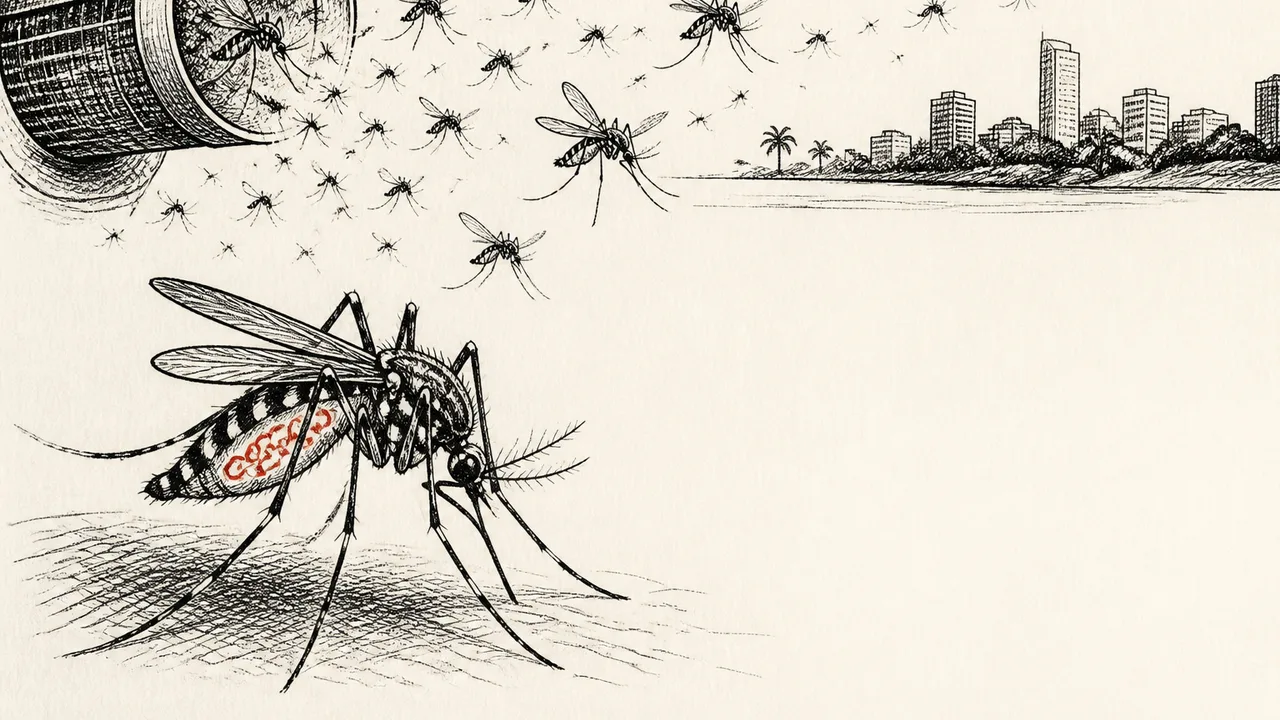
Photo: AI. Eira Pendragon
You know that smell. The fog truck rolls through around dusk, and the air goes sharp and chemical—something between a lawn care product and a mistake. You close your windows. The neighbors close theirs. In the morning, everyone acts like it didn't happen.
That truck is the premise of Google is UNLEASHING 32 MILLION Mosquitoes in California and Florida, a recent episode from The Infographics Show narrated by Josh Risser. The video opens on it like a crime scene: a decades-long public health intervention that has quietly, persistently stopped working. And then it pivots to Google's answer—32 million male mosquitoes, carrying a bacterium called Wolbachia, to be released in phases across Florida and California in 2026, pending EPA approval. Sixteen million the first year in Florida, sixteen million the second in California. Not a mass release. A prescription, administered in stages.
The science underneath this is genuinely fascinating, and the video explains it well enough. But what I kept noticing, listening to Risser's narration build and recede and build again, was how carefully the episode manages your alarm. It's doing something specific. And it's worth naming.
The Craft of the Alarm
The Infographics Show operates in a tonal register I'd describe as controlled escalation—each segment tightens the stakes before the next one offers relief. It's not fear-mongering. It's closer to the structure of a thriller that wants you to feel the danger before it hands you the antidote. The chapter titles telegraph this: "The Deadliest Animal," then "The Pesticide Paradox," then "The Digital Sniper." Fear, complication, solution.
There's a line in the middle of the episode that stopped me: "We were running as hard as we could inventing new poisons and the mosquito was running just as hard to survive."
Risser delivers it flatly, which is the right call—the line doesn't need decoration. It's doing genuine intellectual work. It's not performing urgency; it's locating the tragedy structurally. The Red Queen's hypothesis—the evolutionary arms race with no finish line—has been explained a dozen ways in popular science media, but landing it in that particular rhythm, parallel clauses, human effort against insect survival, gives it weight that a statistic alone couldn't carry. The narration earns that moment.
What it earns less cleanly is the Wolbachia pivot that follows. The bacterium is described as a kind of elegant biological judo—using the mosquito's own reproductive drive against it—and the video is right that this is a fundamentally different playbook than chemical control. But the episode moves quickly past a question it raises and doesn't quite answer: if this approach is so much smarter than the fog truck, why has it taken until 2026 to reach state-scale deployment in the U.S.? The answer involves regulatory timelines, public trust, and manufacturing constraints—all of which the video gestures toward but doesn't sit with long enough to feel honest.
What Wolbachia Actually Does
The mechanism is this: Wolbachia is a naturally occurring bacterium that lives inside roughly half of all insect species. It's not engineered, not novel, not science fiction. Verily, Google's life sciences division, raises male Aedes aegypti mosquitoes carrying a specific Wolbachia strain and releases them into neighborhoods where the local females don't carry a matching strain. When those males mate—and they mate normally, relentlessly—the resulting embryos fail. Fertilized eggs, nothing hatches. Do this at sufficient scale over enough seasons, and the local population collapses from within.
The bottleneck that kept this idea artisanal has been industrialized. For most of the history of sterile-male programs, sorting male from female mosquitoes was done by hand, which meant the approach stayed small and local. Verily's Debug project built automated computer vision systems—similar to facial recognition technology—that can sort 150,000 mosquito pupae per hour at a claimed accuracy of 99.7%. A human team in a comparable Spanish project sorted roughly 240,000 mosquitoes over an entire work week. Getting accuracy wrong isn't a rounding error; a female in the release batch means you're not suppressing the problem, you're couriering it.
The Fresno trials, run from 2017 through 2018 and published in Nature Biotechnology in 2020, showed that treated neighborhoods saw a reduction of more than 95% in biting female mosquitoes compared to untreated control areas. The study released its raw field data for independent replication—which matters, because peer-reviewed with open data is a different category of claim than a press release with a number attached. The remaining gap from 100% suppression came from females migrating in from neighboring untreated zones, which suggests the technique's main remaining adversary is geography, not biology. Treat a larger area, and the effect tightens.
The Two Camps, and the Gap Between Them
Here's where the video does something honest that deserves more attention than it gets: it acknowledges that Wolbachia-based mosquito control has already split the world into two methodological camps, and that the divide is less scientific than economic.
One approach—used by the World Mosquito Program across multiple countries—releases both male and female mosquitoes carrying Wolbachia. The bacteria spread through the population on their own, and over time, the protection becomes self-sustaining. The other approach, which is what Verily is doing and what Singapore and China have pursued, releases only sterile males. It suppresses the population through reproductive disruption, but it never becomes autonomous. You have to keep manufacturing and releasing mosquitoes, season after season, indefinitely. The video describes Singapore's program as requiring roughly two to five million male mosquitoes released every week—a figure that, if accurate, is extraordinary in its operational scale and worth sourcing before treating as settled.
The video calls this "a permanent subscription to mosquitoes." That's a good line. But it underscores an equity problem the episode raises and then steps around: the suppression approach works best in wealthy, regulated environments with stable institutional funding and the infrastructure to sustain a year-round manufacturing operation. The places where dengue does its worst work—tropical megacities, equatorial regions where sustained heat can weaken the Wolbachia effect inside the insect itself—are also the places least equipped to run this kind of program. Brazil alone, in 2024, accounted for a staggering proportion of global dengue cases; whether the Wolbachia approach can scale to that context is a genuinely open question that the video's triumphant closing doesn't quite honor.
There's also the Culex problem, which the video mentions but doesn't linger on: West Nile virus, still the deadliest mosquito-borne disease in America, is carried by Culex mosquitoes that already carry Wolbachia naturally. You can't simply introduce the bacterium. You'd need to import an incompatible strain to trigger the same reproductive collapse, and scaling that to an entire American summer is a question that belongs to a different decade's research agenda.
What the Application Actually Is
As of June 2026, Verily doesn't have regulatory approval. What it has is an EPA application, a Federal Register notice, and a public comment process—anyone can submit comments through the EPA's federal rulemaking portal under the project's assigned docket number. This is how these decisions actually get made: in public, slowly, with everyone's objections on the record.
The video handles this well. It doesn't editorialize about whether the approval should happen; it explains the mechanism by which it might. That's the right move for a science explainer, and it's worth noting because it's a choice the show doesn't always make.
What I'd have wanted—what the episode earns the right to and then steps back from—is an honest accounting of what the public comment process is up against. A century of fog trucks has trained a particular instinct: the only good mosquito is a dead one, and "releasing mosquitoes on purpose" lives in the same psychic neighborhood as "giving people smallpox on purpose." During the Fresno trials, researchers reportedly invited residents to let the male mosquitoes land on bare skin, demonstrating that males physically cannot bite. Nobody got bitten. The fear and the biology are two different conversations, and the gap between them is where this technology will either scale or stall.
Regulatory approval is necessary but not sufficient. The politics of a program that asks people to trust invisible processes—bacteria they can't see, mosquitoes they're told won't bite them, population effects that accumulate over seasons—runs directly into the attention span of a four-year election cycle. A working program can take years to show the kind of visible result that sustains public and political will. That's not a reason to dismiss Wolbachia. It's a reason to take the communication challenge as seriously as the entomology.
The fog truck is still out there. It rolls through neighborhoods that have already lost the argument with permethrin-resistant mosquitoes, coating vegetable gardens and beehives in a chemical whose main remaining function is the appearance of action. If the Verily program gets approved, and if it works at the scale of a state the way it worked in Fresno County, the truck will eventually have nothing to fog. That silence—no engine, no hiss, no sharp chemical evening air—would be the proof of concept.
Whether that silence ever reaches the cities that need it most is the harder question. And it's the one this video, for all its craft, is still working up to asking.
More Like This

Rethinking Cosmic Acceleration: A Local Illusion?
Exploring the debate on whether the universe's acceleration is a local phenomenon, challenging the concept of dark energy.

Neil deGrasse Tyson on Jupiter, AI, and Alien Humor
Neil deGrasse Tyson tackles Jupiter's magnetic core, the AI naming problem, and whether aliens laugh in StarTalk's Cosmic Queries grab bag episode.
How the Asteroid Impact Ended the Dinosaur Era
Explore the catastrophic asteroid impact that ended the dinosaurs, its immediate aftermath, and the long-term environmental changes.
Morphic Resonance: The Science Orthodoxy Tried to Burn
Rupert Sheldrake's morphic resonance theory was publicly burned by academia—while the U.S. military quietly funded similar research. Col. Morrison investigates.

Subcritical Reactors: Nuclear Power's Safety Fix?
A new generation of subcritical reactors promises to make nuclear meltdowns physically impossible. But can they deliver on cost, scale, and timeline?
R21 Malaria Vaccine: A Breakthrough With an Uncertain Future
The R21 malaria vaccine hit 73% efficacy and earned WHO approval. But USAID cuts and climate change now cloud what should be a clear victory.

Geothermal Energy's Promise and Its Real Barriers
Geothermal delivers 24/7 clean power with near-zero emissions. But drilling costs, financing gaps, and policy inertia stand between the technology and global scale.

How Air Pressure Works, From Barometers to Champagne
Neil deGrasse Tyson explains the physics of air pressure — and why understanding it matters beyond parlor tricks and party science.