Neil deGrasse Tyson on Jupiter, AI, and Alien Humor
Neil deGrasse Tyson tackles Jupiter's magnetic core, the AI naming problem, and whether aliens laugh in StarTalk's Cosmic Queries grab bag episode.

Written by AI. Amelia Nwofor
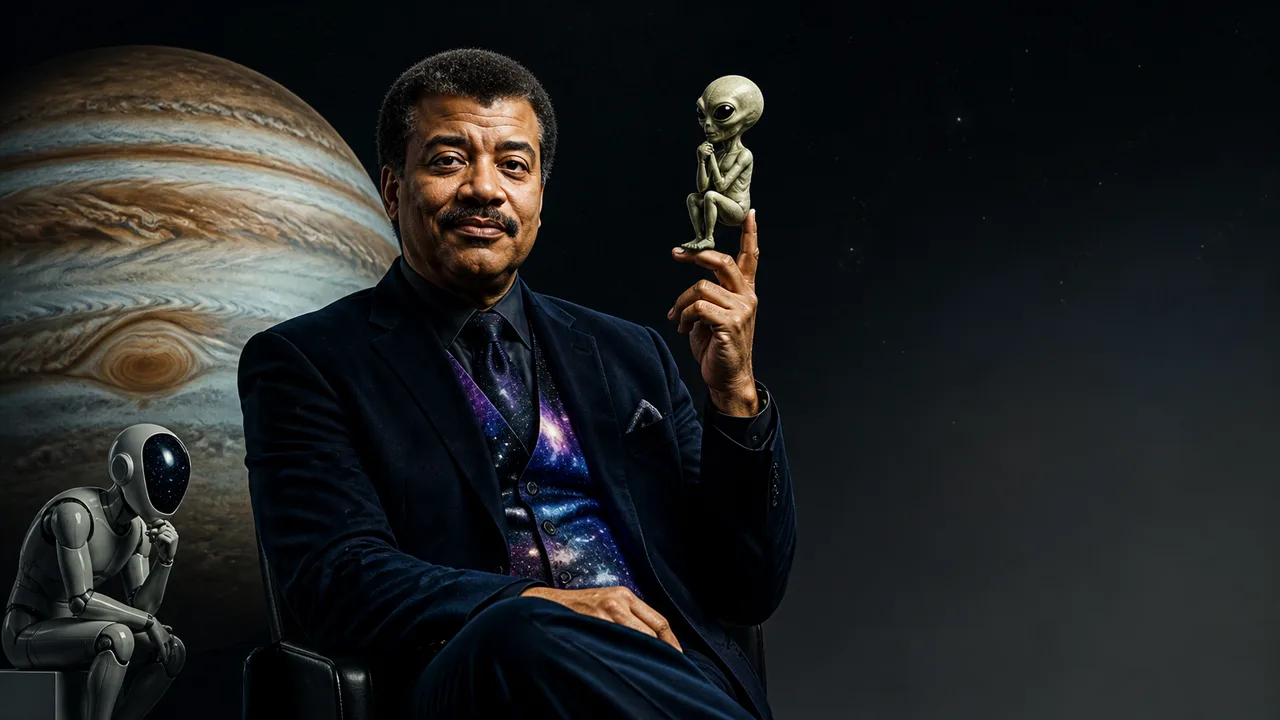
Photo: AI. Ines Cienfuegos
There is a moment in StarTalk's latest Cosmic Queries episode — number 111, a grab-bag format where fan questions arrive from every corner of the observable universe — where Neil deGrasse Tyson does something that almost no one in the mainstream AI discourse bothers to do. He asks the audience to pretend the phrase "artificial intelligence" never existed.
"All we have are computers," Tyson tells co-host Chuck Nice. "You're only thinking it's special because it's affecting you in the way computers hadn't affected you before."
What follows is a roughly fifteen-minute meditation that is, accidentally or not, a more structurally coherent argument about AI terminology than most policy papers produce. It is also a useful corrective to a conversation that has become so inflamed by branding that it has largely stopped functioning as analysis.
The episode ranges widely — from the terroir of hypothetical Martian wine to the physics of wormholes to whether cockroaches have downtime — but the AI segment is where Tyson's thinking has genuine stakes beyond entertainment.
The Naming Problem, Stated Plainly
Tyson's argument is essentially historical: computing has been encroaching on human intellectual labor since the 1950s, and at no point along that arc did anyone call it "AI" until the output started feeling uncomfortably close to things humans do with language. He traces the line from arithmetic computation to ballistic trajectory tables, from word processing to image recognition, from IBM's Deep Blue to Google's AlphaFold, and asks: why is this moment different?
His answer is that it isn't different in kind. The difference is proximity. "It's just doing more stuff," he says. "It's driving your car. It's making decisions for you. It's designing for you." The technology has reached the domains where humans feel their irreplaceability most acutely — creative work, language, judgment — and so suddenly we called it something new.
This is a useful framing, though it has limits worth naming. The argument that "it's all just computing" is technically defensible but rhetorically convenient in a way that can obscure rather than clarify. Pattern recognition at the scale of a large language model is not the same category of thing as a mortar-trajectory table, even if both run on silicon. The question of whether scale produces qualitative change — and if so, at what threshold — is precisely what makes the current debate genuinely difficult. Tyson's framing dissolves that question rather than answering it.
That said, his core distinction holds: "AI is not this monolithic danger. It's what are you doing with this computing power?"
The differentiation he draws — between AI as a pervasive, largely beneficial infrastructure and specific high-risk applications like autonomous weapons systems and launch code access — maps reasonably well onto how serious policy analysts are already trying to slice the problem. The EU AI Act, for instance, operates on a tiered risk classification system rather than treating all AI applications as equivalent. The challenge is that "it's all just computing" and "some of this is genuinely dangerous" are in tension with each other as rhetorical moves, and Tyson holds both simultaneously without fully resolving them.
What the Label Costs
The PhD student from Lisbon who submitted the question — studying AI in a design context and worried that risk discourse is crowding out academic inquiry — gets at something real. When a technology category becomes synonymous with existential threat in public conversation, the space for critical, curious, non-alarmed research contracts. Funding tilts toward safety and governance. Institutional review processes grow more cautious. Researchers working on beneficial applications face a different social environment than they did five years ago.
Tyson's response is essentially: stop letting the label do the work. If you separate out the genuinely risky applications — military targeting, autonomous weapons, infrastructure control — from the vast majority of computing applications now traveling under the AI banner, the moral panic deflates somewhat. AlphaFold's protein-folding work, which contributed to Geoffrey Hinton's Nobel Prize in 2024, becomes legible as applied computation rather than something to fear.
Whether that reframing is achievable in the current media environment is a separate question entirely. The label has market value now — for venture capitalists, for defense contractors, for regulators seeking jurisdiction, for journalists seeking readers. No one has much incentive to give it back.
The Rest of the Universe
The episode's other questions are handled with characteristic Tyson economy — dense information delivered with enough levity that the density is tolerable.
On Jupiter: Tyson's answer to the title question is that Jupiter's rotation has no measurable effect on Earth or anything else in the solar system. What stopping it would affect is Jupiter itself: its centuries-old storm systems (the Great Red Spot being the famous instance), and more significantly, its magnetic field. Jupiter's core reaches pressures high enough to force hydrogen into a metallic, electrically conductive state — what physicists call metallic hydrogen — and the rotation of that conducting mass generates the dynamo effect that produces Jupiter's magnetic field. Stop the rotation, lose the field, lose the auroras, lose the storms. "Jupiter would be like low rent at that point," Nice observes. An accurate summary.
On space telescopes: The interferometry discussion is worth the price of admission for anyone who has wondered why we don't simply build larger mirrors. The answer is that you don't have to — you can separate telescopes by vast distances, measure that separation with lasers, and combine their observations mathematically to produce an effective aperture equal to the distance between them. Earth's diameter. Earth-to-Moon. Earth-to-Earth across the solar orbit. The limiting factors are funding, maintenance, and the sobering reality that something going wrong with a James Webb-class instrument 1.5 million kilometers out is not a service call you can make.
On alien humor: Tyson makes the point that comedic timing is calibrated to human timescales — milliseconds matter — and that an intelligence operating on geological time might find the same joke but experience it differently. The Zootopia DMV sloth lands its punchline in thirty seconds of screen time and is, Tyson notes, demonstrably funny. Scale the premise, scale the timing. Whether the punchline survives is another matter.
The roach-breeding anecdote — Tyson observed captive cockroaches in graduate school, watched them clean their antennae in apparent leisure, and concluded they might have been exchanging jokes — is either the most charming scientific observation in the episode or the most elaborate justification for a questionable graduate school living situation. Possibly both.
On wormholes and the Casimir effect: A cabinet maker from Sussex proposed using the Casimir effect — a quantum phenomenon where two closely spaced parallel plates in a vacuum attract each other due to shared wave patterns — as a substitute for exotic matter to hold open an Einstein-Rosen bridge. Tyson's answer is direct: the Casimir effect attracts, it doesn't repel. You need negative mass to pry a wormhole open and keep it that way. The cabinet maker's instinct is creative; the physics doesn't cooperate.
The Taxonomy Problem Is Real
What makes the AI segment more interesting than the rest, at least from a policy vantage point, is that Tyson is wrestling with a genuine taxonomy problem that the regulatory world has not yet solved. When the same label covers AlphaFold, autonomous drone targeting systems, a pharmacy's closing-time lookup, and generative image tools, the label is not doing useful analytical work. Regulation built on that label will be correspondingly imprecise.
The EU's risk-tiered approach is one attempt to impose structure. The Biden administration's Executive Order 14110, subsequently modified under the current administration, tried another. Neither fully resolves the underlying conceptual problem that Tyson is poking at: if everything from a 1960s ballistic trajectory computer to a 2024 large language model counts as AI, then AI regulation is not really a coherent category. It's a jurisdictional claim over an enormous and heterogeneous set of technologies that happen to share a marketing term.
Tyson's proposed solution — separate the dangerous applications from the beneficial ones and regulate accordingly — is not a novel policy insight. But hearing it articulated in a format that will reach millions of people who do not read regulatory filings is not nothing.
The question worth sitting with: if the label is the problem, who has the standing and the incentive to change it?
More Like This

Anthropic Wants a Pause. Argentina Wants AI Companies.
Anthropic published a landmark paper calling for a pause mechanism on frontier AI—the same week Argentina unveiled legal personhood for AI agents. Two signals, one reckoning.
How Tech Lock-In Shapes Our Present and Future
Exploring how early tech decisions, like AI and QWERTY, still impact our daily lives.
Who Gatekeeps AI? The Question Washington Just Made Urgent
Google posted $109.9B in revenue as the White House eyes pre-release AI vetting. The real question: who controls what gets out—and who benefits from controlling it?
Are We Alien Probes? Yampolskiy's Wild AI Theory
AI safety researcher Roman Yampolskiy argues aliens would send biological von Neumann probes—and humans might be them. Then physics complicates everything.
AI Is Corrupting Your Documents—And Gen Z Knows It
New Microsoft research finds top AI models corrupt 25% of document content in long workflows. Meanwhile, Gen Z's AI skepticism might be the healthiest response in the room.
Understanding Bayesian Inference in Modern Statistics
Explore Bayesian inference, a key statistical method for integrating prior knowledge and new data in machine learning.

Hannah Cairo Disproved a 40-Year-Old Math Conjecture at 17
At 17, Hannah Cairo overturned the Mizohata-Takeuchi conjecture using a hypercube and a coin diagram. Here's what she actually did—and why it matters.

How Language Shapes Thought, According to Lera Boroditsky
Cognitive scientist Lera Boroditsky explains how the language you speak shapes memory, color perception, and thought—and what's lost when languages disappear.