Earth Microbes May Survive on the Moon's South Pole
NASA research finds common Earth microbes could survive in shadowed lunar south pole regions—raising urgent questions about contamination and planetary protection.

Written by AI. Nadia Marchetti
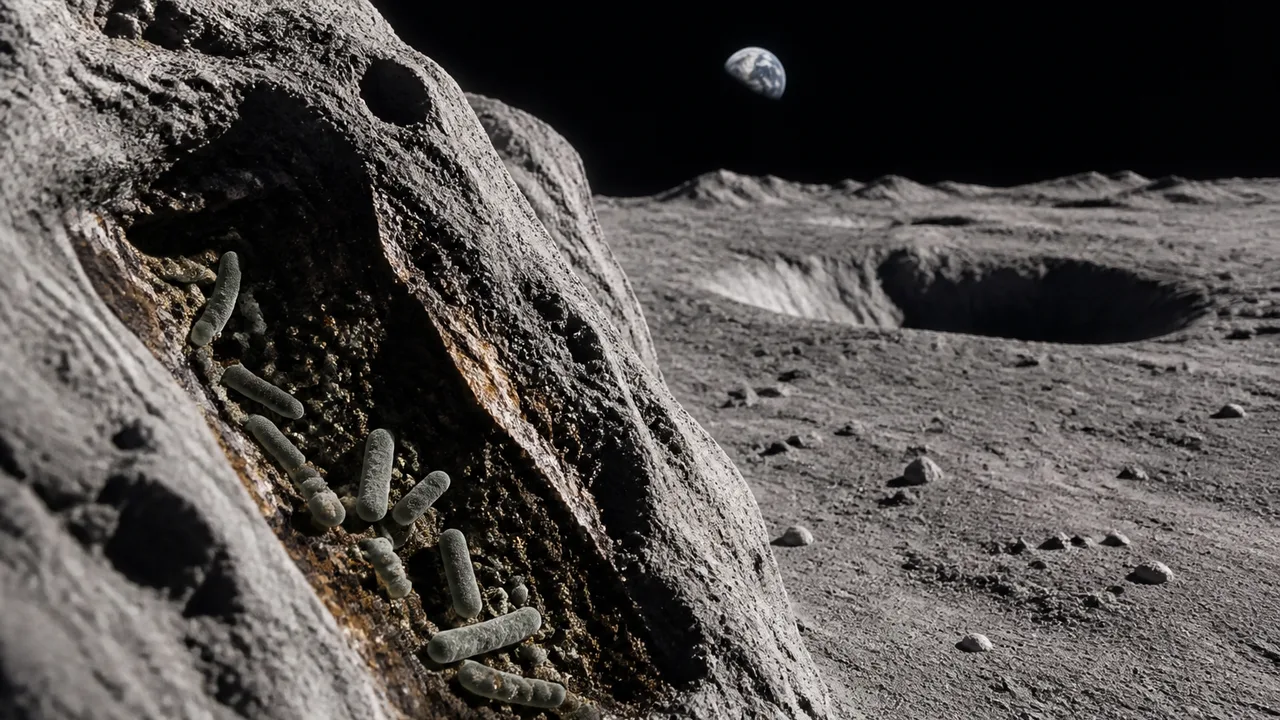
The Moon has always had a reputation as a dead place. Airless, waterless, baked by solar radiation on one side and frozen in permanent shadow on the other. We've spent decades treating it as essentially sterile—a blank canvas for exploration. That assumption just got more complicated.
A study published August 19, 2026, in Science Advances has found that some of Earth's most common microorganisms could survive in the shaded nooks and crannies of the Moon's South Pole region. According to NASA, these are microbes "likely to hitch a ride to space with human explorers"—not exotic lab-engineered extremophiles, but the kinds of organisms that live on and inside human bodies right now. Scientific American puts a finer point on it: five common microorganisms were tested, and the results present a real contamination risk for future human missions.
Let that sit for a moment. Not hypothetical alien life. Our microbes. Potentially establishing a foothold on another world, carried there on the boots and suits and skin of the explorers we send.
What the study actually found
The research focused specifically on the lunar south pole—the region that's become a prime destination for upcoming crewed missions, including NASA's Artemis program. This is not a coincidence. The south pole is scientifically interesting precisely because of its permanently shadowed regions (PSRs): craters and depressions that haven't seen direct sunlight in billions of years, and where water ice has accumulated as a result.
Those same shadowed zones, it turns out, might be survivable for Earth life.
As reported by Phys.org and corroborated by Mirage News, the key factor is shelter from the most lethal aspects of the lunar surface: ultraviolet radiation and solar wind. On open lunar terrain, the lack of atmosphere means microbes are exposed to levels of radiation that would sterilize most life quickly. But in shadows—and even in micro-scale depressions like bootprints or rover tracks—conditions shift enough that certain organisms can persist.
404 Media notes that the Moon "was long thought to be inhospitable to life," and that the regions in question are precisely those "targeted for future human exploration." The convergence of where we're going and where microbes might survive is not a comfortable one.
The cold is also worth understanding carefully here. The lunar south pole's permanently shadowed regions span a remarkable thermal range. According to UCLA's Diviner lunar radiometer data, temperatures in PSRs can range from approximately -173°C to as low as -248°C depending on crater geometry and depth—some of the coldest naturally occurring temperatures measured anywhere in the solar system. That range matters: the less extreme end of that spectrum approaches temperatures where certain cold-adapted Earth organisms can still metabolize, even if very slowly. The study's simulations presumably worked within some portion of this range, though the sources I have access to don't specify the exact parameters the researchers modeled.
The micro-niche problem
Here's where it gets conceptually interesting—and where I think the story deserves more attention than "contamination risk" headlines typically give it.
The finding isn't that the lunar south pole is generally hospitable to life. It's that micro-niches within an otherwise deadly environment can provide enough shelter for survival. A bootprint in lunar regolith isn't just a mark; it's a depression that creates shade, reduces direct radiation exposure, and slightly modifies local thermal dynamics. Space.com describes scientists finding that microbes from Earth "might survive the harsh surface of the moon" specifically through these kinds of protected zones.
This concept of micro-niches—tiny habitable islands within an otherwise lethal environment—is something astrobiologists have applied to Mars discussions for years. The idea that it now applies meaningfully to the Moon is a significant recalibration. It means we can no longer treat the Moon as a simple binary: sterile surface, nothing survives. The terrain is more textured than that, literally and biologically.
It also means that every piece of hardware we land, every human we send, every disturbed patch of regolith is potentially creating new micro-niches where hitchhiker organisms might persist longer than we'd assumed.
What this means for planetary protection
Planetary protection is the field of protocols designed to prevent Earth life from contaminating other worlds—and vice versa. It's governed internationally by the Committee on Space Research (COSPAR), and for decades the Moon occupied a relatively relaxed category in that framework. The thinking was: the Moon is so hostile that even if microbes arrived, they wouldn't survive long enough to matter.
The Science Advances findings complicate that reasoning directly. Scientific American frames this as "a big problem for NASA"—and that framing is accurate not because NASA is doing something wrong, but because it surfaces a genuine policy gap. If microbes can survive in PSR micro-niches at the south pole, and we're sending humans to the south pole, then our current sterilization and containment protocols need to be reassessed against this new evidence.
There's a scientific dimension here too, not just a contamination one. The lunar south pole's water ice is a target for study precisely because it might contain ancient records of solar system history, preserved in the cold. If we inadvertently seed that environment with Earth biology before we've had a chance to read those records, we potentially corrupt something irreplaceable. The contamination risk runs both ways: it's not just about whether our microbes survive, but about what we might overwrite.
NASA's own science portal acknowledges this directly, noting that the findings "highlight a need to better understand" the biological risks involved. That's measured language for what is, in practice, a call to revisit assumptions that have shaped mission planning for years.
The deeper question the data raises
What I keep returning to is what this means for our intuitions about "habitable" and "hostile" as categories.
The Moon gets held up as the paradigm case for a dead world—closer than Mars, more studied than anywhere except Earth itself, and thoroughly inhospitable by every standard metric. If even the Moon has pockets where Earth life can persist, it suggests that the universe may be far more permissive of biology than our default models assume. Not because the Moon is secretly hospitable, but because life—or at least microbial life—is stubbornly good at finding the margins.
That's not the same as finding life on the Moon. To be precise: this study found that Earth microbes can survive under simulated lunar south pole conditions. It says nothing about whether any life originated there, or whether any currently exists. The distinction matters enormously, and it's one that tends to get blurred in coverage of astrobiology findings.
But the finding does sharpen a question that planetary scientists have been quietly grappling with for years: if we send humans to the south pole before we've adequately characterized the biological risk, and if contamination occurs, will we ever be able to fully trust what we find there afterward?
That's not a reason to stop going. It's a reason to go carefully—and to decide now, before the boots hit the regolith, exactly what we're protecting and why.
More Like This
What Living in Antarctica Is Really Like
McMurdo Station houses 900 people, 24/7 pizza, and live music. The field camps have bucket toilets. Antarctica contains multitudes.
Mars, Enceladus, and the Search for Life
From Mars's vanishing water to Enceladus's hidden ocean, planetary science is reshaping our understanding of where life might exist.
A 1.27-Billion-Year-Old Mars Meteorite Changes Everything
A dark green Martian rock found in Algeria in 2019 just filled a 1.8-billion-year blank in Mars's geological record — and it came from a region no one knew existed.
Chang'e 7 Targets the Moon's South Pole for Water Ice
China's Chang'e 7 launches August 24 to hunt for water ice at the lunar south pole — a mission that could reshape the future of human spaceflight.
The Most Sensitive Dark Matter Detector Might Find Nothing
LUX-ZEPLIN sits a kilometer underground, waiting for dark matter. But success might look like silence—and that would tell us something huge.

Heavy Spoilers Builds an Office, Ditches the Algorithm
YouTube creator Paul from Heavy Spoilers explains why he built a garden office, changed his logo, and chose depth over views in content strategy.
Conformal Gravity: A Case Against Dark Matter
Professor Philip Mannheim argues dark matter doesn't exist—and his conformal gravity theory fits 138 galaxies without it. Here's what the evidence actually shows.
Brian Keating on What Came Before the Big Bang
Cosmologist Brian Keating explains the multiverse, dark energy, string theory's fatal flaw, and why finding extraterrestrial wisdom matters more than finding aliens.