Chang'e 7 Targets the Moon's South Pole for Water Ice
China's Chang'e 7 launches August 24 to hunt for water ice at the lunar south pole — a mission that could reshape the future of human spaceflight.

Written by AI. Olivia Meng
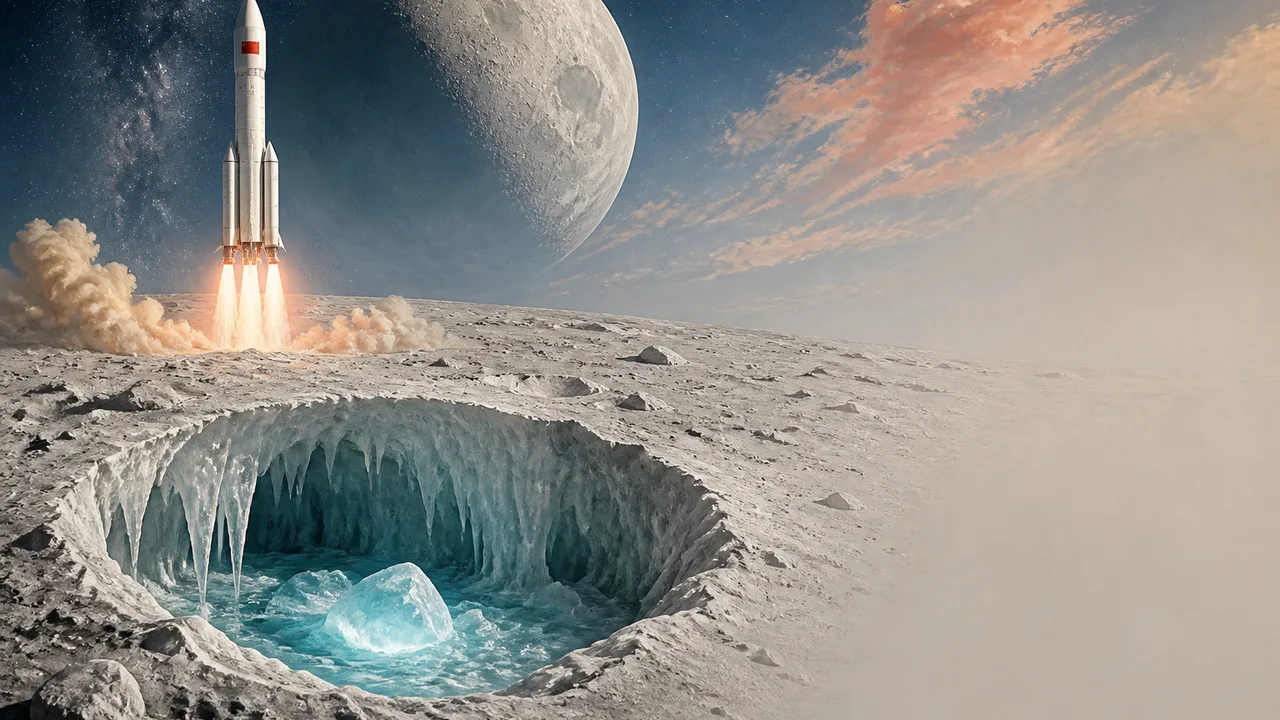
The moon's south pole is, in at least one sense, among the most valuable real estate in the inner solar system. Not for what it offers on the surface — the terrain there is punishing, shadowed craters stacked against each other across billions of years of impact history — but for what may be locked inside those shadows. Water ice, potentially ancient, preserved by temperatures that Quanta Magazine reports can plunge to around minus 170 degrees Celsius or colder in permanently shadowed regions, making them among the coldest stable environments in the inner solar system.
That ice, if accessible in useful quantities, would change the arithmetic of human spaceflight. Water means drinking water. It means oxygen. Split it with electricity and you get hydrogen — rocket propellant. The south pole of the moon could function less like a destination and more like a waystation, a place from which going deeper into the solar system becomes materially less expensive. That is the logic animating Chang'e 7, China's most complex lunar mission to date, set to launch from the Wenchang Space Launch Site on the island of Hainan on the morning of August 24 local time, according to Scientific American.
A Mission Built for the Question, Not Just the Destination
What distinguishes Chang'e 7 from its predecessors is not merely that it goes to the south pole — India's Chandrayaan-3, which SpaceNews credited as making India the fourth country to achieve a soft lunar landing, targeted the same general region in 2023. The distinction is architectural. According to Space.com, the mission will send a lander, a rover, a hopper, and a wide range of science experiments to the lunar south pole. The hopper — a small probe capable of leaping into and out of permanently shadowed craters — is the piece that matters most scientifically. No spacecraft has ever deliberately entered one of those craters. Getting direct measurements from inside a permanently shadowed region, rather than inferring conditions from orbit, would represent a genuine step-change in what we actually know versus what we reasonably suspect.
The Conversation frames the mission's purpose plainly: Chang'e 7 will attempt to determine where useful lunar resources are found near the moon's south pole and characterize their nature. That framing matters. "Characterize their nature" is doing real scientific work — detecting spectral signatures of water is one thing, understanding whether ice is accessible, how deep it sits, how pure it is, and how evenly it distributes, is another problem entirely.
The follow-on mission, Chang'e 8, is slated for a potential launch in 2028, according to The Conversation, and will move toward demonstrating how those resources might actually be used. Crewed lunar exploration in China's program follows after that. The sequencing is deliberate: characterize, then demonstrate, then inhabit. It is a methodical approach, and it reflects the structural advantage of a national program with a long planning horizon and, at least for now, consistent political backing.
Wikipedia's mission overview confirms the mission will include an orbiter, lander, rover, and the mini-hopper — a five-element stack that makes this among the more complex multi-vehicle deployments attempted in robotic lunar exploration.
The Water Question Is Not Yet Settled
It is worth being precise about what remains unknown, because the discourse around lunar water ice can slide into overstatement. Orbital data — from instruments aboard India's Chandrayaan-1, NASA's Lunar Reconnaissance Orbiter, and others — has produced consistent signals consistent with water ice in permanently shadowed craters. But "consistent with" is not the same as confirmed, accessible, or economically viable. The ice, if it exists in the quantities hoped, may be mixed with regolith in ways that make extraction difficult. It may be distributed unevenly. The permanently shadowed craters are also extraordinarily difficult environments to operate in: no solar power, extreme cold, and terrain that no prior mission has navigated from the inside.
Chang'e 7's hopper is designed to gather data that could begin resolving these uncertainties. Whether it succeeds is a genuine open question — landing at or near a shadowed crater, then deploying a hopper that survives the thermal and operational challenge of entering one, involves failure modes that are hard to simulate from Earth. China's Chang'e program has an impressive track record: Chang'e 4 was the first mission to land on the moon's far side, and Chang'e 5 returned lunar samples to Earth. But the south pole is a harder target, with steeper terrain and less forgiving conditions.
The Geopolitical Subtext
No mission of this scale exists outside a geopolitical context, and it would be evasive to pretend otherwise. The lunar south pole has become the site of an accelerating convergence of national interests. NASA's Artemis program — despite delays and budget pressures — has oriented its crewed return to the moon around the same region. The Artemis Accords, a framework for responsible lunar exploration behavior, had reached 50 signatories by 2024, according to AIP.org. China has not signed.
That absence is not merely symbolic. It reflects a genuine divergence in how the major space powers envision lunar governance. China and Russia have proposed an alternative framework — the International Lunar Research Station — which has attracted different partners and operates on different principles. The result is that the most scientifically significant piece of land in the inner solar system is being approached simultaneously by programs that are not coordinating with each other and, in the case of the U.S. and China, are actively prohibited by law from bilateral cooperation in space.
Whether that competition produces faster progress or wasteful duplication is not a question with an obvious answer. The history of the first space race suggests both are possible. Competition accelerated timelines; it also produced parallel investments that might have been more efficiently shared. The difference now is that the endgame is not a flags-and-footprints moment but a long-term infrastructure question: who establishes a sustained presence, and under what rules.
What the Hopper Is Actually Trying to Answer
Strip away the geopolitics and what you have is a genuinely interesting scientific mission. The hopper probe, as Devdiscourse reports, is among the novel elements of a mission that combines a robotic lander, rover, and hopping probe in a single integrated package. The science questions it addresses are foundational: Is the water there? In what form? At what concentrations? And — the question that everything else depends on — can it realistically be extracted and used?
Those answers will matter regardless of which flag is planted nearby. Water ice at the lunar south pole, if confirmed and accessible, is a fact about the solar system, not about any particular nation's space program. The knowledge belongs to everyone, even if the infrastructure built to exploit it will not.
China launches August 24. The permanently shadowed craters of the south pole have kept their secrets for billions of years. Whether a small hopping probe can extract a few of them in the next several months is the most interesting question in planetary science right now — and the answer will shape decisions being made in Houston, Moscow, and Beijing alike.
More Like This

Rethinking Cosmic Acceleration: A Local Illusion?
Exploring the debate on whether the universe's acceleration is a local phenomenon, challenging the concept of dark energy.

How the Asteroid Impact Ended the Dinosaur Era
Explore the catastrophic asteroid impact that ended the dinosaurs, its immediate aftermath, and the long-term environmental changes.

Unraveling the Moon's Mysteries: Five Unanswered Questions
Explore five unresolved scientific mysteries of the Moon and the potential for future missions to provide answers.

Subcritical Reactors: Nuclear Power's Safety Fix?
A new generation of subcritical reactors promises to make nuclear meltdowns physically impossible. But can they deliver on cost, scale, and timeline?

Understanding the Real Risk of Brain-Eating Amoebas
Explore the facts and myths surrounding brain-eating amoebas. How real is the threat, and can climate change affect its spread?
Starlink Satellites Are Now Scanning Earth's Atmosphere
Kyoto University researchers repurposed 1,200 Starlink satellites as an accidental atmospheric scanner. Here's what that means for science—and who controls it.

How Humidity Makes Extreme Heat Deadly
Wet bulb temperature, not air temperature, determines when heat kills. Joe Hanson's lab experiment reveals what our bodies face in a hotter, more humid world.

Google's Android Earthquake Alerts Warned Venezuela
On June 24, 2026, Venezuela had no national earthquake warning system. Google's Android alert network reached 11.4 million phones anyway. Here's what that means.