Starlink Satellites Are Now Scanning Earth's Atmosphere
Kyoto University researchers repurposed 1,200 Starlink satellites as an accidental atmospheric scanner. Here's what that means for science—and who controls it.

Written by AI. Zara Chen
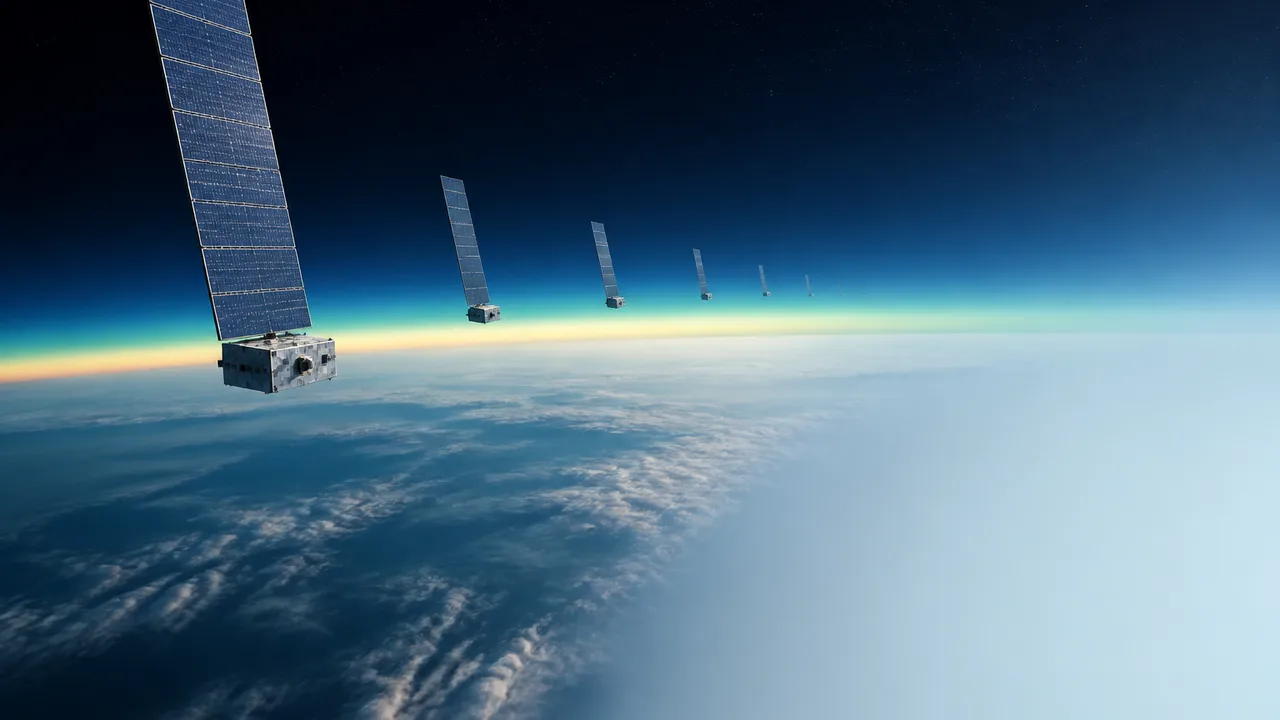
Okay so Elon Musk built a planetary-scale CT scanner by accident. That's the story. Let me explain.
Researchers at Kyoto University looked at the orbital drift data from roughly 1,200 Starlink satellites — the tiny positional wobbles that SpaceX engineers treat mostly as a navigation headache — and realized those wobbles are actually a readout of atmospheric density at about 500 kilometers above Earth. According to ScienceDaily, the team reconstructed changes in atmospheric density at that altitude with a level of coverage that was basically impossible to achieve before. And per phys.org, they did it using publicly available orbital data, then ran it through tomography — yeah, the same math that powers medical CT scanners — to build a map of that nearly invisible layer of sky. The findings are published in the journal Earth, Planets and Space.
Stop and sit with that for a second. Thousands of satellites built to sell internet subscriptions just became the most comprehensive sensor array ever deployed for upper atmospheric research, and nobody at SpaceX planned it that way. This is legitimately insane in the best possible way.
The zone they're mapping — the thermosphere, hovering around 300 miles up — has always been the most frustrating gap in Earth science. Too high for weather balloons, too low for most satellites to orbit stably for long. As Earth.com puts it, it's a layer of sky that's been hidden in plain sight: close enough that its density fluctuations affect every satellite we send up, but historically thin enough on data that scientists have had to work around it. Solar storms, geomagnetic events, even long-term climate shifts all leave fingerprints in the thermosphere — fingerprints we've never had a good way to read at planetary scale, until now.
The Kyoto team's method works because Starlink's fleet is so enormous and so precisely tracked. Each satellite's drift tells you something about the air resistance it's experiencing. One satellite doing this gives you a data point. Twelve hundred satellites doing it simultaneously, distributed across orbits that together stitch together a near-global coverage area? That's a completely different class of instrument. SciTechDaily calls it an "unexpected second purpose" — which is the polite way of saying this capability wasn't in anyone's grant proposal.
What makes the finding credible rather than just exciting: the team validated their atmospheric density maps against existing independent observations, and the results lined up. Brightcast News notes the method is highly scalable and has real potential for continuous global monitoring — and that scalability is what separates this from a clever one-off demonstration. If it works with today's Starlink fleet, it works even better as the constellation grows. SpaceX has regulatory approval for tens of thousands of satellites. The sensor network gets more powerful every time one more Starlink launches.
Applications are not abstract. Space weather — solar flares, geomagnetic storms — directly affects satellite communications, GPS accuracy, and power grids on the ground. The thermosphere is where those impacts show up first, and better real-time density maps mean better early warning. Atmospheric drag models used for collision avoidance in low Earth orbit also depend on thermospheric data; getting that data continuously and at scale is the kind of infrastructure upgrade that makes operating in an increasingly crowded orbital environment actually viable. Slashdot flagged the space safety angle specifically — this isn't just academic atmosphere science, it's load-bearing for the entire industry.
Now here's where my brain keeps snagging. All of this runs on publicly available data, which is great! But "publicly available" right now means SpaceX is choosing to publish it. There's no treaty, no regulatory requirement, no international mechanism that compels orbital transparency at the data-sharing level these researchers needed. The scientific infrastructure that just materialized around Starlink exists because SpaceX's current data policies happen to permit it — not because there's any institutional guarantee it stays that way.
That's not a critique of SpaceX specifically. It's an observation about what kind of thing we've built. When your planetary atmospheric monitoring system runs on the orbital telemetry of a commercial constellation owned by one company, the continuity of the science is entangled with the continuity of that company's data-sharing decisions. If the access gets restricted — for competitive reasons, regulatory complications, or just a policy shift — the sensor network disappears overnight. No hardware breaks. Nothing physically changes in orbit. The data just stops flowing to researchers who need it. That's a structural fragility that the elegance of the method doesn't solve.
There's also the separate, still-open question of what mega-constellations are doing to the near-space environment over time. Thousands of satellites add atmospheric drag at altitude, contribute to the growing debris problem, and complicate astronomical observations. Whether the scientific and commercial utility outweighs those costs isn't a question the Kyoto research answers — and it'd be dishonest to use this finding to argue it does. The research shows Starlink can be a powerful scientific tool. That's genuinely exciting. It doesn't resolve the larger argument about whether orbital space is being developed in ways the rest of us get meaningful input on.
What it does do — and this is actually the part worth sitting with — is crack open a different frame for thinking about commercial mega-constellations. The dominant story has been adversarial: astronomers versus Starlink, researchers versus SpaceX, public interest versus private orbit. This finding is a legitimate data point on the other side. Not a closing argument, but real evidence that the same infrastructure that's causing headaches for some scientists is generating unanticipated capabilities for others. The relationship between commercial space buildout and scientific research is weirder and more entangled than either the celebratory or the critical narratives want to admit.
Kyoto's researchers took a phenomenon that everyone else treated as noise — satellites getting nudged around by wispy air at the edge of space — and heard signal in it. That's the move. And now the question hanging over everything is whether the institutions and agreements that govern access to that signal can move as fast as the science just did.
Because the atmosphere doesn't care who owns the satellites measuring it.
More Like This

This Creator Got Shadowbanned on YouTube in 25 Days—On Purpose
A vidIQ creator deliberately shadowbanned their channel with AI-generated content to expose how YouTube's algorithm actually works. The results are wild.

Master Remote Access with Comet Pro KVM
Explore the Comet Pro KVM for seamless remote PC access: Wi-Fi 6, out-of-band management, and Tailscale security.
Starlink V3 Satellites Photographed Starship in Orbit
SpaceX used Starlink V3 satellites to image Starship's heat shield in real time during Flight 13 — and the implications go far beyond a cool photo.

Starcloud Wants to Build Data Centers in Orbit
Starcloud launched an Nvidia H100 GPU into orbit and trained an AI model in space. The physics are real. The business case depends on launch costs nobody can guarantee.
FCC Approves First Space Mirror Satellite Launch
The FCC cleared Reflect Orbital's Eärendil-1 space mirror for launch. Here's what the approval means for astronomy, connectivity, and orbital governance.
![Man in Laravel cap looking thoughtful beside phone displaying "Debounce for [301]" hashtag on pink background](https://static.buzzrag.com/articles/laravel-13-6-drops-debounceable-jobs-and-json-health-checks/thumb-5e646253.webp)
Laravel 13.6 Drops Debounceable Jobs and JSON Health Checks
Laravel 13.6 introduces debounceable jobs, JSON health check responses, and Cloudflare email support. Here's what developers need to know.
Solar Orbiter Captures First Direct View of the Sun's Poles
Solar Orbiter has captured the first direct images of the Sun's poles, revealing a chaotic magnetic field mid-reversal—and what it means for space weather forecasting.
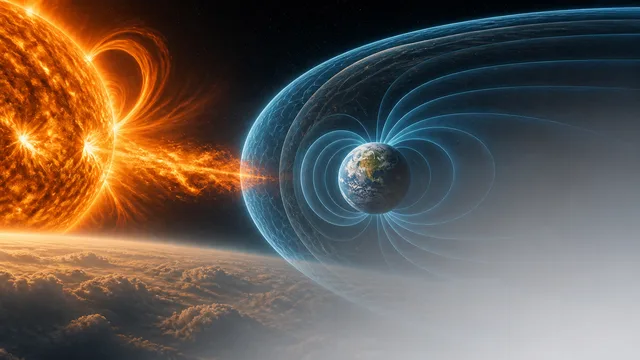
Solar Flares, Earth's Magnetosphere, and StormWall
Recent X-class solar flares and CMEs have prompted serious discussion about Earth's space weather vulnerability—and a theoretical plasma shield called StormWall.