FCC Approves First Space Mirror Satellite Launch
The FCC cleared Reflect Orbital's Eärendil-1 space mirror for launch. Here's what the approval means for astronomy, connectivity, and orbital governance.

Written by AI. Amelia Nwofor
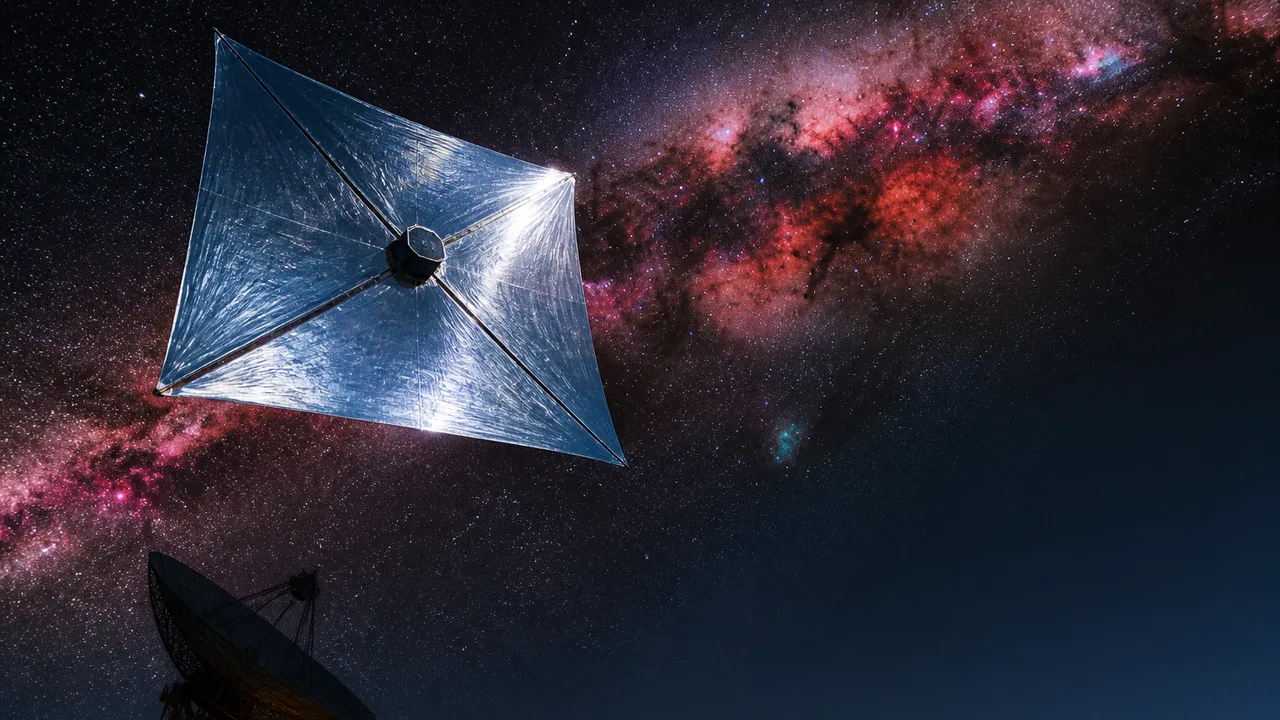
There's a star named Eärendil in Tolkien's mythology — a mariner who carries a jewel of captured starlight across the heavens as a beacon for those lost in darkness. It's a name that does a lot of work. Reflect Orbital clearly picked it carefully.
On July 9, the U.S. Federal Communications Commission formally authorized the launch of Eärendil-1, a prototype satellite developed by the California-based startup that will deploy a thin-film reflector 18 meters on a side in low Earth orbit, bouncing sunlight back down to Earth's surface, according to SpaceNews. It is, in the plainest terms, a space mirror. And it's the first of what the company envisions as a very large fleet — Space.com reports the constellation could eventually number in the tens of thousands.
Let that number settle for a moment. Tens of thousands of orbital mirrors. Each one purpose-built to redirect sunlight onto the Earth's night side.
What Reflect Orbital Is Actually Building
The pitch is, on its face, genuinely interesting. Ground-based solar infrastructure doesn't work at night. Remote communities and disaster zones frequently lose power precisely when they need it most — during extended darkness, or when terrestrial infrastructure collapses. Space-based reflectors could theoretically extend solar generation hours for ground stations, provide illumination to remote agricultural operations, and support satellite-relay infrastructure.
As Phys.org notes, the constellation is framed around enhancing global internet coverage and scientific data collection, though the details of exactly how reflected sunlight translates to those outcomes remain thin in publicly available materials. Eärendil-1 is a demonstration mission — the point is to prove the hardware works and gather data on how the reflected light behaves in practice. That's a reasonable first step. Ambitious technology programs live or die on proof-of-concept, and a single 18-meter prototype is genuinely modest compared to the scope being implied by the long-term constellation vision.
Still. The FCC granted this authorization despite concerns over how the technology could impact optical astronomy, according to The Verge. And that "despite" is doing real work in that sentence.
The Astronomy Problem Is Not Hypothetical
We've been here before — or rather, astronomers have. When SpaceX began deploying Starlink satellites, the astronomical community raised similar alarms. Those concerns turned out to be well-founded. Streaks from low-Earth orbit satellites have compromised optical telescope observations, required expensive software mitigation strategies, and generated enough documented impact that the International Astronomical Union, the American Astronomical Society, and others formalized working groups to address it.
Starlink satellites are primarily communication infrastructure. They reflect sunlight incidentally, as a byproduct of their physical existence in orbit. Eärendil-1 and its proposed siblings are designed specifically to reflect sunlight — at scale, with precision, into the night side of Earth. The difference is not subtle.
KeepTrack Space reports that astronomers have raised concerns about orbital streaking and wildlife impacts, not just scientific observation. That second point often gets lost in the telescope-access framing: artificial lighting at scale disrupts circadian biology across species. We already know this from ground-based light pollution research. The question of what happens when you add orbital reflectors to the mix — even "modest" ones — is not one that has been rigorously studied, because nothing quite like this has existed to study before.
Universe Today frames the core concern plainly: a constellation of bright reflector satellites could soon compete with the night sky. That's not hyperbole. An 18-meter aluminized film surface in LEO, at the right orbital geometry, would be visible to the naked eye. Multiply that by tens of thousands and you are, in a very literal sense, rebuilding the night sky.
The FCC's Role, and Its Limits
Here's where the governance question gets genuinely thorny. The FCC's mandate covers spectrum management and satellite communications regulation. It is the correct agency to license a satellite for launch. It is not, by design or statutory authority, the agency best positioned to weigh the cumulative environmental impact of a planned constellation of tens of thousands of reflective objects on optical astronomy, wildlife biology, or the cultural and scientific heritage represented by a dark night sky.
This isn't a critique of the FCC specifically — it's a structural observation about how space regulation works. Or doesn't, yet. The authorization of Eärendil-1 as a demonstration satellite is, legally speaking, a narrow question about whether this particular object can safely occupy a particular orbital regime without interfering with other licensed spectrum users. The FCC answered that question. It was not asked — and arguably cannot be asked, within its current authority — to answer the broader question of whether an eventual constellation of mirrors is wise.
That gap is familiar territory. The pattern with emerging space infrastructure is consistent: demonstration mission first, regulatory frameworks second (if at all), and cumulative impact assessment somewhere in the indefinite future. Starlink, OneWeb, and Amazon's Kuiper all moved faster than the governance apparatus built to assess them. Reflect Orbital is following the same playbook.
What "Minimizing Impact" Means Without Specifics
Reflect Orbital has stated its commitment to minimizing impact on astronomical observation, according to the brief. What that looks like in practice — altitude management, orientation controls, operational schedules that avoid windows critical for telescope surveys — is not yet publicly detailed for the demonstration mission, let alone for the full constellation concept.
The astronomy community's experience with Starlink offers a relevant data point. SpaceX initially offered broad commitments to work with astronomers, then deployed visor kits and orbital altitude adjustments that meaningfully — though not completely — reduced the satellites' optical brightness. The mitigation was real but arrived after hundreds of satellites were already in orbit and generating documented impact. The process was reactive, not proactive.
It would be genuinely useful to know whether Reflect Orbital has engaged with bodies like the IAU's Centre for the Protection of the Dark and Quiet Sky, or whether such engagement is planned before — not after — a full constellation filing. The public record on this, at least as visible in current sources, is quiet.
The Honest Uncertainty
The thing I keep turning over is the demonstration framing. One satellite is small. An 18-meter reflector in LEO is, in global terms, a science experiment. The FCC was probably right, within its authority, to grant the license — you need to fly hardware to learn what hardware does.
But "first demonstration launch" is also always the foot in the door. The commercial logic runs in one direction: if Eärendil-1 works, the path toward scaling is cleared. The scientific and ecological questions don't get easier to answer at scale; they get harder, and the infrastructure more entrenched.
The name Eärendil carries that beacon mythology deliberately. Light in darkness. Connectivity where none existed. There's a genuine version of this story where space-based solar reflection meaningfully extends renewable energy access to underserved communities, and I don't want to dismiss that possibility. There's also a version where the night sky — already dimmed significantly by terrestrial light pollution over the past century — gets substantially worse, and the scientific and ecological cost lands on communities and ecosystems that had no vote in the decision.
Both versions begin here, with one 18-meter mirror, newly authorized, preparing for orbit.
The question worth watching isn't whether Eärendil-1 launches successfully. It's whether anything changes between this demonstration and the filing for the next ten thousand.
More Like This
The Deeper Geometry Behind the Pythagorean Theorem
Explore why the Pythagorean Theorem appears in unexpected places, from geometry to relativity.
NASA's Artemis Program: What Returning to the Moon Actually Takes
After Artemis 2's successful circumlunar mission, NASA faces extraordinary technical and biological challenges before astronauts can land on the lunar South Pole.
SMILE Spacecraft: X-Raying Earth's Magnetic Shield
ESA and China's SMILE spacecraft launched May 2026 to image Earth's magnetosphere in X-rays—here's why that perspective shift matters for space weather science.

Why Light Beams Seem to End: Physics Explained
Discover why searchlight beams appear to stop and how physics and atmospheric conditions contribute to this phenomenon.

Donald Hoffman: Evolution Hid Reality From Us
Cognitive scientist Donald Hoffman argues on StarTalk that evolution gave us a VR headset, not a window—and the math behind Darwin backs him up.
NASA's PROMISE Rover: A Mars Machine Headed to the Moon
NASA is considering repurposing a spare nuclear-powered Mars rover called PROMISE for the lunar south pole. Here's what that plan actually involves.
Measuring the Sun's Temperature Without Touching It
How 19th-century physicists used spectroscopy and radiation laws to calculate the Sun's temperature from Earth—no probe, no contact, no vaporized instruments required.

Could Spacetime Actually Break? The Physics of Fracture
From LIGO's gravitational wave data to Planck-scale fracture mechanics, physicists are asking what it would actually take to tear spacetime apart.