Starcloud Wants to Build Data Centers in Orbit
Starcloud launched an Nvidia H100 GPU into orbit and trained an AI model in space. The physics are real. The business case depends on launch costs nobody can guarantee.

Written by AI. Bob Reynolds
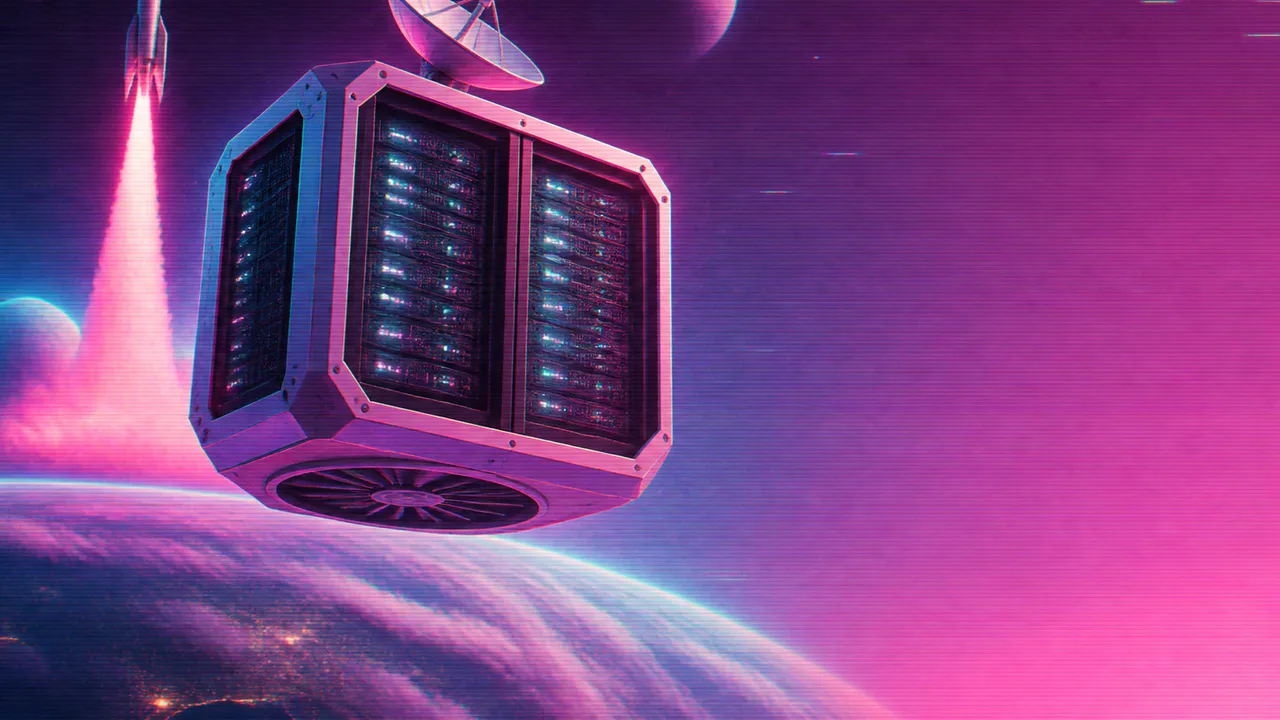
Photo: AI. Roxanne Vex
On January 1st, 2024, Philip Johnston founded a company. On January 2nd, before anyone had built a single piece of hardware, he booked a slot on a SpaceX rocket. The launch was 18 months out. He had no idea yet what would be on it.
That detail tells you almost everything about how Starcloud operates — and maybe everything about whether it will work.
Johnston, the co-founder and CEO, sat down recently for a long interview with Y Combinator's podcast, walking through the origin story, the engineering, the fundraising, and the case for why the world's AI compute eventually belongs in orbit. It's a compelling pitch. It's also one that rests on a bet most investors spent two years refusing to take.
The Math That Changed Everything
Johnston came to the idea through the back door. He'd been doing consulting work with national space agencies and noticed, consistently, that launch costs were falling. A weekend trip to Starbase, Texas — SpaceX's Starship development site — in early 2023 sharpened that observation into a conviction. He watched the scale of what was being built and ran the numbers forward: if launch costs dropped tenfold and launch capacity expanded a thousandfold, what would suddenly become economically viable?
His first answer was space-based solar power — giant orbital panels beaming energy down to Earth, a concept that dates to the 1940s. Starcloud even operated under the name Lumen Orbit for its first two months. Then someone did the transmission math carefully: you lose about 95 percent of the energy converting it from microwave beam back to usable electricity. The idea collapsed under its own physics.
Data centers were the pivot. The key calculation was launch cost break-even: what does a kilogram to orbit need to cost before putting compute up there makes economic sense? For space-based solar, that number came out around $50 per kilogram — far below anything achievable. For orbital data centers, Johnston says the break-even sits at roughly $500 per kilogram. That number is still below current Falcon 9 rideshare pricing, but it's within the range that Starship, if it delivers on SpaceX's promises, could plausibly reach.
I find the $500/kg break-even figure the most important number in Starcloud's entire story, and also the most exposed. It's a calculated estimate from a motivated party, not an independently audited threshold. If Starship's economics land at $600/kg rather than $400/kg, the whole model breathes differently. Johnston acknowledges this openly — "lots of things need to go right with the Starship program" — which is either admirable honesty or a tell, depending on your tolerance for dependency on someone else's rocket program.
Getting an H100 Into Orbit Without Killing It
Thermal management in a vacuum and radiation hardening of consumer-grade chips — those are the two problems Starcloud's engineering team split itself down the middle to solve.
The vacuum problem is counterintuitive. Space feels cold, and it is, but cold is only useful if you can transfer heat away from something. On Earth, air does that work. In orbit, there's no air. Heat has nowhere to go except radiation, which is slow. An Nvidia H100 GPU — the kind used in commercial AI training — runs hot enough that without active cooling it would destroy itself within minutes.
For Starcloud-1, Johnston's team landed on a solution that is either inspired or borderline insane, depending on your engineering disposition: they submerged the entire payload in phase-change material, essentially a specialized wax. When the GPU runs, the wax melts, absorbing heat. When it cools, the wax solidifies. The satellite then waits in the cold until it can run again. Johnston calls it "not a particularly scalable solution," which is an understatement — you can only run the chip in bursts, and the duty cycle is limited by how fast the wax re-solidifies. But it proved the concept. The H100 ran in space. A large language model was trained on it. That's not a marketing claim. That's a dataset.
For the next generation, they're moving to direct-to-chip liquid cooling with deployable radiators — structures that extend from the satellite body to radiate heat into space. Johnston says their radiator design achieves ten times less mass per watt of heat dissipation than the International Space Station's radiators, and roughly 500 times lower cost. The ISS comparison is, as he admits, a low bar on cost — NASA's procurement process is not known for efficiency — but the mass reduction is the harder engineering achievement and the more meaningful one.
The radiation problem required sending hardware to particle accelerators. Starcloud has run tests at Brookhaven National Lab in New York and at a cyclotron facility in Knoxville, blasting GPUs with heavy ions and high-velocity protons to simulate years of orbital exposure. One of Johnston's co-founders, a SpaceX veteran who now leads much of the hardware work, apparently treats radiation exposure the way the rest of us treat long flights. The output of all this testing is granular failure-mode data — Johnston claims Starcloud now has the world's most complete picture of exactly where an H100, H200, and B200 break under orbital radiation conditions. That particular kind of knowledge doesn't show up in any product spec sheet. It gets built by doing the unglamorous work of blasting chips and logging what dies first.
The component philosophy mirrors SpaceX's own approach: skip the expensive space-grade certified parts, use automotive-grade off-the-shelf components, and do your own radiation testing to know which ones survive. It's cheaper, faster, and generates proprietary data that certified parts suppliers have never bothered to collect.
100 No's and a Forcing Function
Johnston tried to raise $2 million on a simple funding note — essentially a promise of equity at a future valuation — and collected approximately 100 rejections over three months. YC initially rejected the application too. The objections were consistent: the idea sounds like science fiction, and the underlying premise requires believing that a rocket program will dramatically cut launch costs on a timeline nobody can guarantee.
Those were not unreasonable objections. They're still not unreasonable. But two things shifted the investing climate. First, the software businesses that dominated the last decade of venture capital started looking structurally weaker as AI tools made the moats easier to cross. The investor attention that had flowed automatically toward software subscription businesses needed somewhere new to land. Second, and more concretely, terrestrial data centers began running into political resistance. Johnston notes that New York moved to block new data center construction — his account from the podcast, not independently confirmed here — and that similar restrictions are reportedly spreading to other states. Suddenly "too sci-fi" started competing against "impossible to permit."
The round that Benchmark led — confirmed in Starcloud's own public announcements — didn't come together cleanly. Johnston describes losing potential investors midway through because SpaceX publicly announced it was pursuing orbital computing, and investors with existing SpaceX positions had conflict-of-interest policies to navigate. The round eventually closed. By Johnston's account, what moved the needle at Benchmark was less the theory and more the team: engineers who had come from SpaceX and from companies that run the world's largest data centers, doing work that looked credible under close technical scrutiny.
Johnston's hiring philosophy matches the engineering philosophy: ruthlessly slow. Twenty engineers total, six months to make the first hire after raising, a deliberate refusal to scale headcount ahead of problems that actually need solving. In a sector where startups routinely staff up to look like companies before they've proven they can build anything, this is either discipline or it's the natural consequence of the work being too specialized to hire quickly. Probably both.
The Two Bets
Starcloud is, at its core, a compound bet. The first bet is technical: that the thermal and radiation problems are genuinely solvable at commercial scale, and that Starcloud's specific approaches — deployable radiators, radiation-tested consumer components, modified GPU architectures developed in partnership with Nvidia — will get there on cost. The second bet is infrastructural: that Starship or some combination of new launch vehicles will bring per-kilogram costs down far enough, fast enough, that the orbital economics actually clear.
The physics challenges are real and documented. Johnston doesn't pretend otherwise. What he argues — and what Starcloud-1 provides at least partial evidence for — is that the physics aren't disqualifying. They're expensive engineering problems, not theoretical impossibilities.
The launch cost dependency is the one Johnston can't engineer around. He can build the best radiator in the world and it won't matter if Starship's commercial pricing lands in the wrong range. He knows this. He says it plainly.
What's interesting is that he may not need the full thesis to work in order for Starcloud to have a real business. The nearer-term market — processing satellite imagery and sensor data on-orbit for government and military customers, delivering analyzed results rather than raw data streams — doesn't require Starship economics. It just requires satellites that work and customers with money. Starcloud has already won contracts with Defense Department entities on that basis.
The 88,000-satellite constellation and 20 gigawatts of orbital compute capacity are further out, contingent on launch economics that don't yet exist. Whether that vision materializes depends on SpaceX, on regulatory environments neither company controls, and on whether the political resistance to terrestrial data centers gets worse faster than orbital deployment gets cheaper.
Johnston booked the launch before he knew what he was building. That worked once. The question for the next few years is whether the rest of the infrastructure shows up on schedule too.
More Like This
AI Frontier Breaks Open as Apple Sues OpenAI
Four major AI models dropped in seven days. Apple sued OpenAI over trade secrets. China landed an orbital booster. Here's what it all means for the compute race.
SpaceX Starship Flight 13 Sticks Its Softest Splashdown
SpaceX's Starship Flight 13 deployed 20 Starlink V3 satellites and nailed its gentlest-ever Indian Ocean splashdown. Here's what that actually means.

Alexandr Wang on AI, Vision, and Building Frontier Labs
Scale AI founder Alexandr Wang argues AI's bottleneck is adoption, not capability. Here's what his argument gets right — and what it leaves unexamined.
Starlink V3 Satellites Photographed Starship in Orbit
SpaceX used Starlink V3 satellites to image Starship's heat shield in real time during Flight 13 — and the implications go far beyond a cool photo.

Waymo's Dolgov on Why the Demo Is the Easy Part
Waymo co-CEO Dmitri Dolgov laid out seven technical lessons at Y Combinator's Startup School — a rare honest account of what it actually takes to ship physical AI.
Radiant Nuclear Wants to Ship Reactors Like Appliances
Radiant's portable 1MW microreactor aims to deliver nuclear power like a diesel generator. Here's what the factory-built thesis gets right—and what it's up against.
Portfolio Analysis in Python Using QuantStats
QuantStats brings institutional-grade portfolio analytics to Python in a few lines of code. Here's what the library actually does—and where its limits begin.

Ponytail Cuts Claude Code Token Usage by 94%
Ponytail is a Claude Code plugin that enforces a seven-step minimalism checklist before writing code. Here's what it does, how it works, and what to watch for.