Space Data Centers Face Physics Problems No Money Can Fix
Orbital data centers sound elegant until you run the numbers. Cooling, bandwidth, and economics collide with thermodynamics in ways launch costs can't solve.

Written by AI. Marcus Chen-Ramirez
When Elon Musk and Jensen Huang started publicly discussing orbital data centers, the tech world's first instinct was to dismiss it as science fiction. Then Google and Amazon quietly started circling the same idea. Then a startup called StarCloud actually launched an Nvidia Hopper GPU into space—100 times more powerful than any computer previously operated in orbit—and got it running inference successfully.
So maybe this isn't science fiction. Maybe it's just insanely difficult engineering.
Anastasi In Tech, a chip designer with a decade of experience building silicon that lives or dies by physics, walked through exactly what it would take to build a functioning 40-megawatt data center in orbit. The analysis lands somewhere between "technically possible" and "economically absurd," which is exactly where interesting problems live.
The Cooling Problem Everyone Misses
The popular misconception about space is that it's cold, so cooling should be easy. This is backwards in a way that matters. Space is cold—but vacuum is an insulator. On Earth, heat dissipates through air molecules colliding with hot surfaces, carrying energy away. Water cooling works even faster. In orbit, none of that exists. You can only radiate heat away, and radiation is hundreds of times less effective than convection.
"Everyone thinks that space is cold. That's why this problem is so dangerous," the video notes. "Your GPU doesn't care about the temperature in space. It cares whether the heat can escape silicon."
For a 40-megawatt orbital data center—modest by modern AI standards, roughly 20,000 GPUs—the math demands about 120,000 square meters of effective radiator area. That's 15 to 20 football fields of radiator wings, weighing somewhere between 400 and 800 tons. At current launch prices of $5,000 per kilogram, you're looking at $2 to $4 billion just to lift the cooling system into orbit. Even with Starship driving costs down to $500 per kilogram, that's still $200 to $400 million for radiators alone.
And that's before you account for the thermal stress. Low Earth orbit means circling the planet every 90 minutes, swinging from 120°C in direct sunlight to -170°C in shadow. That's a 300-degree temperature swing every orbit, every day, forever. Satellites handle this with multi-layer insulation and small onboard heaters, maintaining internal temperatures between 10°C and 60°C. But satellites run at a few hundred watts. Scaling that thermal management to megawatts is an unsolved problem.
Power Is Solvable, Bandwidth Isn't
Power, surprisingly, is the least insane part of the equation. In orbit, solar panels receive constant, unfiltered sunlight—at least 10 times more effective than ground-based systems. A 40-megawatt data center needs roughly 350×350 meters of solar array, about 400 tons worth. Massive, but not impossible if delivered in pieces.
The real bottleneck is getting data back to Earth. Modern AI clusters expect links pushing 1.6 terabits per second—constant, high-throughput communication between racks and users. In space, you can achieve hundreds of gigabits per second between satellites using laser communication (free-space optical communication). No atmosphere, no cables, just light.
But the moment that signal hits Earth's atmosphere, everything degrades. Clouds scatter light. Weather interferes. Atmospheric turbulence distorts the beam. Phased arrays can help—steering and focusing signals into tight beams—but you still end up with a strange mismatch: massive compute capacity in orbit feeding through narrow pipelines to the ground.
"Massive compute in orbit and very narrow pipelines down to Earth," as the analysis puts it. "And the thing is, the further from Earth you go, the worse it gets."
The Economics Don't Work Yet
Run the full calculation for a 40-megawatt orbital data center and you hit about 1,200 tons of total mass: 400 tons of compute hardware, 400 tons of radiators, 400 tons of solar panels. At $5,000 per kilogram, that's $6 billion just for launch costs. Add the actual hardware—GPUs, batteries, structural components—and you're deep into territory where even the richest hyperscalers pause.
The only reason serious people are discussing this at all is that launch costs are falling precipitously. SpaceX's internal costs are likely five times lower than public pricing. But even with Starship economics, you're still looking at costs that make ground-based data centers look cheap.
Maintenance compounds the problem. In orbit, there are no technicians, no quick fixes. Everything is designed for survival through redundancy—extra nodes sitting idle, ready to take over when something fails. Starlink already operates this way, constantly launching new satellites while old or failed ones deorbit and burn up in the atmosphere. At small satellite scale, this works. At data center scale, every upgrade is tied to a rocket launch.
The Moon Is Worse
If orbital data centers are hard, lunar data centers are harder in every dimension. Radiation on the moon is far more brutal—no magnetic field, no atmosphere, nothing between your hardware and space. Solar storms hit directly, bombarding silicon with high-energy particles that flip bits, corrupt memory, and trigger logic errors. A normal GPU might survive days, maybe a week.
This forces a retreat to radiation-hardened chips built on mature process nodes like 7 nanometer. AMD has radiation-hardened designs for some applications, but no radiation-hardened GPUs yet. You're trading cutting-edge performance for survival, using chips that cost 10 to 100 times more and run significantly slower.
Power on the moon means dealing with 29-day lunar cycles: 14 days of continuous sunlight, followed by 14 days of complete darkness. You need either massive battery storage or nuclear reactors deployed on the lunar surface. Both add mass. Mass adds launch cost. Launch cost dominates everything.
And then there's lunar dust—fine, abrasive, electrostatic particles that cling to everything, coating radiators and degrading hardware over time.
But the video suggests the biggest killer isn't heat or radiation or dust. It's physics. Specifically, the speed of light and the 1.3-second delay between Earth and moon, which fundamentally limits certain types of real-time computation.
Where This Leaves Us
The analysis doesn't end with a verdict because there isn't one yet. The physics is solvable—we have proof of concept. The economics might become solvable as launch costs continue falling. What's unclear is whether the engineering challenges resolve faster than Earth-based alternatives improve.
StarCloud has already demonstrated that GPUs can survive and function in orbit. That changes the question from "can we?" to "should we?" And "should we" depends entirely on whether watts-per-dollar math eventually favors vacuum over atmosphere.
Right now, it doesn't. But "right now" is a weak position when you're betting against falling launch costs and rising demand for compute. The moon might be a bridge too far, but low Earth orbit might not be.
The real answer probably isn't "space data centers are impossible." It's "we're still missing a breakthrough or two."
More Like This
AI's Inference Crisis: Why Sora Died Burning $15M Daily
OpenAI killed Sora after six months. The reason reveals AI's shift from training races to inference economics—and what breaks next.
Why Hackers Are Ditching Stolen Passwords for Apps
Public-facing app exploits surged 44% while credential theft dropped. IBM's new threat report reveals what's driving the shift—and why it matters.
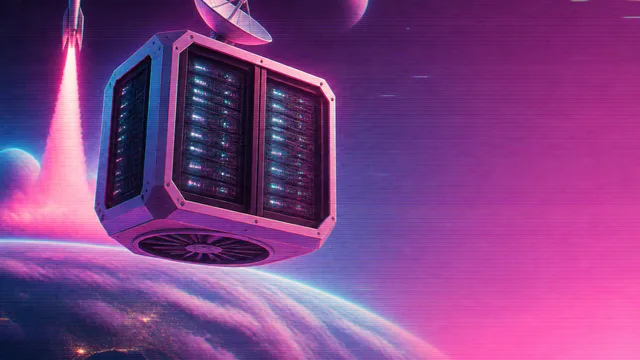
Starcloud Wants to Build Data Centers in Orbit
Starcloud launched an Nvidia H100 GPU into orbit and trained an AI model in space. The physics are real. The business case depends on launch costs nobody can guarantee.

The AI Agent Infrastructure Nobody's Watching Yet
A new infrastructure stack is being built for AI agents—six layers deep, billions in funding, and most builders can't tell what's real from what's hype.
Transforming Unstructured Data with Docling: A Deep Dive
Explore how Docling converts unstructured data into AI-ready formats, enhancing RAG and AI agent performance.
This Chip Uses Chaos Instead of Fighting It
Extropic's thermodynamic computing chip harnesses thermal noise for AI calculations. Could embracing randomness solve computing's energy crisis?

Hugging Face ML Intern Automates AI Development
Hugging Face's ml-intern is an open-source agent that automates the full ML research loop. Here's what it does, what it can't, and what it signals.

Small Language Models Are Reshaping Agentic AI
Small language models are outperforming larger rivals on key AI agent benchmarks. Here's what the efficiency shift means for how AI gets built and deployed.