Radiant Nuclear Wants to Ship Reactors Like Appliances
Radiant's portable 1MW microreactor aims to deliver nuclear power like a diesel generator. Here's what the factory-built thesis gets right—and what it's up against.

Written by AI. Alex Volkov
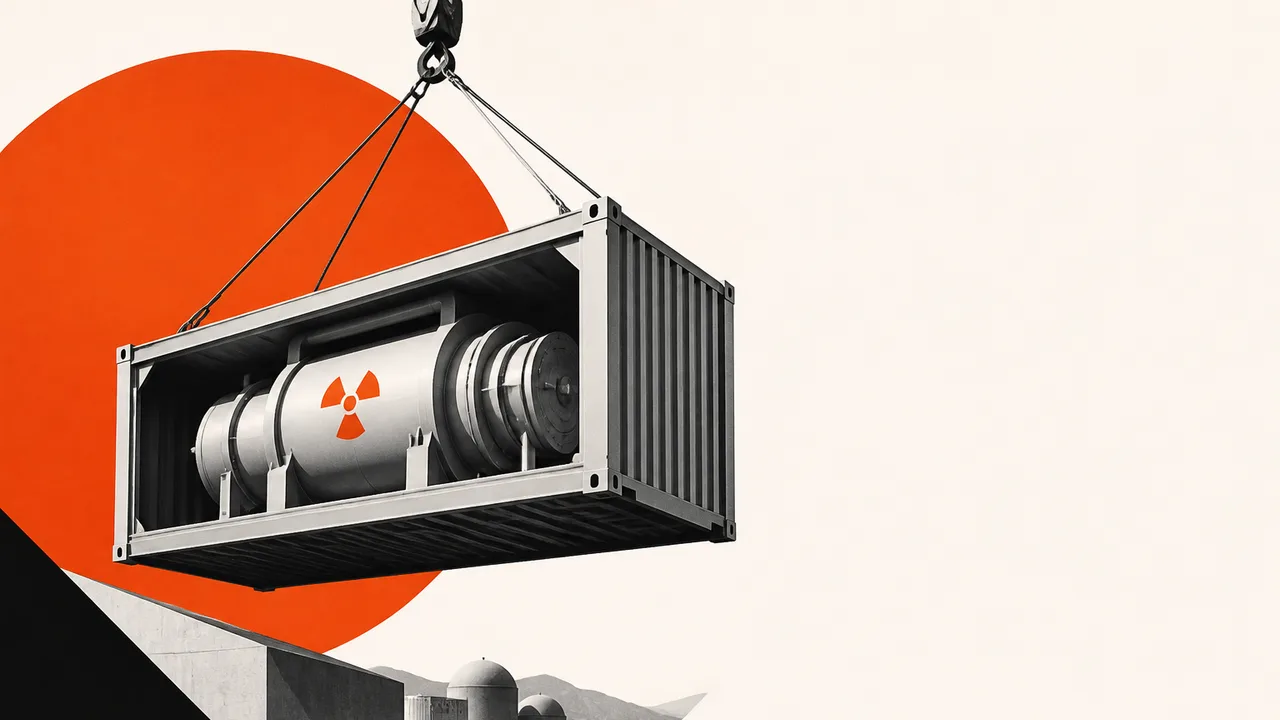
Photo: AI. Ondine Ferretti
The standard pitch for a new nuclear company sounds like this: cleaner, safer, cheaper, faster. Radiant, the a16z-backed microreactor startup, makes all four claims. What separates their pitch from the usual reactor-company wishful thinking is one specific design constraint that actually changes the underlying economics: the thing has to fit on a flatbed truck.
That's not a marketing detail. It's the load-bearing premise of the entire business model.
Radiant's reactor, called Kidos, is a roughly 1-megawatt unit designed to be transported by land, air, or sea, deployed above ground, operated for five years, and then returned to the company's facility in Oak Ridge, Tennessee for refueling. The customer never touches the fuel. They never own a radiological site. They get power for five years and then Radiant comes and takes the whole thing back. CEO Tori Shivanandan describes the customer experience with deliberate simplicity: "It shows up, it plugs in, you get power."
The diesel generator comparison Shivanandan uses is doing a lot of work here, but it's the right analogy for the customer segment they're targeting. Remote industrial sites, military forward operating bases, off-grid data centers, communities that currently run on diesel at significant cost and logistical complexity — these are buyers who already understand the economics of paying a premium for power reliability. The question isn't whether they'd want something better than diesel. It's whether Radiant can actually deliver it, and at what price point.
Before accepting the factory-built logic at face value, it's worth noting that this thesis has already had one high-profile stress test — and the results weren't clean. NuScale, which spent years developing a small modular reactor and secured a Department of Energy loan guarantee, cancelled its lead project in late 2023 after projected costs ballooned beyond what its anchor customer could absorb. The factory-built promise didn't protect NuScale from the same cost-escalation dynamics that have plagued conventional nuclear. Radiant's 1MW scale is genuinely different — smaller, simpler, more transportable — but anyone presenting factory-built nuclear as a solved problem is getting ahead of the evidence.
That said, Radiant's co-founder Doug Bernauer articulates why the factory thesis is structurally sound even if it hasn't been proven yet: "If you can change that dynamic to factory build, you take those uncertainties off the table. You might translate a little or some part of those uncertainties to building your factory and your entire process, but once you've done that, you're done." The key word is once. The uncertainty doesn't disappear — it front-loads into factory construction and regulatory approval, where you can theoretically control it, rather than spreading across every individual site deployment, where you historically cannot. That's a real insight. It's also exactly what NuScale believed.
The regulatory dimension is where Radiant's timeline becomes genuinely hard to read. The Nuclear Regulatory Commission's process for licensing new reactor designs is measured in years, not quarters. The NRC has been working to streamline pathways for advanced and microreactor designs, but "streamlined" in nuclear regulatory terms is still not fast. Radiant's target is a full-power test at Idaho National Laboratory's historic dome structure — a facility that, per the Atomic Heritage Foundation, hosted 52 nuclear reactors in a 21-year span ending in 1977 — by 2026, after which they'd go critical. Whether commercial deployment follows within a timeframe that keeps investors patient and customers committed is the central unknown. Regulatory delay isn't a fatal constraint here — it's a genuinely open variable, one that depends on NRC capacity, political tailwinds, and whether Radiant's design clears each review stage without significant redesign. That uncertainty compounds, and there's no honest way to handicap it yet.
The customer friction problem — the one Radiant is most clearly solving — is real and underappreciated. Conventional nuclear has always asked customers to accept enormous construction risk, permanent site contamination, and complex waste management obligations. Utilities that built large reactors accepted those terms because the scale of power output justified the pain. For smaller customers, that calculus never worked. Radiant's model reassigns all of that friction back to itself: Radiant owns the fuel cycle, Radiant handles the waste, Radiant operates within its own factory cost structure. This is reminiscent of how early Starlink terminals worked — customers paid a premium upfront and accepted SpaceX's terms entirely because the alternative (no connectivity) was worse, and because the service bundle was genuinely indivisible. You couldn't buy just the dish. Radiant's customers similarly can't unbundle the reactor from the fuel logistics. That's not a bug. It's how the unit economics close.
Shivanandan, per the a16z American Dynamism film series, floats the vision of "one nuclear reactor per week just coming off of a production line." That's an aspiration, not a forecast, but it signals what the business looks like if the factory thesis holds: a commodity throughput model, not a project-by-project construction business. The difference in investor return profiles between those two models is enormous, which is why a16z is interested. It's also why the model attracts skepticism — commodity throughput in nuclear has never existed, and anyone who tells you they know exactly when it will is guessing.
The broader grid context Shivanandan lays out is harder to dismiss than it might seem coming from a founder with obvious incentives. The American grid is an aging infrastructure built for a different demand profile — the claim that roughly 45% of Americans experienced at least one outage in the past year reflects a system running without meaningful headroom. AI infrastructure, electrification of transportation and heating, and domestic manufacturing reshoring are all layering demand onto a grid that wasn't designed for any of them. The argument that the US needs to get "above the line" of baseline energy capacity before it can genuinely innovate is a structural observation, not a sales pitch. Whether nuclear microreactors are the right instrument for closing that gap — versus grid-scale storage, distributed solar, or demand-response systems — is a separate question Radiant doesn't really engage with. They're not wrong that there's a gap. They're making a specific bet on how to fill part of it.
The INL test campaign is the real near-term proof point. Radiant was selected through a competitive process to test a commercial prototype in the historic dome structure at Idaho National Laboratory, targeting 150 hours of continuous operation at over 700°C. INL's own characterization, per the video, is that this will be "our first full power test at the laboratory in a very, very long time." If that test goes well in 2026, the conversation changes materially. The subcritical reactor conversation and the microreactor conversation merge into a single question: can the US actually execute on advanced nuclear at pace, or is "renaissance" just the word the industry uses every decade before the regulatory and cost realities reassert themselves?
Radiant is betting it's different this time because the product is different this time. "Nothing we're trying to do at Radiant is considered reasonable," Shivanandan says in the film. "We're an energy company at our core. We want to change society's relationship to energy. You don't do that by doing a slightly different version of something that's always been done."
That's either the most accurate self-assessment a founder has ever given, or the most expensive kind of optimism. The dome test will start telling us which.
More Like This
Bolt Graphics Wants to Build a GPU That Rivals Nvidia
Bolt Graphics is a US GPU startup with a RISC-V based, user-expandable card targeting content creators before gaming. Here's what we know so far.
Can Unreal Engine 5 Run on a $500 MacBook? Sort Of.
Testing Unreal Engine 5.7 on the MacBook Neo reveals what happens when professional software meets budget hardware—and why friction matters.
Engineering an LED Supernova: A Nuclear Approach
A nuclear engineer evaluates a DIY LED project, highlighting heat management, design intricacies, and nuclear parallels.

OpenAI's IPO Is a Regulatory Filing First
The OpenAI and Anthropic S-1s will be financial documents, yes — but first they're SEC filings with disclosure obligations no AI lab has faced before.
This Tool Treats Your Home Lab Like Infrastructure Code
RackPeek documents home labs as YAML code in Git. Brandon Lee shows how this infrastructure-as-code approach beats static diagrams and spreadsheets.
Project Pele: The Pentagon's Portable Nuclear Reactor
The Pentagon's Project Pele aims to power remote military bases with a containerized nuclear reactor. Here's what the technology promises—and what it can't yet answer.

Elon Musk's Problem-Solving Methods, Examined
Eric Jorgenson spent five years studying Elon Musk. Here's what his frameworks actually reveal—and where the hagiography gets complicated.

Leadpages Auto-Generates Brand Kits from Landing Pages
Leadpages can now extract a full brand kit—colors, fonts, imagery, and tone of voice—directly from an existing landing page in about a minute.