Elon Musk's Problem-Solving Methods, Examined
Eric Jorgenson spent five years studying Elon Musk. Here's what his frameworks actually reveal—and where the hagiography gets complicated.

Written by AI. Alex Volkov
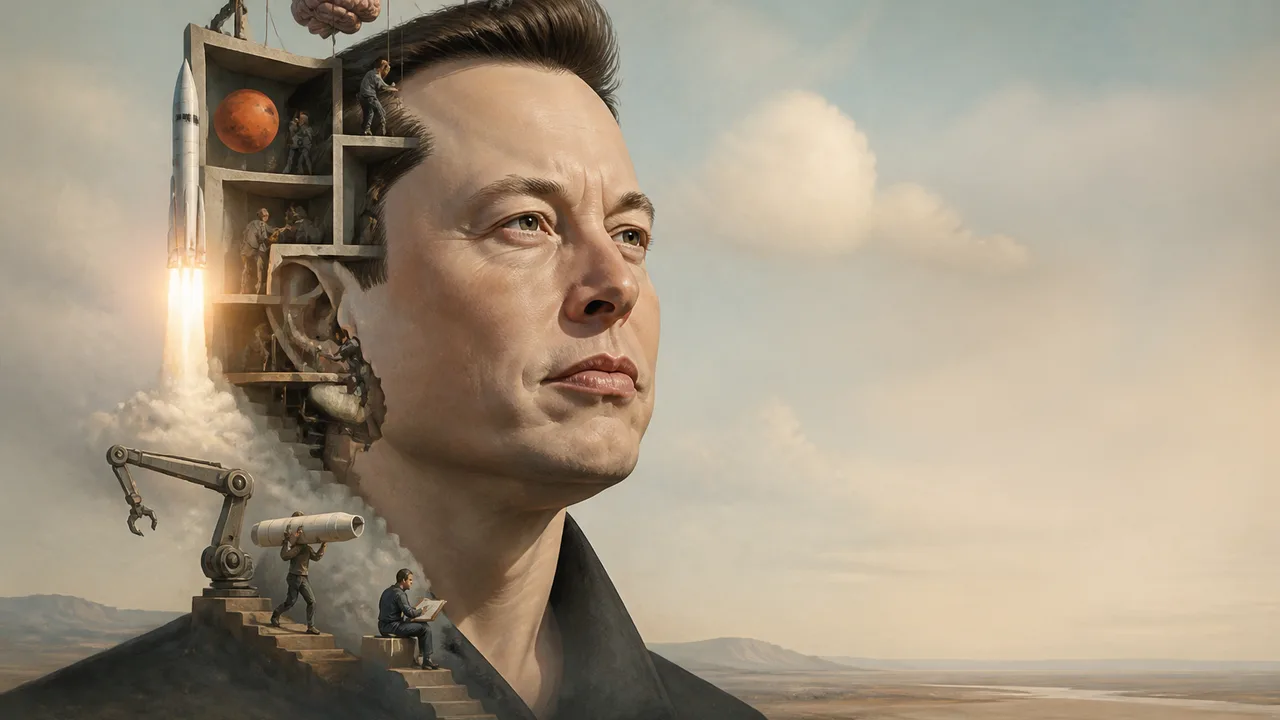
Photo: AI. Iolanthe Fenwick
Eric Jorgenson has now written two books distilling how the world's most effective people think—first Naval Ravikant, now Elon Musk. The pattern he's chasing is legitimate: there are people who operate at a fundamentally different level, and understanding their mental architecture is genuinely useful. His new book, The Book of Elon, attempts to make that architecture portable.
In a recent conversation on Codie Sanchez's BigDeal podcast, Jorgenson walked through the frameworks he extracted from five years of study. Some of it is sharp. Some of it strains toward mythology. The useful thing is knowing which is which.
The 2008 story earns its weight
Most Musk hagiography starts with rockets and electric cars and glosses over what it actually cost to get there. Jorgenson doesn't do that. The story he returns to most is late 2008: both SpaceX and Tesla were essentially dying simultaneously. SpaceX had just suffered its third consecutive launch failure and was out of money. Tesla was selling cars at negative gross margin with no DOE loan, no Daimler deal, and almost no cash in the bank. Musk had roughly $30 million left.
His advisors told him to pick one company and let the other die. Split the money between them and both probably fail. Put it all in one and at least something survives.
He split it anyway.
Jorgenson's read: "He couldn't bear to let either one die. He describes it as like holding a kid in each hand off a cliff. And he's like, rather than let go of one, I'm going to take the highest risk path, even if it's embarrassing, even if it's financially ruinous."
The reason this story matters isn't the outcome—we know how it ends. It's what it reveals about the underlying decision logic. This wasn't expected-value math. It was something closer to identity: the money was a tool in service of missions he'd already committed to at a deeper level than financial rationality. That's a genuinely different operating mode than most founders run on, and it explains a lot of what comes after.
Worth noting: this framing is also exactly the kind of story that makes for a compelling book pitch. The risk really happened. The interpretation—that it "proved" mission-driven nature—is still an interpretation.
The algorithm is real and actually useful
The most transferable thing in Jorgenson's account is what Musk calls his five-step engineering process, which emerged from the wreckage of the Fremont factory: question requirements, delete, simplify, accelerate, automate—in that order.
The order is the point. Jorgenson explains that Musk has run the steps backwards multiple times—spent weeks automating something that should have been deleted, or optimizing a process that should never have existed. Every hour spent on a requirement that shouldn't exist is sunk cost on a mirage.
Step one carries a specific rule: every requirement must have a named human being attached to it. Not "industry standard" or "best practice" or "the way we've always done it"—a person, who can be questioned. Jorgenson flags a counterintuitive corollary: "Requirements from smart people are particularly dangerous because you take them more seriously." The smarter the source, the less you interrogate the premise. That's a real organizational failure mode.
The Tesla service center story illustrates the delete step better than any abstract explanation. When the service team came to Musk with a $300 million proposal to build a hundred new service centers, he didn't approve it or reject it—he rejected the frame. Repair the cars without the service centers. When the team actually triaged what came in, they found 90% of repairs could be done by a technician with a portable toolkit at the customer's home. The best solution for the customer was also the cheapest and fastest to implement. They'd just never questioned whether a service center was required.
The employee onboarding case is even starker. Tesla's sales floor was bottlenecked partly by a month-long onboarding process of training videos and FAQs. The algorithm applied to that question produces a single sentence: Be so good that the customer talks about you at dinner. A month of materials, deleted. Nothing broke.
These examples don't require Musk to be a genius. They require someone willing to ask the question most organizations find too uncomfortable to ask: Does this thing need to exist at all?
The bottleneck obsession has a specific shape
Jorgenson describes Musk's operating style during Model 3 production hell in a way that's worth sitting with. Musk literally moved into the Fremont factory. The production line used red and green lights to signal status. His entire job, for a period, was walking toward the red lights—wherever parts were piling up, wherever the constraint lived—and solving it, then moving to the next one.
The goal was simple and binary: 10,000 cars a week meant Tesla lives. Below that, it dies.
"So many CEOs that we know, so many operators are like, 'Well, I've got a board meeting to prepare for. I've got a weekly meeting. I've got a status update,'" Jorgenson says. "They are not like eye-of-Sauron focus, clear schedule, wake up and attack whatever the biggest priority is that day."
The relevant pattern here isn't that Musk worked hard. It's the inversion of how most executives relate to their schedule. Musk's calendar serves the bottleneck; most executives serve their calendar. At some point he reportedly fired his scheduler—not because the person was bad at the job, but because a two-weeks-ago version of himself shouldn't be dictating what today's highest priority is.
The status update cadence is also instructive. Weekly reviews escalate to daily syncs, which can escalate to hourly updates—Jorgenson recounts one engineer who slept in 45-minute increments and sent status emails to Musk every hour for seven days. Whether that's the right call depends on the severity of the constraint. But the underlying principle—that the urgency of communication should track the urgency of the problem—is sound, and rare.
The idiot index is a pricing tool dressed up as a philosophy
The idiot index is simple: the ratio of a part's final cost to the cost of its raw materials. A high ratio means you're paying for someone else's inefficiency, overhead, or market position. The aerospace industry, before SpaceX, had rocket components with idiot indexes approaching 1,000—meaning 0.1% of the final cost was actual material. SpaceX's central business insight was essentially: what if we took that seriously?
The half-nozzle jacket example is concrete. An aerospace supplier charges $13,000 for a piece of steel. The steel itself is worth $200. The gap is subcontractors layered on subcontractors, each adding margin. Musk's position: I'll accept an idiot index of three. I will not accept one hundred.
For comparison, the raw material cost of an iPhone or a car is roughly 30% of final price—an idiot index of about three. Complex manufactured goods. Not a thousand.
The useful generalization is that this lens applies to services too. What's the idiot index of a consultant engagement? Of a marketing agency retainer? Of any process you've outsourced because questioning it felt uncomfortable? You're usually not paying for materials—you're paying for someone else's organizational complexity and your own unwillingness to look directly at the number.
Where the hagiography gets wobbly
Jorgenson is more candid than most Musk chroniclers about the tensions in the story. He acknowledges the Asperger's factor—that some of Musk's capacity to make hard people-decisions at speed comes partly from a neurological profile that discounts interpersonal friction. That's not a template; it's a context. The empathy-at-the-mission-level framing (caring about the mission more than any individual within it) is genuinely coherent as a leadership philosophy, but it requires acknowledging that the people on the receiving end of that logic experience it as getting fired with very little ceremony.
The happiness question is the most honest moment in the conversation. Jorgenson's answer: "I don't think he cares. I don't think he prizes his personal happiness." Musk has described his own mind as "a non-stop explosion" and "a never-ending storm, an unhappy storm." He's said explicitly that most people shouldn't aspire to live the way he lives. That's not false modesty from someone who's figured out the secret. That's a person reporting accurately on what it costs.
The framework conversation and the personal cost conversation are usually kept separate in founder mythology. Jorgenson at least puts them in the same room.
What's portable and what isn't
The algorithm is portable. The idiot index is portable. The bottleneck obsession is portable. The communication-bandwidth thinking—minimize delays, collapse gaps between people who need to interface, treat your reply latency as a tax on everyone downstream—is portable.
The 2008 bet is not portable. Not because it was reckless, but because the preconditions were singular: two companies that happened to be real, a founder whose identity was inseparable from the missions, and a particular moment when the math of splitting versus concentrating actually made sense given what failure would have meant to him personally. Trying to extract a general rule about "don't pick one when you can bet on both" from that story is the kind of thing that gets founders into serious trouble.
The more useful question the book raises—one Jorgenson circles without quite landing—is whether the operating methods work because of the psychological intensity behind them, or whether they work independently of it. The five-step algorithm doesn't require a rage demon. The idiot index doesn't require sleeping in a factory. If the tools are genuinely good, they should hold up without the mythology attached.
That's probably the version of this material worth taking seriously: not Musk as a model to emulate whole-cloth, but a set of operational questions—does this requirement need to exist, what's the real cost of this thing, what's the actual bottleneck right now—that most organizations are actively avoiding asking.
The cost of not asking them compounds quietly. That part, at least, doesn't require any special wiring.
More Like This
The Power of Starting Conversations with 'What'
Discover how asking 'what' instead of 'why' can transform communication and influence.

Eric Ries: Good Governance Is a Builder's Job
Eric Ries argues that without structural governance, every mission statement is a lie. His new book Incorruptible makes the case for building corruption-resistant companies.

Sam Harris: The Self Disappears When You Look for It
Sam Harris tells Brian Keating why the "self" can't survive close inspection—and why that matters more than any wellness trend. A climate reporter's take.

5 Life Regrets That Are Actually Real (With Caveats)
The Art of Improvement's viral regret video gets a lot right — but the gap between what you *should* do and what you *can* do is where self-improvement content always falls apart.
Rethinking Loneliness: A Signal, Not a Failure
Explore loneliness as a signal of unmet needs, not a failure. Discover its impact on health and how reframing it can benefit well-being.
Musk Says We're Already in the Hard Takeoff
Elon Musk claims recursive AI self-improvement is here, predicts 10x economy in 10 years, and says money will become irrelevant. What does the data say?

Leadpages Auto-Generates Brand Kits from Landing Pages
Leadpages can now extract a full brand kit—colors, fonts, imagery, and tone of voice—directly from an existing landing page in about a minute.

Test-Driven Development Tames AI Coding Agents
Red-green-refactor is a decades-old discipline. Brainqub3 argues it's also the most practical fix for AI coding agents that break things while fixing things.