Sam Harris: The Self Disappears When You Look for It
Sam Harris tells Brian Keating why the "self" can't survive close inspection—and why that matters more than any wellness trend. A climate reporter's take.

Written by AI. Olivia Meng
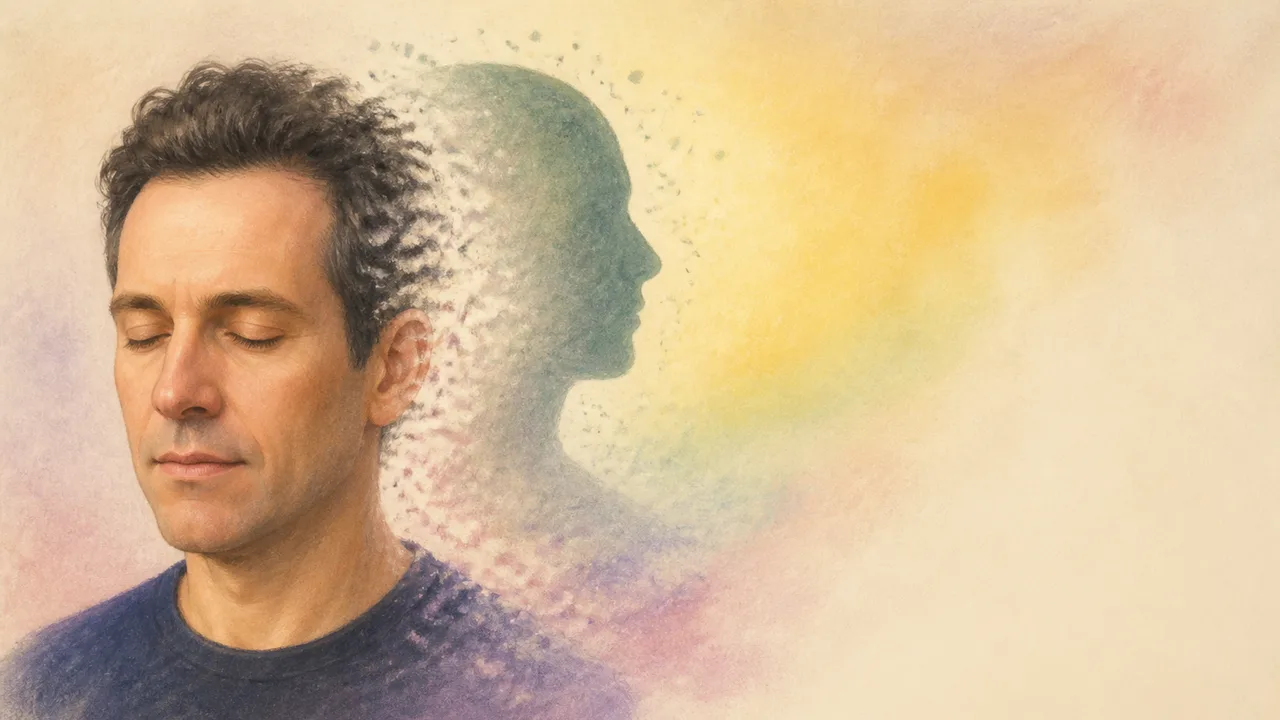
Photo: AI. Aiyana Stone
I cover planetary collapse for a living. I spend my days tracking feedback loops, tipping points, and the yawning gap between what climate science demands of us and what humans actually do. So when I find myself genuinely arrested by a philosopher-author talking about the dissolution of the self, I ask myself the obvious question: what does this have to do with anything I cover?
More than I expected.
The conversation in question is a recent exchange between Sam Harris — who holds a PhD in neuroscience but operates today primarily as a public intellectual, author, and creator of the Waking Up meditation app — and cosmologist Brian Keating. Most of it lands squarely in philosophy-of-mind territory. But there is a thread running through it that maps, with uncomfortable precision, onto the problem I cannot stop thinking about: why people who understand the climate crisis clearly still cannot seem to act on it.
Harris's argument, stripped of the contemplative vocabulary, goes like this. There is a felt sense of being a self — a stable "I" riding through time, accumulating grievances, projecting futures, rehearsing arguments. That self is not just philosophically dubious; it is, Harris argues, the anchor for virtually all psychological suffering. And crucially, it does not survive direct examination. Look for it carefully enough and you find its absence, not its presence.
"The claim is if you look closely enough at this sense of self, what you're calling I, this feeling of being a subject, you won't find it," Harris says in the Keating conversation. "And you won't find it in a way that is conclusive, which is to say you'll find its absence."
He reaches for an analogy that, coming from a neuroscientist, is characteristically precise: the optic blind spot. You can locate the gap in your own visual field with a piece of paper and two marks. No special equipment, no mysticism — just a specific way of looking that reveals something your unaided perception would never find by accident. Meditation on the self, he argues, is structurally similar: a deliberate method that produces a reproducible result. Either the felt sense of "I" survives close phenomenological inspection, or it doesn't. Test it.
This is where Harris parts company with Deepak Chopra, and the parting is instructive. In the Keating conversation — and this is consistent with Harris's broader public record on the subject — he draws a clean boundary around what first-person meditative experience can and cannot tell you. Chopra, Harris notes, tends to slide from the interior experience of pure consciousness to claims about the nature of the cosmos before the Big Bang. Harris's objection is epistemological rather than spiritual: "When you're meditating, you can't even tell that you have a brain. The existence of your brain is not among the things you can notice while meditating. Much less its significance. If you can't draw any direct first-person conclusions about your own nervous system, how is it that we can imagine that you can say anything about what happened before the Big Bang?"
This is a genuinely important epistemological boundary, and not only for consciousness researchers. The error Harris is identifying — treating the jurisdiction of first-person phenomenology as unlimited, using what feels true from the inside as evidence about the structure of the outside — is one I watch play out every day in climate discourse. Personal experience with weather is not evidence about climate trends. The fact that last winter was cold in your town does not bear on forty years of global temperature records. The subjective sense that things are probably fine is not data. The mechanism Harris is criticizing in Chopra is the same mechanism by which millions of people treat their gut feelings about environmental risk as epistemically equivalent to the instrumental record.
He makes a second distinction that I find equally useful. Keating introduces the conversation by invoking a quote widely attributed to Einstein — "no problem can ever be solved from the same level of consciousness that created it" — though it should be noted this attribution is disputed by scholars and may be apocryphal. Harris's response is to reject the framework of "levels" of consciousness entirely. Consciousness, he argues, is not tiered. What changes is its contents. This is not a semantic quibble. The "levels" framing implies that some people are operating at a higher plane of awareness, which tends to produce exactly the kind of metaphysical inflation Harris is criticizing throughout the conversation: the idea that achieving the right inner state grants you special access to external truths. The "contents" framing is more tractable and more honest. You are not ascending to a different consciousness; you are changing what fills the one you have.
Here is where I have to be direct about why this conversation caught me the way it did. The self Harris describes — the contracted, reactive, self-talk-saturated "I" that rehearses the same argument fifteen times an hour — is also the self that burns out covering the climate crisis. It is the self that catastrophizes at 2 a.m. and then, paradoxically, disengages by morning. Climate anxiety research has documented this loop with some precision: acute awareness of the scale of the problem tends to produce not sustained action but what psychologists call "motivated disengagement" — the mind protecting itself from unbearable futures by retreating from the information that produces them. The self, in other words, is not a neutral processor of climate risk. It is an active distorter of it, cycling between overwhelm and numbness in ways that serve neither comprehension nor action.
Harris is not making a climate argument. But his claim that the sense of self is the anchor for virtually all psychological suffering, and that its temporary dissolution produces "a profound feeling of relief," describes something I recognize from the literature and from my own reporting: the people I've interviewed who do sustained, effective climate work over decades tend to share a quality that is hard to name but that Harris's framing helps identify. They are not detached. They are not unaffected. But they do not seem to be run by the story of a self that is personally implicated in every bad outcome. They witness the data and act on it without the reactive loop that burns most people out.
Whether meditation is the mechanism for developing that capacity — or whether it's just one path among several — is a question Harris doesn't resolve, and I won't pretend to either. What he does argue, convincingly, is that the change is real, reproducible, and doesn't require metaphysical commitment to anything. "Wisdom is really nothing more profound than the ability to take your own advice," he says. Everyone knows what they should do. The gap is operationalization. The obstacle is not ignorance; it is the self that keeps interrupting execution.
That observation hits differently when the advice in question is: the planet is warming, the window is closing, and the systems that could prevent the worst outcomes require collective action at a scale and speed we have never managed before. We know what to do. The question is always who is doing the knowing, and whether that knower can stay present long enough to act.
Harris is describing a first-person investigation with reproducible results. The Chopra comparison matters precisely because it shows what responsible epistemic humility looks like: you can make genuine discoveries about the nature of mind through direct attention without immediately inflating those discoveries into a theory of everything. The self may dissolve under close inspection. That tells us something real about suffering and attention. It does not tell us when the next IPCC report drops.
But the gap between knowing and doing — that's where I live. And Harris is pointing at something in that gap that deserves more than dismissal as wellness content.
More Like This
Are You Actually Calm, or Just Really Good at Hiding?
Are calm people emotionally healthy—or just great at suppressing? Psych2Go's breakdown of "Zen masters" vs. "swans" hits closer to home than you'd expect.
How Childhood Trauma Shapes Adult Relationships
Explore how childhood trauma influences adult relationships and discover pathways to healing.
Is Nature Good? Harari and Žižek Say No
Yuval Noah Harari and Slavoj Žižek agree: nature isn't inherently good. Their debate reveals why "natural" is almost always a political argument in disguise.
Fitness Is Tracking the Wrong Scoreboard
The wellness industry optimizes for calories and scale weight—not health. A climate entrepreneur's insight about broken metrics applies directly to your body.

Your Weird Habits Are "Genius"—Or Are They?
Psych2Go says replaying conversations and laughing alone proves you're highly intelligent. The science says: it's more complicated than that.

The Friendship Recession Is Real—And It's Personal
Three experts break down the science of loneliness, the friendship recession, and why saying "I need a friend" might be the hardest thing adults do.
Solar Cycle 25 Was Twice as Strong as Predicted
Solar cycle 25 peaked at nearly double forecast levels. Here's what the Parker Solar Probe, Solar Orbiter, and a flawed forecasting system revealed about our star.
Anil Menon Reaches the ISS on His First Spaceflight
NASA astronaut Anil Menon launched to the ISS on July 14 aboard Soyuz MS-29. His eight-month mission raises questions about what space cooperation looks like next.