The Friendship Recession Is Real—And It's Personal
Three experts break down the science of loneliness, the friendship recession, and why saying "I need a friend" might be the hardest thing adults do.

Written by AI. Marcus Obi

Photo: AI. Ines Cienfuegos
Somewhere around month four of staying home with newborn twins, I realized I hadn't had a real conversation—not a logistical one, not a "how are you, good, good, okay bye" one, but an actual conversation—in longer than I could track. My wife and I were tag-teaming two infants on negative sleep. My friends from my marketing days had real jobs, real commutes, real lives that didn't involve me narrating diaper changes at 2 a.m. I wasn't sad exactly. I was just... sealed off. Like the world had continued without me and nobody had thought to leave a note.
I didn't call it loneliness then. That felt like too dramatic a word for what I was experiencing. I wasn't in crisis. I was just a dad who had quietly lost the thread.
I thought about that a lot watching a recent Big Think video featuring three researchers—Robert Waldinger, MD, Kasley Killam, MPH, and Ethan Kross, PhD—walk through what loneliness actually is, what it does to you, and why it's getting worse across generations. The video is sharp, a little dense, and covers a lot of ground in under seven minutes. But one line stopped me cold.
Waldinger says it plainly: "Actually saying, 'I need a friend,' is maybe one of the hardest sentences any human being can utter."
Yeah. I know exactly why.
Loneliness as signal, not sentence
The framing the three experts keep returning to is this: loneliness isn't a verdict on your personality. It's information. Killam puts it cleanly: "Loneliness is not a reflection on who we are. It's a reflection of what we need."
That reframe sounds simple, but it cuts against something deep. From childhood onward, being alone carries stigma—the implication that nobody chose you, or that something about you made connection impossible. So when adults feel lonely, they tend to either deny it or spiral into it. What the experts suggest instead is treating it the way you'd treat hunger: a signal that something is missing, not proof that you're broken.
The biology backs this up. Loneliness triggers a stress response—elevated cortisol, increased inflammation, immune suppression. Kross cites a 2010 meta-analysis by Holt-Lunstad et al. in which researchers found that chronic loneliness is associated with health risks comparable to smoking roughly 15 cigarettes a day. It's a figure that gets tossed around a lot, and the experts acknowledge that translating a meta-analytic risk correlation into "cigarettes per day" involves some interpretive compression. But the underlying finding—that social isolation has measurable physiological consequences—holds up across a lot of research.
One study Kross describes makes the mechanism vivid: participants received mild electric shocks while looking at either a photo of their romantic partner or a photo of a stranger. Those looking at their partner reported less fear. The brain activity in pain-associated regions was measurably lower. Your sense of social connection doesn't just affect your mood—it shapes how your nervous system processes threat.
The friendship recession, by the numbers
The structural picture is where things get genuinely grim. Waldinger references the work of Daniel Cox, a scholar at the American Enterprise Institute, who coined the term "friendship recession" to describe a documented collapse in close social ties. Cox's 2021 Survey Center on American Life data found that 15% of young men today report having no close friends—up from roughly 3% in the 1990s. That's not a rounding error. That's a generational shift in the baseline of human connection.
For women, the pandemic accelerated a different pattern. According to data cited in the video (the specific source isn't named in the transcript, and that attribution is worth pinning down before you cite it), more than half of women reported losing touch with at least some friends during COVID. Not drifting—losing touch. The kind of erosion that's hard to reverse once it's set in.
The causes the experts point to are structural: declining religious participation, delayed and less frequent marriage, a labor market that demands more mobility and leaves less room for rootedness. The institutions that used to organize social life—church, neighborhood, workplace longevity—have thinned out, and nothing has filled the gap. So friendship, which already requires more intentional effort than most people have bandwidth for, is now something you have to build from scratch, repeatedly, without scaffolding.
As a millennial parent, I find this both obvious and kind of devastating. Making a friend as an adult isn't like making a friend at eight, when proximity and a shared interest in Pokémon cards was basically sufficient. Now it involves coordinating two people's work schedules, two sets of kid commitments, maybe two partners who also need to be socially compatible, and a collective willingness to admit that yes, we are scheduling a playdate for ourselves. The logistics alone are enough to make you give up and just text an old college friend something vague and never follow up.
The solitude question
The piece of the video I found most unexpected was Kross's argument about solitude. His research team found that media coverage describes experiences of being alone as negative roughly ten times more often than positive—a 10-to-1 ratio that, if it holds up against the published study (Kross works in this area and the finding is consistent with his broader research on emotion regulation, but the specific ratio should be sourced before you cite it as hard fact), says something striking about how culturally loaded the concept of aloneness has become.
But Kross's research on people's actual experiences cuts against that. When he tracked people over time, he found that individuals who believed that solitude was good for them actually felt better when they spent time alone. The belief shaped the experience. Which means there may be room to intervene not just in behavior but in the story people tell themselves about what it means to be alone.
The tension the video doesn't fully resolve is between these two truths: chronic loneliness is genuinely harmful, and not all aloneness is loneliness. Killam addresses this somewhat—noting that optimal social health looks different for different people, that introversion isn't pathology—but the video is largely organized around the harms of disconnection, which can blur those edges if you're not paying attention.
What the experts are not doing, to their credit, is treating this as a personal optimization problem. The friendship recession isn't happening because people are bad at friendship. It's happening because the conditions that friendship requires—time, proximity, stability, low-stakes recurring contact—have been systematically stripped out of American life. They name the structural decay. They just don't push all the way through to what that implies about who's responsible for fixing it.
For what it's worth: I eventually made a friend. It took about eighteen months, a neighborhood meet-up I almost didn't go to, and two people independently complaining about the same thing until we realized we should probably just keep talking. It was awkward in the way that adult friendship-making is always a little awkward. It felt, briefly, like I was doing something embarrassing.
Waldinger's right that saying "I need a friend" is one of the hardest sentences. It requires admitting that you're not self-sufficient in the way the culture insists you should be. It requires being findable.
I'm not sure the experts fully account for how much the system makes that hard. But they're not wrong that it's worth trying anyway.
More Like This
Understanding Emotion Regulation with Dr. Marc Brackett
Explore emotion regulation with Dr. Marc Brackett, focusing on practical strategies for emotional intelligence in personal and professional contexts.
The Starbucks Problem: Why AI Might Not Kill Jobs After All
Economist Alex Imas argues AI won't eliminate work—it'll shift value toward human connection, taste, and relationships in a 'post-commodity economy.'

How Childhood Trauma Shapes Adult Relationships
Explore how childhood trauma influences adult relationships and discover pathways to healing.
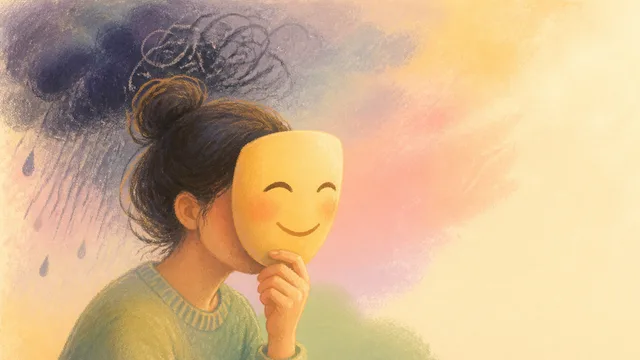
The Hidden Face of Anxiety and Depression
Anxiety and depression don't always look like breakdowns. Psych2Go explores the quieter, harder-to-name struggles—and what actually helps.

The Self-Loathing Monologue Playing on Loop
Alain de Botton's School of Life video on loneliness gets the diagnosis right — but who's actually providing the antidote? A music critic weighs in.
Rethinking Loneliness: A Signal, Not a Failure
Explore loneliness as a signal of unmet needs, not a failure. Discover its impact on health and how reframing it can benefit well-being.
How to Make a College Tour Actually Matter
College tour season is here. Here's how families can shift from passive observers to active explorers—and why who leads the visit changes everything.
Public Trust in Science Is Fragile and Complicated
Trust in science is eroding—but the data is more complicated than the panic suggests. Here's what's actually happening, and why it matters.