Are You Actually Calm, or Just Really Good at Hiding?
Are calm people emotionally healthy—or just great at suppressing? Psych2Go's breakdown of "Zen masters" vs. "swans" hits closer to home than you'd expect.

Written by AI. Marcus Obi
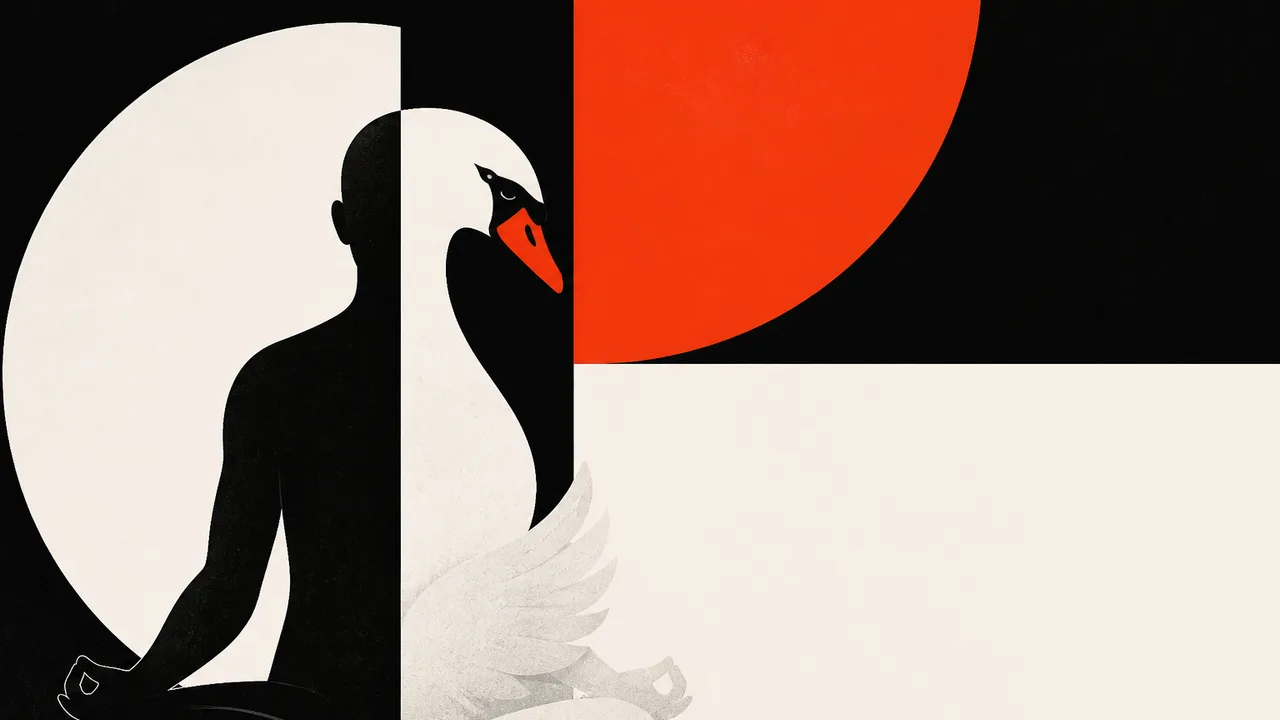
Photo: AI. Ondine Ferretti
My twins are seven. When one of them cries because the other one looked at their toast, my instinct — the one I was raised with — is to say: calm down. Two words. Universal parenting reflex. Completely useless.
Because "calm down" doesn't mean feel better. It means stop showing me that feeling. We tell kids to calm down as if the goal is the absence of visible emotion rather than the healthy experience of it. And then we wonder why so many adults are walking around with faces like blank walls and pressure building behind their eyes.
That's the thing a recent Psych2Go video on the psychology of calm people cracked open for me — not because it told me something I'd never heard, but because it named something I've been watching in myself for years without having the right words for it.
Two Kinds of Calm (and One of Them Is a Lie)
The video opens with a taxonomy. There are, it argues, two kinds of calm people: the genuine Zen masters and the swans.
The Zen master has done actual internal work. High frustration tolerance. Sees problems as puzzles, not catastrophes. Probably practices mindfulness, maybe has engaged with Stoic philosophy — the Stoics, as the video notes, believed you can't control external events, only your responses to them. Psych2Go describes this type with a useful image: "His calm isn't passive, it's an active strength. He's seen the worst the world has to offer, but he's chosen to cultivate peace because he knows it's the most powerful weapon."
That's a person who has metabolized their hard stuff. Rare, but real.
Then there's the swan. Serene on the surface, paddling like mad underneath. The video is pretty clear that this is the more common type — and that it's not health, it's camouflage. Swan calm is a defense mechanism usually built in childhood, in homes where emotions weren't safe. "If you grew up in a home where emotions were dangerous or unpredictable, you learned one thing very fast. Being calm kept you safe."
I read that and sat with it for a minute. I know a lot of swans. I think I spent a good chunk of my twenties as one.
The Bill Comes Due
Here's where the video earns its runtime: it doesn't just identify the swan type, it traces the cost.
First: the delayed explosion. Swans can hold the lid down for years, then completely detonate over something small — losing keys, a wrong turn, someone asking a perfectly reasonable question in the wrong tone. The video calls it a "disproportionate meltdown," which is a polite way of saying everyone in the room is suddenly terrified and confused. The explosion isn't about the keys. It never was. It's about a decade of unfiled emotional paperwork finally crashing the system.
Second: emotional numbness. When you suppress feelings long enough, you don't get to pick which ones stay muffled. The video mentions anhedonia — losing enjoyment of things you used to love — and alexithymia, the difficulty identifying or describing your own emotions at all. It's worth noting that researchers debate exactly how suppression maps onto these conditions; the causal arrow isn't as clean as it might sound. But the broader picture — that years of emotional avoidance can leave you dimmer, flatter, watching your own life from a slight remove — that rings true to a lot of people who've been in therapy long enough to say so.
Third, and this one hit differently: swans often appear cold. Not because they don't care, but because their wiring runs toward solving rather than feeling. "You offer logic when people need comfort. You try to fix their feelings when they just want you to sit with them, in them." As someone who, for years, thought "let me help you fix that" was the same as emotional support — yeah. That one lands.
The Stoic Complication
The video leans on Stoicism as part of the Zen master toolkit, which is where I want to pump the brakes slightly — not because Stoicism is wrong, but because its current cultural moment deserves a second look.
Stoicism has had a real renaissance. Ryan Holiday has a podcast, a book series, and merchandise. "Memento mori" is on coffee mugs. The Meditations of Marcus Aurelius has been downloaded approximately eleventy billion times. And there's genuine wisdom in it — the idea that your response to events is within your control, when practiced thoughtfully, is legitimately useful.
But here's the thing nobody in the Stoicism content space really wants to say: it can also be a very prestigious-sounding permission slip for emotional suppression. "I don't react because I'm disciplined" and "I don't react because I learned early that reacting wasn't safe" can look identical from the outside. One of them is wisdom. The other one is the swan in a toga.
Albert Ellis's Rational Emotive Behavior Therapy is the branch of modern psychology most explicitly rooted in Stoic ideas — his whole framework is essentially Stoicism with a worksheet. The broader CBT lineage is more complicated; Aaron Beck came up through cognitive science and phenomenology, not Marcus Aurelius. The point being: "ancient wisdom meets modern psychology" is a cleaner story than the actual intellectual history. Worth knowing when you're deciding how much weight to put on either.
What the Video Actually Gets Right
Despite my skepticism about the packaging, the practical core of the Psych2Go video is solid and I don't want to bury it under caveats.
The advice for recovering swans: become an emotional scientist. "When you feel the flicker of anger or sadness, just pause and say, 'Hmm, that was interesting. Where's that coming from?' You don't have to act on it, just observe it. This teaches your brain that feelings are data, not emergencies."
That framing — feelings as data — is probably the most useful reframe in the whole video. It's not "emotions are beautiful and should be expressed freely at all times," which would be chaotic (I have seven-year-old twins; I know what unchecked emotional expression looks like, and it involves a lot of screaming about toast). It's something quieter: there is information here, and you can look at it without it destroying you.
The video also recommends scheduling time to feel — ten minutes a day, journaling, music, whatever opens the valve slightly. "It's like opening the pressure valve just a little bit so it doesn't explode later." It sounds faintly ridiculous until you realize that most of us do have to schedule the things we actually need.
What I Keep Coming Back To
The part that won't leave me alone is the structural absurdity underneath all of this.
We raise kids to suppress emotions. We then promote adults who appear emotionally controlled into positions of leadership, authority, and power — and we call it composure. We build workplaces that reward the swan performance and punish visible feeling. And then we publish think-pieces asking why everyone seems so numb, so disconnected, so bad at actual human intimacy.
Meanwhile, I'm standing in my kitchen telling a seven-year-old to calm down, about to pass the whole thing forward.
"True calm isn't the absence of emotion," the video argues. "It's the ability to navigate your emotions without letting them capsize your boat."
I believe that. I'm also aware that believing it and actually doing it — especially when you're tired, when you grew up learning a different language for feelings, when you're trying to teach something you're still learning yourself — those are very different things.
Which is maybe the most honest thing I can offer: the video is right about the destination. The route is longer than a seven-minute animated video suggests. But it's probably worth taking.
More Like This

Eckhart Tolle Says You're Not Who You Think You Are
Eckhart Tolle's 'historical self' vs 'deep eye' framework is either profound or a very elegant dodge. A parenting writer tries to figure out which.
Schizoid Personality Disorder Inside Your Family
SPD isn't just clinical—it lives inside families. Marcus Obi on what schizoid personality disorder actually looks like when it's someone you love.

Why Introverts Intimidate People Without Trying
Psychology explains why introverts come across as intimidating—and it has less to do with their behavior than with how others respond to it.
Your Weird Habits Are "Genius"—Or Are They?
Psych2Go says replaying conversations and laughing alone proves you're highly intelligent. The science says: it's more complicated than that.
The Psychology Behind Avoidant Lovers, Explained
Alain de Botton's viral School of Life video on avoidant attachment is everywhere on TikTok. Here's what it gets right — and what it leaves out.

The Friendship Recession Is Real—And It's Personal
Three experts break down the science of loneliness, the friendship recession, and why saying "I need a friend" might be the hardest thing adults do.

How to Make a College Tour Actually Matter
College tour season is here. Here's how families can shift from passive observers to active explorers—and why who leads the visit changes everything.
Public Trust in Science Is Fragile and Complicated
Trust in science is eroding—but the data is more complicated than the panic suggests. Here's what's actually happening, and why it matters.