Project Pele: The Pentagon's Portable Nuclear Reactor
The Pentagon's Project Pele aims to power remote military bases with a containerized nuclear reactor. Here's what the technology promises—and what it can't yet answer.

Written by AI. Olivia Meng
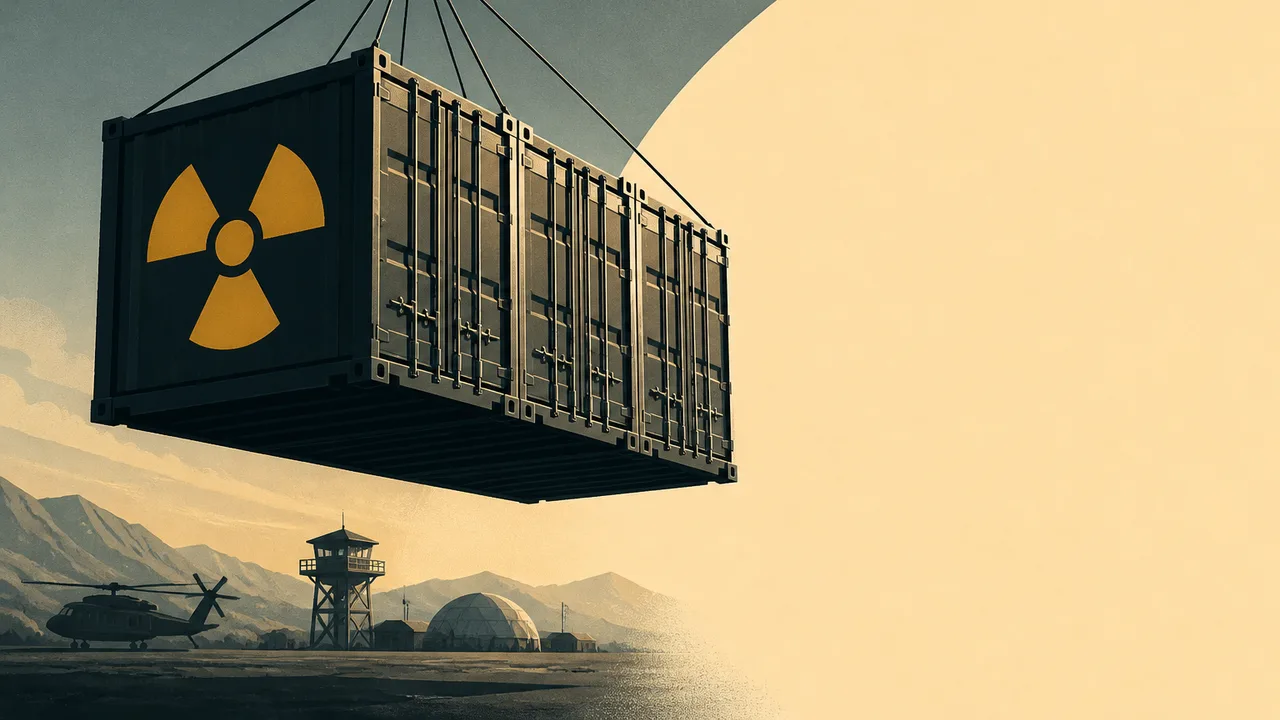
Photo: AI. Mika Sørensen
Four shipping containers. One nuclear reactor. The Pentagon's theory is that this combination could sever the fuel supply chain that has shaped — and constrained — American military operations for decades.
Named for the Hawaiian goddess of volcanoes rather than the Brazilian footballer, Project Pele is the Defense Department's attempt to build a reactor that can travel by road, rail, sea, or air to a forward operating base, switch on within 72 hours of arrival, run for at least three years without refueling, and then pack up and leave. The Strategic Capabilities Office, a small organization set up in 2012 to push new technology into the field faster than conventional acquisition systems allow, is running the program. A prototype is currently under development at Idaho National Laboratory.
The tyranny of fuel
The problem Pele is designed to solve is older than the program itself. The Department of Defense is the single largest institutional energy consumer in the United States, burning through roughly 30 terawatt hours of electricity annually. A modern forward operating base is a significant draw on its own: radar arrays, satellite uplinks, drone ground stations, field hospitals, water purification units — all of it running continuously, all of it fed by diesel generators, and all of that diesel having to get there somehow.
The supply chain for fuel in a conflict zone is not a logistics footnote. It is a vulnerability. Fuel convoys running between Kuwait, Bagram, Kandahar, and smaller outposts were among the most dangerous assignments of the Afghanistan and Iraq wars — frequent targets for ambushes and roadside bombs. Army analysis from the period concluded that a significant share of casualties were tied directly or indirectly to moving fuel and water. The phrase the Pentagon internalized from that era was "the tyranny of fuel" — the way logistics dictate where forces can go, how long they can stay, and what they can do once they get there.
Pele's pitch is straightforward: a reactor that arrives once and runs for three years removes the daily dependency on the fuel tanker. As the Megaprojects video puts it, "the trucks still come, of course — they've got food, parts, and ammunition. But the fuel tanker, in theory, doesn't have to."
A revival, not an invention
What makes Pele interesting to a historian of technology is that none of this is conceptually new. From 1954 to 1977, the U.S. Army ran a nuclear power program aimed at precisely the kind of remote, fuel-starved installations the Pentagon worries about today. It built eight reactors across the continental United States, the Arctic, Antarctica, and the Panama Canal Zone.
The most evocative of them powered Camp Century, a classified network of tunnels carved into the Greenland ice sheet. From 1960 to 1963, a portable reactor called the PM2A supplied its electricity and heat, hauled in by tractor train and assembled on site. A similar unit — the PM3A — ran at McMurdo Station in Antarctica from 1962 until 1972. There was even a floating version: the MH1A, a pressurized water reactor installed inside a converted Liberty ship called the Sturgis, moored in Gatun Lake from 1968 to 1976, feeding power into the Panama Canal Zone grid. The Sturgis hull was finally scrapped in 2019, decades after the reactor itself was shut down.
Those systems proved the concept was possible. Then SL-1 happened.
In January 1961, an experimental Army reactor at the National Reactor Testing Station in Idaho — the same site where Pele is being developed — went prompt critical during a maintenance procedure. A control rod was withdrawn too far, the core power surged, and the reactor vessel was driven upward with enough force to kill the three servicemen working on it. The cleanup involved recovering highly contaminated bodies and burying the reactor in place. By 1977, cost, complexity, and the shadow of that accident had closed the program. Cheaper diesel made the math easy.
Now the math has changed again — and the engineers argue the technology has too.
What's actually different
Strip away the container design and the military branding, and Pele is a high-temperature gas-cooled reactor. Helium flows through a graphite core, picks up heat from the fission reaction, and carries it to a power conversion system that produces electricity. BWXT, the Virginia-based contractor that won the prototype contract in June 2022 — a deal worth up to $300 million — has sized the current design at around 1.5 megawatts electric, enough to sustain a small base, sitting inside the program's original 1-to-5 megawatt requirement window.
The fuel is the genuine engineering story. Pele uses TRISO fuel: each particle is a kernel of uranium roughly a millimeter across, wrapped in successive layers of carbon and silicon carbide ceramic. Those coatings act as their own miniature containment vessel, trapping fission products inside and holding together at temperatures well above normal operating range. Researchers at Idaho National Laboratory and Oak Ridge have heated TRISO samples past 1,600 degrees Celsius and watched the coatings hold. For a reactor that might end up on an austere airfield, that thermal margin matters considerably.
The uranium in those kernels is HALEU — high-assay low-enriched uranium, enriched to less than 20 percent U-235. Standard commercial reactor fuel sits around 5 percent. Weapons-grade material is above 90 percent. HALEU occupies the middle ground, giving advanced reactors a more energetic fuel without crossing into weapons territory. For Pele, the material is being prepared by down-blending highly enriched uranium from existing U.S. government stockpiles while a commercial HALEU supply chain is still being built.
The cooling architecture is also a departure. Conventional power reactors dump waste heat into water, which is why they tend to sit beside rivers, coastlines, or purpose-built reservoirs — the South Texas Project electric generating station, for instance, uses a man-made cooling reservoir built solely for reactor operations, according to the Texas Almanac. Pele is air-cooled, which means it can be placed on a concrete pad in a desert or on a Pacific island without requiring an adjacent water source or disturbing a nearby waterway. Combined with the shipping container form factor, that opens the list of viable sites considerably.
The safety case rests on physics rather than active intervention. As the graphite and fuel heat up, the fission reaction slows on its own — a property called negative temperature feedback. Decay heat after shutdown is designed to dissipate through conduction and natural air circulation slowly enough that the TRISO coatings stay intact. The program's phrase for this is "walk away safe": the claim that if every operator left and every active system failed, the reactor would settle into a stable state rather than melt through its containment. Whether that holds across every credible scenario — sabotage, transport accident, direct attack, years of fuel degradation — is precisely what the Idaho test campaign is supposed to determine.
The convoy problem doesn't disappear
The case for Pele is coherent. The complications are also real, and they don't resolve themselves by pointing at the engineering.
The reactor's spent fuel has to return to the United States at the end of each three-year cycle for storage and disposition. That means the transport vulnerability the program was designed to reduce doesn't end when the reactor arrives at a base — it repeats in the opposite direction, with material that is considerably more radioactive than what shipped out.
Security presents a different category of problem. A reactor on a forward base is a fixed, high-value, politically charged target. A mortar round landing in the same compound, a drone strike against the shielding, or an insider incident could produce a contamination event that shapes policy regardless of the engineers' assessments. Guarding sensitive nuclear material in a conflict zone is not the same problem as securing a warhead in a hardened bunker.
Proliferation concerns are harder to dismiss than proponents sometimes suggest. HALEU is well short of weapons-grade material, and TRISO fuel is difficult to extract uranium from. But a transportable system that may eventually move through multiple countries normalizes the movement of more highly enriched uranium than the existing commercial fleet requires. Any overseas deployment would require host-nation approval, and the domestic politics of accepting an American military nuclear reactor are unlikely to be straightforward anywhere.
Cost is the final complication. The prototype contract alone runs to $300 million, with site preparation, testing, fuel production, and spent fuel return sitting on top of that. Pele is not designed to be cheap power — its value proposition is continuous power without convoys. Whether that trade-off pencils out against a diesel generator depends entirely on how you price the human cost of the fuel runs it eliminates.
What Idaho will actually settle
In September 2024, crews broke ground at the Critical Infrastructure Test Range Complex in Idaho. In July 2025, BWXT began fabricating the reactor core at its Lynchburg Innovation Campus in Virginia — the same facility that produces components for U.S. Navy submarines. Northrop Grumman is handling control and monitoring systems. Rolls-Royce Liberty Works supports the power conversion side. The timeline that once pointed to 2024 testing has slipped toward the latter half of the decade, which, as the Megaprojects video notes, is "not exactly uncommon" in the nuclear world.
When the prototype does run, it is expected to be the first operational Generation IV reactor to produce electricity on American soil — the first physical instantiation of a class of designs that has lived in engineering journals and policy roadmaps for more than twenty years.
The test will answer engineering questions. It will not answer the harder one: whether a working reactor can travel with a military, park in a contested region, and be accepted as a piece of infrastructure rather than a provocation. That determination will be made by commanders, diplomats, and host-nation governments, in conditions that no laboratory can fully replicate.
The standard Idaho sets for transportable advanced reactors will likely outlast the prototype either way. Whether the technology ultimately moves beyond the desert test range — into a military base, a disaster zone, or an isolated civilian community — depends on how many of those non-engineering questions find workable answers.
More Like This

Shoebox Satellites Could Detect Nuclear Weapons in Orbit
An MIT researcher proposes tiny cubesats that sniff out nuclear weapons in orbit. Here's what the physics can do—and what no satellite can fix.

How the Asteroid Impact Ended the Dinosaur Era
Explore the catastrophic asteroid impact that ended the dinosaurs, its immediate aftermath, and the long-term environmental changes.

Subcritical Reactors: Nuclear Power's Safety Fix?
A new generation of subcritical reactors promises to make nuclear meltdowns physically impossible. But can they deliver on cost, scale, and timeline?

Project X-Ray: The WWII Bat Bomb That Almost Worked
In WWII, the U.S. military spent $2 million strapping incendiary bombs to bats. The plan was absurd. It was also, frustratingly, not entirely wrong.

Understanding the Real Risk of Brain-Eating Amoebas
Explore the facts and myths surrounding brain-eating amoebas. How real is the threat, and can climate change affect its spread?

Japan's Deep-Sea Bet on Rare Earth Independence
Japan is spending half a billion dollars mining rare earths six kilometers underwater. The numbers don't work—and they're doing it anyway. Here's why that matters.

Solar Cycle 25 Was Twice as Strong as Predicted
Solar cycle 25 peaked at nearly double forecast levels. Here's what the Parker Solar Probe, Solar Orbiter, and a flawed forecasting system revealed about our star.

Anil Menon Reaches the ISS on His First Spaceflight
NASA astronaut Anil Menon launched to the ISS on July 14 aboard Soyuz MS-29. His eight-month mission raises questions about what space cooperation looks like next.