AI Frontier Breaks Open as Apple Sues OpenAI
Four major AI models dropped in seven days. Apple sued OpenAI over trade secrets. China landed an orbital booster. Here's what it all means for the compute race.
Written by AI. Dev Kapoor
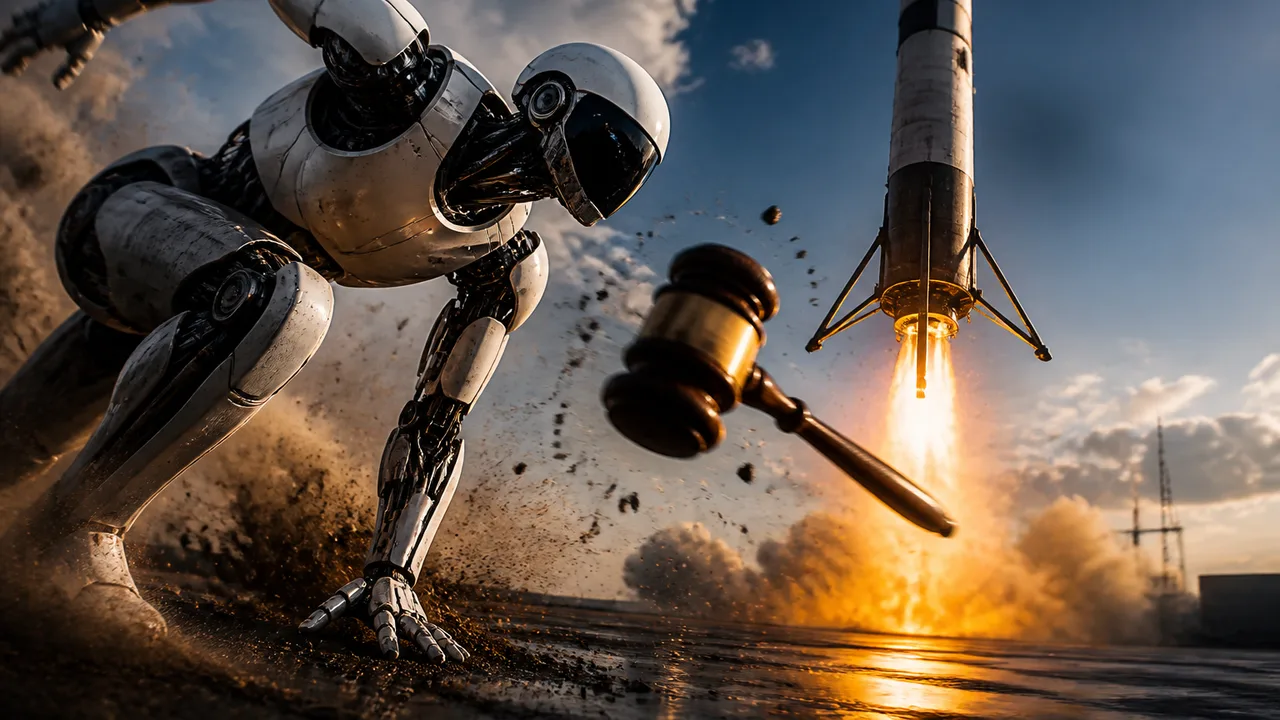
Photo: AI. Lev Zolotov
Four major AI models released in seven days. Apple suing OpenAI over trade secrets. China landing an orbital booster for the first time. These aren't separate stories running in parallel — they're the same story, told from three different angles, about who controls the infrastructure that's about to run everything.
The Moonshots crew — Peter Diamandis, Dave Blundin, Salim Ismail, and computer scientist Alexander Wissner-Gross — processed all of it in a bonus episode recorded July 11th, and the conversation is worth sitting with, not because they're always right, but because the tensions they surface are real.
The Duopoly Is Over. Now What?
Going into last week, the frontier AI market was effectively a two-vendor world: Anthropic and OpenAI. If you wanted state-of-the-art performance, those were your choices. By the end of the week, Wissner-Gross was reading a very different chart.
"We have four American labs now at the optimal frontier," he said, pointing to the Artificial Analysis intelligence index — a scatter plot tracking cost-per-task against composite performance scores. Grok 4.5 arrived July 8th. GPT-5.6 followed July 9th, with a model family that includes a high-end weight class (Soul) being used to post-train the lower-end Luna — OpenAI openly promoting what it's calling recursive self-improvement. Meta's Muse Spark appeared the same day, landing inside WhatsApp, Messenger, Instagram, and Facebook's combined 3.5+ billion daily users. Google, notably, is still off the optimal frontier, with Gemini 3.5 Pro reportedly delayed — which is its own story.
Two Chinese labs, DeepSeek and Xiaomi, also appear on the chart, and GLM 5.2 holds a position on the open-weight frontier. The Chinese model surge has been building for months; this week's releases confirm it's not slowing down.
What the episode's participants disagree on — productively — is what the frontier expansion actually means. Blundin's read: the real moat was never model quality or price, it's distribution. Meta pushing Muse Spark to 3.5 billion daily users doesn't just mean more eyeballs; it means the average person will use whichever model is embedded in whatever app they're already in. They won't choose. They won't know. That's the game.
Wissner-Gross pushes back in an interesting direction: distribution is valuable to the labs primarily as a capital-markets argument, not an economic one. Zuckerberg and Musk both used consumer distribution platforms — Meta's app family, X — to justify the capex for enormous AI supercluster buildouts. Once the clusters existed, the distribution rationale became almost beside the point. The clusters are the asset. Which is why, when Wissner-Gross is asked whether he'd rather have 7 billion combined users across X, Meta, and Google, or own TSMC's fabs, he doesn't hesitate: the fabs.
That framing matters for developers navigating model choice right now. The model consolidation dynamic has been accelerating for months, and the leapfrogging isn't stopping — it's compressing. The question for anyone building on top of these models isn't which one wins. It's how to avoid being locked into the wrong substrate when the compute supply stays constrained.
Apple vs. OpenAI: The Post-Smartphone Fight Gets Ugly
Apple filed a 41-page complaint in the US District Court of Northern California accusing OpenAI of trade secret theft at scale. The complaint names Tang Tan, OpenAI's chief hardware officer and a 24-year Apple veteran who ran iPhone and Apple Watch design programs, and a technical staff member accused of downloading confidential files. Apple's language in the filing is not measured: "At every level, from members of its technical staff to the chief hardware officer and in coordination with business partners, OpenAI has been stealing Apple's trade secrets."
The lawsuit names OpenAI's AI hardware venture — reported by CNBC to have been acquired for $6.4 billion — though Jony Ive himself is not named as a defendant.
What makes this genuinely complicated is the context. A year and a half ago, Apple and OpenAI were partners. OpenAI's ChatGPT was integrated into Apple devices. Now they're in federal court. The episode's panel reads this less as a legal play than a strategic signal — Apple is bleeding design talent to OpenAI and needs to stanch the wound, or at minimum make the exit cost visible.
Ismail's read is direct: "I think this is Apple trying to slow things down while it catches up." Blundin adds the tactical wrinkle: Northern California is a notoriously difficult jurisdiction for trade secret litigation. Silicon Valley's entire startup ecosystem is built on the premise that talent moves between companies and brings knowledge with it. Filing there, rather than Texas, suggests either genuine desperation or a different objective — documentation, deterrence, recruitment signaling — than actually winning.
The deeper subtext, as Wissner-Gross frames it, is valuation anxiety. OpenAI is approaching a trillion-dollar market cap, roughly 20-25% of Apple's. That gap is narrowing. Apple, which arguably had the hardware substrate advantage to become the dominant consumer AI platform, watched Jony Ive — its most totemic designer — leave and help build exactly that for a competitor. The lawsuit might be legally weak. The strategic hurt it represents is very real.
China's Booster Landing and the Infrastructure Bet Underneath Everything
On July 10th, China's Long March 10B booster performed a propulsive landing — the first time any non-US vehicle has stuck this maneuver. It's not reuse yet; landing is step one. But the comparison is instructive: Falcon 9 has now completed 580 booster reflights, and booster B1067 hit its 36th mission this same week.
The gap between where China is and where SpaceX is remains enormous. The question the episode raises is whether it matters for trajectory.
Wissner-Gross argues it does, and not just for geopolitical reasons: "We really don't want a heavy launch monopoly." His argument is that if the long-term plan involves moving serious compute off-planet — space-based data centers, orbital superclusters — then the launch supply chain has to be competitive. Single-vendor dependency in orbital infrastructure would replicate exactly the TSMC concentration problem, just higher up the stack. A China capable of propulsive landings, even years behind SpaceX, creates pressure that keeps the market from calcifying. The same logic that makes four labs at the AI frontier better than two applies to launch providers.
There's a clean line from this back to the compute conversation: the frontier labs that win the next decade will be the ones that can scale infrastructure fastest. That means energy, chips, and eventually — if Wissner-Gross and Ismail are right — orbital real estate. Low Earth orbit is scarce and self-cleaning, which means whoever claims it first holds it. SpaceX's Starlink buildout is partly about connectivity; it's also a land grab in the only real estate market that physically cannot expand.
What Developers Should Take From a Week Like This
The open-weight model story is the one that most directly affects the developer community, and it's the one the Moonshots episode handles least directly. Muse Spark from Meta is open-weight. GLM 5.2 from China holds the open-weight frontier. The economic incentives of the organizations releasing those models point toward proprietary superclusters and compute-as-a-service revenue, not toward open ecosystems. Meta and Musk used distribution as a fundraising argument; the infrastructure they built with those funds isn't primarily oriented toward openness.
That's the thing developers are underestimating right now. Open-weight releases are real and genuinely useful, but they're coming from organizations whose core economic interests are increasingly aligned with owning the compute layer, not liberating it. The leapfrogging visible on benchmark charts is healthy competition. What sits underneath it — who owns the power, the chips, the orbital slots — is consolidating faster than the benchmarks suggest.
The community should be building for portability, not just capability. The model that's cheapest and fastest today will be different in three months. The infrastructure concentration problem will still be there.
More Like This

GPT 5.6 Sol vs Fable 5: Early Numbers, Real Tradeoffs
GPT 5.6 Sol is half the price of Fable 5 — but is it half as good? Early benchmark comparisons, alignment regressions, and the politics reshaping who gets access.

US and China Train Almost All the World's AI Models
US and Chinese companies train nearly every major AI model the world uses. Here's what that concentration means for global power, values, and sovereignty.
Cursor's Composer 2 Drama: What Really Powers the Model
Cursor's impressive new Composer 2 model turns out to be built on Moonshot AI's Kimi—raising questions about disclosure, licensing, and transparency.
OpenClaw Raises Questions Nobody Wanted to Answer
An Austrian hobbyist's open-source AI project is forcing developers to confront what happens when your assistant calls you first—and won't stop calling.
Musk Says We're Already in the Hard Takeoff
Elon Musk claims recursive AI self-improvement is here, predicts 10x economy in 10 years, and says money will become irrelevant. What does the data say?

Planet Labs, Orbital AI Compute, and the Chip Tax
Planet Labs CEO Will Marshall argues chip efficiency—not launch cost—will determine who wins the race to put AI compute in orbit.
Webhooks, Event Gateways, and the Chaos of Vendor Latency
Hookdeck founder Alex Bouchard argues webhooks are just the visible tip of a messy event-driven architecture iceberg. Here's what that actually means.

Apple Sues OpenAI Over Alleged Trade Secret Theft
Apple filed a federal lawsuit accusing OpenAI of orchestrating a systematic theft of hardware trade secrets via former employees. Here's what we know.