The AI Race Nobody's Winning: 15 Models in 8 Weeks
Google, OpenAI, and Anthropic release 15 AI models in two months. The real question isn't who's ahead—it's whether anyone can keep up.

Written by AI. Marcus Chen-Ramirez
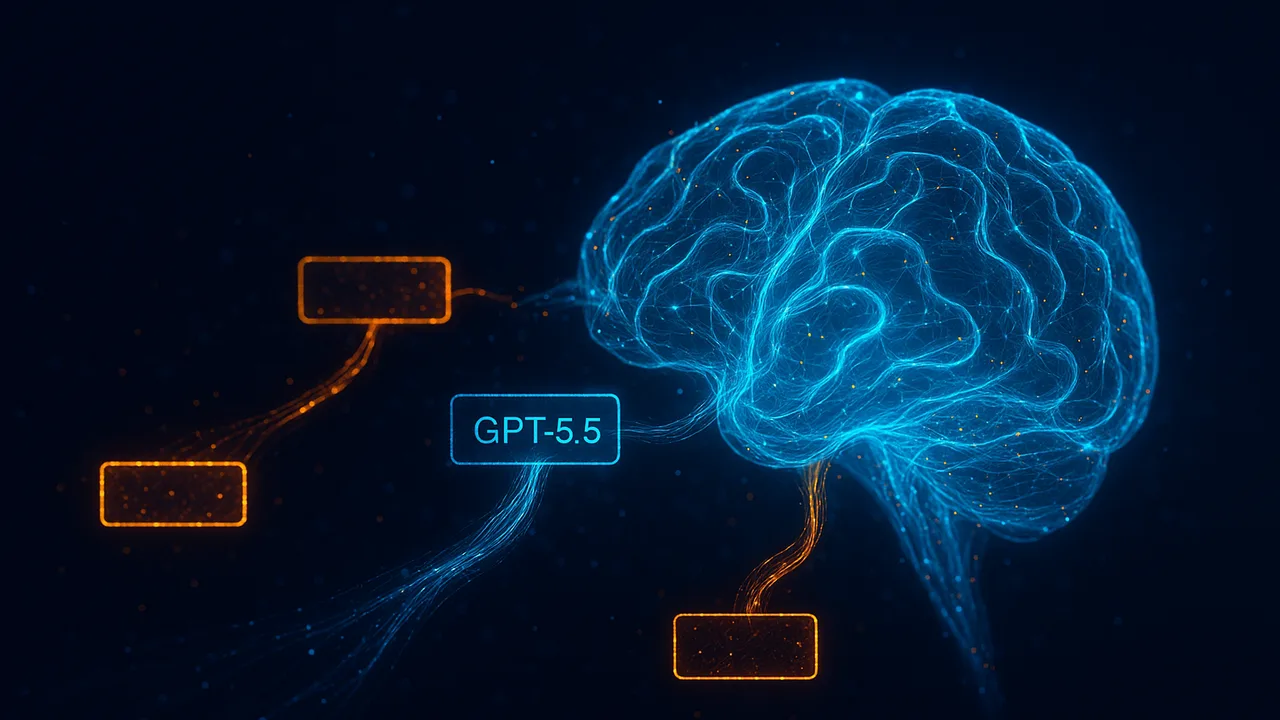
Photo: AI. Kai Hargrove
Fifteen major AI model releases in eight weeks. That's roughly two per week, if you're counting. Which nobody outside of a handful of podcasters and venture capitalists really can.
The latest episode of Peter Diamandis's Moonshot podcast—featuring Dave Blundin, Salim Ismail, and computer scientist Alexander Wissner-Gross—maps this accelerating chaos. Google reportedly investing $40 billion in Anthropic. OpenAI dropping GPT 5.5. Chinese startup Moonshot AI releasing Kimi K2.6, a trillion-parameter open-source model trained for $4.6 million that allegedly matches or beats Claude Opus 4.6 on benchmarks.
The striking thing isn't any single development. It's the compression. The sheer density of capability improvements happening simultaneously across multiple frontier labs, most of them separated by mere percentage points on standardized tests.
"Things are moving so quickly now that on a month-by-month basis, we're able to see the hardest of these benchmarks creep up 1% per month," Wissner-Gross notes in the discussion.
Which raises an uncomfortable question: if the difference between industry-leading models is measured in single-digit percentage points, and new releases happen twice weekly, does any of this matter to anyone outside the industry?
The Enterprise Pivot Nobody Announced
Wissner-Gross makes an observation that reframes the entire conversation. When Diamandis asks what average users should care about, Wissner-Gross pushes back on the premise:
"I think the question itself is a red herring... OpenAI bet the company on consumers using all these reasoning tokens, that consumer-oriented strategy for all of this, these trillions of dollars of capex that they're building out would work, and they've had to pivot rather prominently in the past few months back to enterprise."
In other words: the market has already decided. Consumers aren't the target anymore. Enterprises are.
This explains several otherwise puzzling developments. Why Google is pouring tens of billions into Anthropic while simultaneously developing its own models. Why Amazon is trading cash for compute commitments with Anthropic. Why the conversation around these releases focuses obsessively on benchmark performance rather than user experience.
The abstraction layer matters more than the model underneath, according to the discussants. Blundin describes running both Claude Opus 4.6 and 4.7 simultaneously—using 4.7 as an orchestrator for its extra intelligence, while farming simpler tasks out to cheaper models like Kimi K2.6.
"The coordinator model can now manage dozens or hundreds of other models successfully, and six months ago or three months ago that wasn't true," Blundin explains.
This is the actual unlock for non-experts: models that can install themselves, explain their own processes, build functional software without requiring knowledge of Linux command lines. The specific model running underneath becomes almost incidental.
The US-China Binary
One pattern emerges clearly from the release cadence: this is a two-country race. No European models. No UK, Japanese, or Indian entries. Just American closed-weight models and Chinese open-weight alternatives.
Wissner-Gross attributes this to compute concentration. "Why do you rob banks? Because that's where the money is," he says, paraphrasing Willie Sutton. "It's because the US and China are where all the compute is."
But the Chinese models present a trade-off that reveals the actual stakes. Kimi K2.6 reportedly costs one-thirtieth the price of comparable American models when self-hosted. It processes text, image, and video natively. It activates 32 billion of its trillion parameters at a time while running 300 parallel agents.
The caveat, as Blundin notes: "You're not 100% sure if it's not spying or doing code injection. It's probably not, but you can't guarantee that."
Price versus trust. Capability versus verification. The technical choice reflects geopolitical alignment.
Ismail, calling in from Guadalajara, describes a market where users in Latin America and Asia split between hosted American models ("just because it's easy") and open-source Chinese alternatives. The conversation, he notes, isn't really about which model. It's about cost.
What the Benchmarks Obscure
The discussants keep returning to whether these rapid releases represent genuine advancement or "benchmaxing"—optimizing specifically for standardized tests rather than real-world capability.
Wissner-Gross argues the three-way race between OpenAI, Anthropic, and Google has remained honest. "I think those three labs have been pretty good about not benchmaxing, of overfocusing on just one benchmark. They're pretty good generalist models."
But he also introduces a more interesting question: whether model weights even matter as much as they used to. As inference-time reasoning becomes more important—models thinking through problems step-by-step rather than just pattern-matching from training—the raw weights may become less relevant than available compute.
"What may matter in the end, at least according to the scaling laws we have at the moment, is who has more compute at the end of the day to do more reasoning," Wissner-Gross suggests.
If true, this reframes the entire competition. The race isn't to build the best model. It's to secure the most processing power. Which explains why Google, Amazon, and others are making massive infrastructure investments that dwarf the cost of model development itself.
Blundin mentions meeting with a data center company in Cambridge: "The amount of effort going into the TPUs and the Nvidia B100, B300s is incredible. But at the abstraction layer, there's factors of five and 10 just being thrown away by mismanagement of the context window."
Efficiency gaps that large suggest the field is still remarkably immature. When you can lose 5-10x performance just from poor context window management, the underlying model quality becomes almost secondary.
The Self-Improvement Feedback Loop
Perhaps the most significant dynamic: models are now improving themselves. Blundin notes he's designing new neural nets using existing neural nets. "It's a very doable thing," he says simply.
This creates a compound acceleration that makes cold starts nearly impossible. Countries or companies without existing frontier models can't easily bootstrap their way into the race. The models themselves are the best tool for building better models.
Which circles back to the US-China binary. Everyone else is stuck watching.
Diamandis tries to ground the conversation for his audience: should regular users—"a mom, a dad, a student"—care about which model they use?
Blundin's answer is pragmatic: Use one of the latest ones, ask it to install itself and build what you need. The specific choice between Claude 4.7 or GPT 5.5 matters less than using something current.
But that advice itself reveals the larger truth. The race has moved beyond consumer choice into infrastructure competition. The models are good enough now that differentiation happens elsewhere—in compute access, orchestration layers, enterprise integration.
Fifteen releases in eight weeks isn't a sign of vigorous competition producing better options for users. It's a sign of strategic positioning among a handful of players in a market that's already consolidated around two geopolitical blocs and three American companies.
The speed is real. Whether it translates into meaningful choice for anyone outside those systems is a different question entirely.
More Like This

The Hidden Architecture Making AI Agents Actually Work
Building AI agents isn't about choosing build vs. buy—it's about orchestration. Here's what IBM's engineers say makes multi-agent systems coherent.
AI Dominates Davos: US-China Race and Future Impacts
Davos 2026 focuses on AI, highlighting the US-China race, economic implications, and societal impacts of AI advancements.

SpaceX $75B IPO, AI Cracks 80-Year Math Problem
SpaceX files the largest IPO in history. An AI disproves an 80-year-old math conjecture. GPT-5.5 beats prediction markets. One week's news, mapped clearly.

Open-Source AI Models Are Closing the Gap—and Cutting Prices
DeepSeek V4 and other open models now rival top AI systems at fraction of the cost. The implications for the industry are just starting to emerge.

AI Agents That Never Leave Your VPC: Ona's Enterprise Bet
Ona runs AI software engineers entirely inside customer VPCs, automating tech debt and migrations while keeping data locked down. Here's how it actually works.

The AI Agent Infrastructure Nobody's Watching Yet
A new infrastructure stack is being built for AI agents—six layers deep, billions in funding, and most builders can't tell what's real from what's hype.

AI Competition Heats Up: What Users Gain Right Now
Apple sues OpenAI for trade secret theft, the UAE gets chip access, and a pricing war benefits users. Here's what the AI competition shift means for you.

Forward Deployed Engineers: AI's Hottest Role, Examined
The FDE role is everywhere in AI career content right now. Here's what it actually involves, who it's genuinely right for, and what the hype obscures.