Mars 1's 1962 Launch and the Limits of Early Mars Flight
Mars 1 launched toward a planned flyby in 1962, but contact failed before it could return observations. Its story traces the demands of early planetary flight.

Written by AI. Olivia Meng
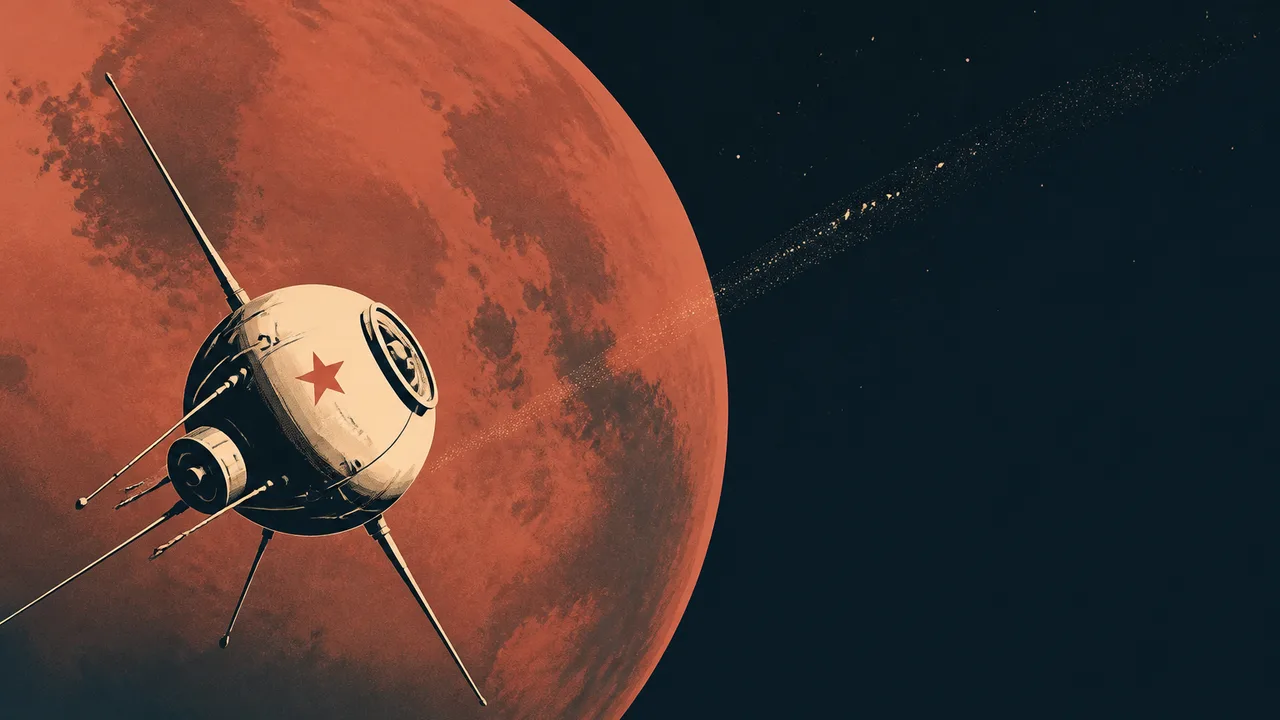
On Nov. 1, 1962, the Soviet Union launched Mars 1 toward a planned flyby of the Red Planet. Radio contact failed in March 1963, months before the spacecraft was expected to pass Mars in June. The launch secured Mars 1 a place in the history of planetary exploration. The lost link prevented it from returning observations during its planned flyby.
Sixty-four years later, the mission offers a useful measure of what an interplanetary flight demands. Getting a spacecraft away from Earth is one achievement. Keeping it on course, hearing from it across an expanding distance and receiving observations at the right moment are further achievements, each dependent on the ones before it. Mars 1 exposed that chain at a time when engineers were still learning how to build it.
A Destination and a Data Plan
Mars 1 was intended to fly past the planet at a distance of about 11,000 kilometers, or 6,800 miles. The spacecraft was designed to image the Martian surface. That target distance describes a mission plan, not an observed close approach: after contact ended, its subsequent trajectory could not be confirmed.
A flyby was an ambitious scientific proposition. A spacecraft passing Mars would have a limited opportunity to point its instruments, collect observations and transmit them to Earth. Unlike an orbiter, it would not have repeated passes to recover from a missed chance. The encounter would also require navigation accurate enough to bring the probe near its target after months of travel. Launching toward Mars began that process; it did not settle where the spacecraft would be when Mars came into range.
The scientific objective gives the lost radio link its consequence. An image can expand knowledge of Mars only if the spacecraft acquires it and the signal reaches Earth. Even a probe that passes close to a planet cannot deliver the intended science after communication fails. Mars 1’s designers had set out to observe a world that, in 1962, no spacecraft had yet studied at close range. Their plan depended as much on a functioning connection home as on the journey outward.
The Distance Problem
Earth-orbiting spacecraft face serious engineering demands, but an interplanetary mission adds distance and time on another scale. As a probe recedes, its radio signal spreads through space. A receiver on Earth must distinguish that weaker signal from background noise. The spacecraft must also have power, a working transmitter and an antenna oriented well enough for communication. Ground equipment must be ready to listen. None of those requirements disappears simply because the launch vehicle performed its job.
Distance also changes how engineers respond to trouble. Commands and replies take time to cross interplanetary space, so a ground team cannot treat a probe like a machine it can adjust instantly. Diagnosis depends on whatever information the spacecraft can transmit. If that link stops, engineers lose both the planned science and their main means of determining what happened aboard the vehicle.
Mars 1 illustrates the result without supplying a tidy diagnosis. Communication ended in March 1963; assigning a specific cause for that failure would go beyond the established account. With no continuing contact, controllers could not guide the remaining mission or collect the observations planned for the flyby.
Navigation has a similar dependence on information. A destination on a mission chart is a prediction based on launch conditions and any later measurements or adjustments. Over a long journey, a small change in direction can become a large difference at the destination. Continued tracking lets controllers refine their estimate of a spacecraft’s path. Mars 1’s loss of contact removed that feedback before the expected flyby, leaving its distance from Mars unconfirmed.
What Counts as Progress?
The early space race rewarded visible milestones: a launch, a departure from Earth, a spacecraft headed toward another planet. Those milestones required formidable work. Mars 1 reached a stage that many proposed missions never do, and its flight demonstrated the scale of Soviet ambition in the first years of planetary exploration. Calling it an early attempt to reach Mars gives that achievement its due.
A different measure asks what the mission learned about Mars. By that standard, the planned flyby could not do its intended job. These measures answer different questions. One concerns the development of interplanetary flight; the other concerns scientific return. Placing both on the same timeline prevents the launch date from standing in for a completed observation.
Reliable planetary science requires several systems to succeed together: propulsion and navigation to put a probe where its instruments can work, spacecraft hardware to operate after a long journey, and communications to deliver the results. Progress in one system does not guarantee success in the others. A mission can therefore push the boundaries of flight while leaving its central scientific question unanswered.
That helps explain why later successful Mars missions should not make the 1962 effort look simple in retrospect. Subsequent spacecraft benefited from accumulated experience in guiding, operating and communicating with vehicles far from Earth. That experience was built through repeated attempts, including missions whose limitations made the next engineering problem harder to ignore. Mars 1 belongs in that history, even though its intended images never arrived.
An Anniversary with a Precise Date
Nov. 1 marks Mars 1’s launch; the flyby expected months later yielded no observations after contact failed. The anniversary is a chance to examine how easily those events can collapse into a single phrase such as “mission to Mars.” A mission has stages, and each stage has its own outcome. Mars 1 left Earth on a trajectory aimed at a flyby; the loss of contact prevented that planned passage from yielding observations.
The distinction also shapes how to understand the persistence of Mars exploration. The goal survived the failure of any single spacecraft because the scientific questions remained: what the planet’s surface was like, and what instruments could reveal from nearby. Reaching a position to ask those questions and returning an answer required engineers to solve problems that only become apparent across millions of kilometers.
Mars 1’s launch date records how early that effort began. Its silence records how much of the journey still had to be mastered.
More Like This

Stroke Risk Peaks in the First Three Months After a Cancer Diagnosis
New research in Cancer finds stroke risk rises 2.5-fold in the first three months after a cancer diagnosis, especially with pancreatic and lung cancers.

A Victorian Train Delay Exposes Space Weather Risk
A disputed Victorian train delay links geomagnetic activity to telegraph faults, showing how space weather affected systems before satellites and power grids.

Montana's JM Reef and America's Platinum Supply Problem
The JM Reef in Montana is America's only platinum and palladium source. What that means for clean energy, emissions tech, and supply chain security.
Magnetic Shielding for Space Radiation: What's Possible
A new study assesses neodymium permanent magnets as radiation shields for spacecraft. Here's what the physics allows, what it doesn't, and why this problem won't go away.
Mars, Enceladus, and the Search for Life
From Mars's vanishing water to Enceladus's hidden ocean, planetary science is reshaping our understanding of where life might exist.
Can Humans Really Live on Mars? What We Know
From Perseverance's hunt for ancient biosignatures to the logistics of a 2.5-year round trip, here's where the Mars ambition actually stands.
AI Finds 7 Quasar Lenses That May Explain Black Hole Growth
An AI trained on simulated data found 7 rare quasar lenses in 800,000 DESI objects. The method reshapes how astronomers—and scientists everywhere—search for rare phenomena.

How the First Trees Conquered a Barren Earth
From acid-secreting fungi to lignin-packed wood, the 385-million-year story of how trees came to dominate Earth is stranger than most people realize.