Stroke Risk Peaks in the First Three Months After a Cancer Diagnosis
New research in Cancer finds stroke risk rises 2.5-fold in the first three months after a cancer diagnosis, especially with pancreatic and lung cancers.

Written by AI. Olivia Meng
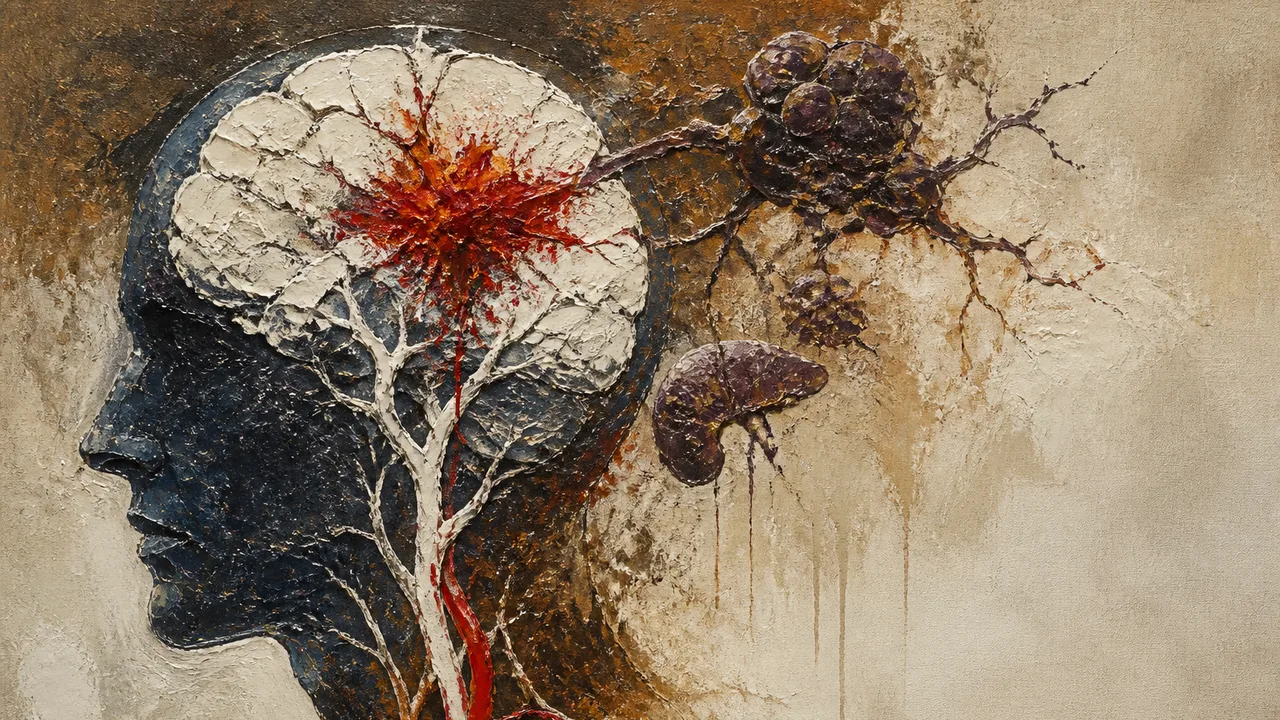
People with invasive cancer had a stroke rate 2.5 times higher than expected during the first three months after diagnosis, according to new research published in the journal Cancer and reported by Medical Xpress. The finding describes a window, not a steady state: the risk was not spread evenly across the year following diagnosis, but peaked sharply in those first ninety days, as Starts at 60 reports.
That timing is the most useful part of the result. A risk that is constant can be averaged into general advice; a risk that spikes and fades points to something happening in a specific period, and in principle it can be planned for.
What the Study Found
The researchers identified the first months after a cancer diagnosis as "a critical window of heightened ischemic stroke risk," according to News-Medical. The elevation was not uniform across tumor types. The highest stroke rates occurred in patients with pancreatic cancer and lung cancer, while breast and prostate cancers were not linked to a higher risk at all, per Scimex. Risk also appeared especially elevated in younger patients and those with advanced disease.
Read those two patterns together and a coherent picture emerges. Pancreatic and lung cancers are among the tumor types most strongly associated with abnormal blood clotting in the broader medical literature; cancer-associated thrombosis has been recognized since the nineteenth century, when the French physician Armand Trousseau linked migratory clots to occult malignancy. Ischemic stroke is, at bottom, a clotting event in a brain artery, so the concentration of elevated risk in the pro-thrombotic cancers fits a mechanism rather than a coincidence. The higher risk in advanced cancer and in younger patients fits too: advanced disease carries more tumor burden and more inflammatory activity, and a younger patient with cancer has less baseline atherosclerosis for the cancer's effects to hide behind.
Why the First Three Months
Medical Xpress describes the window as one in which tumour biology, inflammation, abnormal clotting, treatment effects and the stress of serious illness may overlap. That list is a menu of plausible contributors rather than a settled causal account, and it is worth separating the entries.
Some cancers directly generate pro-coagulant factors; pancreatic tumors in particular are notorious for shedding substances that activate the clotting cascade. Systemic inflammation from a growing tumor makes blood more prone to clot and destabilizes existing arterial plaque, the standard pathway to ischemic stroke. Treatments add their own risks: some chemotherapy regimens and surgery each raise clotting risk independently. And a diagnosis itself is a physiological event; the weeks after one involve scans, biopsies, operations and hospital stays, all of which are associated with vascular events in their own right.
The study design cannot fully untangle these strands. The result is an association: people diagnosed with invasive cancer had more strokes than a comparable population, concentrated early. Whether the cancer biology caused those strokes or whether diagnosis simply marks a period of intense medical activity and shared underlying risk factors is a question the available summaries do not answer. Details of the study population, how stroke and diagnosis dates were recorded, and how patients were matched are not provided in the source reports, so the size of the effect should be read with that qualification in mind.
One pattern the authors themselves flag makes selection bias hard to ignore entirely: a stroke can precipitate a cancer workup, meaning some cancers are diagnosed during or shortly after the stroke that brought the patient to hospital. To their credit, the reported peak extends across a full three months, which is longer than that reverse-causation artifact would predict on its own, but it likely contributes to the earliest weeks of the curve.
Why Breast and Prostate Are Absent
The null results are as informative as the positive ones. Breast and prostate cancers, the most common cancers in high-income countries, showed no elevated stroke risk in this study. Both are often diagnosed early and treated with long courses of therapy rather than immediate major surgery, and neither sits at the aggressive end of the thrombosis spectrum. If stroke risk tracked merely with the stress of any serious diagnosis, these cancers would light up too. They did not. The contrast argues that the mechanism tracks tumor biology, particularly the pro-clotting behavior of pancreatic and lung tumors, more than diagnostic distress alone.
The younger-patient finding is more puzzling. Younger patients generally have cleaner arteries, so an added pro-thrombotic insult should face less competition as an explanation for a stroke; a 45-year-old's stroke is more likely to have an unusual cause. That is consistent with the data, but it could also reflect how the study counted baseline risk in a matched comparison. Without the full methods, the interpretation stays open.
What It Would Take to Act On
The clinical question is whether this window justifies changes in care. The temptation is to reach for anticoagulation: if cancer makes blood clot, thin the blood. Medicine already does this selectively. Cancer patients who develop venous clots are routinely treated with blood thinners, and certain high-risk outpatient groups, such as many pancreatic cancer patients on chemotherapy, are candidates for preventive anticoagulation in current guidelines.
Extending that logic to stroke prevention across all new cancer diagnoses would be a mistake, and the study does not support it. Anticoagulants carry substantial bleeding risks, including intracranial hemorrhage, and applying them broadly would trade a concentrated, partially understood stroke risk for a diffuse bleeding risk in a population that also faces surgery and thrombocytopenia from chemotherapy. The published summaries are explicit that the finding does not mean every newly diagnosed patient needs preventive treatment.
The more plausible application is surveillance and risk stratification. If the risk is concentrated in identifiable groups, the clinical task is to build a profile: pancreatic or lung primary, advanced stage, younger age, perhaps known clotting history or an immobility in the first weeks of treatment. Patients matching it might warrant closer attention to neurological symptoms, faster imaging when symptoms appear, and tighter management of conventional stroke risk factors like blood pressure and atrial fibrillation during the first months of cancer care. None of that requires new drugs; it requires the oncology team and the stroke pathway to know about each other during a period when patients are usually focused elsewhere.
What the Evidence Does Not Settle
Several questions remain open, and the honest reading of this study is that it raises them sharply rather than answering them. Does the risk decline to baseline after three months, and if so, what changed: tumor treatment, or the biology itself? Would the elevation persist in health systems that diagnose cancer at earlier stages? Does the effect vary with specific treatment sequences, such as surgery followed by chemotherapy, which the aggregated result cannot distinguish? And critically, does intensified surveillance or preventive management in the first ninety days actually reduce stroke rates in a randomized setting, or does knowing the window exist simply sharpen the statistics?
The strongest version of the finding is that it gives clinicians a time and a population to watch. The weakest version is that it reflects detection artifacts and the ordinary vascular turbulence of a cancer workup. The truth is probably between those poles, and the tumor-type pattern, elevated for pancreatic and lung cancers, absent for breast and prostate, is the strongest clue about where in that range it falls.
For now, the practical takeaway sits with patients and families rather than protocols. Stroke symptoms in the months after a cancer diagnosis, sudden face drooping, arm weakness, speech difficulty, warrant the same urgent response as they do anywhere else, and perhaps more vigilance than usual. The ninety days after a cancer diagnosis are already crowded with appointments and fear; this study suggests the brain deserves a place on that calendar too.
More Like This

Statins May Cut Dementia Risk in Type 2 Diabetes
A major study finds early statin use after a type 2 diabetes diagnosis is linked to up to 15% lower dementia risk. Here's what the evidence actually shows.

SpaceX Launches 27 Starlink Satellites, Lands Booster at Sea
A Falcon 9 launched 27 Starlink satellites from Vandenberg on Sept. 6. What the routine flight reveals about the industrial pace of low-Earth orbit.

Private Satellites and AI Are Rewriting How We Watch Earth
Commercial satellite constellations and AI can track forests, ice and fires in near real time. The catch: who can audit the data, and who gets to see it.
Pancreatic Cancer Treatments That Could Change Everything
NALIRIFOX, daraxonrasib, and a personalized mRNA vaccine are reshaping pancreatic cancer treatment. Here's what the breakthroughs mean—and who can actually access them.
Unveiling the Trench Effect: Lessons from King's Cross
Explore the King's Cross fire, the trench effect, and vital fire safety reforms reshaping public infrastructure.

AHA Says 5 Cups of Coffee a Day Is Safe for Your Heart
The American Heart Association says up to 5 cups of coffee daily is safe and may lower heart disease risk. Here's what that actually means—and what it doesn't.

Three Gorges Dam: Engineering at Planetary Scale
China's Three Gorges Dam generates more power than 20 nuclear reactors and measurably slowed Earth's rotation. The physics are astonishing. The cost was human.

Utah's Giant Solar Project Is Real—and Complicated
Utah's Green River Energy Center pairs 400 MW of solar with 1,600 MWh of battery storage. Here's what the press release leaves out.