SpaceX Launches 27 Starlink Satellites, Lands Booster at Sea
A Falcon 9 launched 27 Starlink satellites from Vandenberg on Sept. 6. What the routine flight reveals about the industrial pace of low-Earth orbit.

Written by AI. Olivia Meng
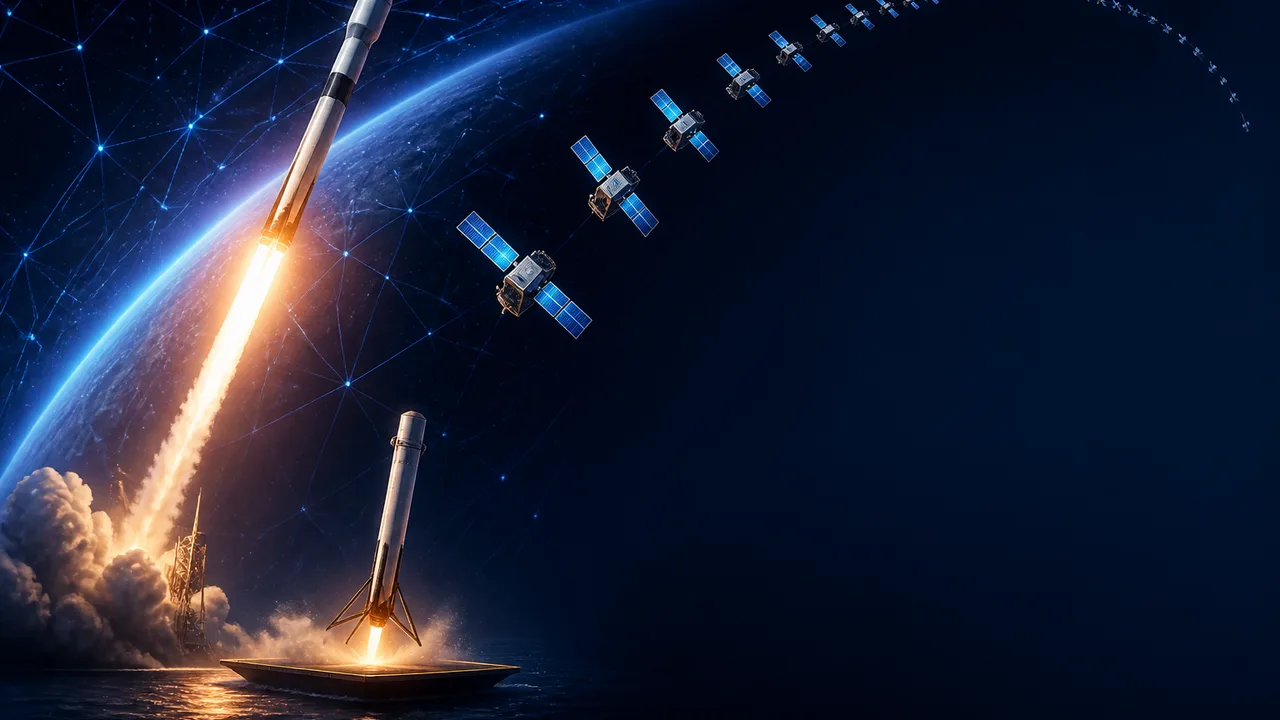
A Falcon 9 rocket lifted off from California's Vandenberg Space Force Base at 10:26 a.m. EDT (1426 GMT) on September 6, carrying 27 Starlink internet satellites into low Earth orbit, according to freeindependentnews.com. Eight and a half minutes later, the booster came back down through the atmosphere and settled onto the drone ship "Of Course I Still Love You" in the Pacific, as newsbeep.com reports.
By now this is a production line. The launch was routine in the most literal sense: another standardized batch, another landing, another tick in a cadence that has made low-Earth-orbit deployment an industrial activity rather than an event. space.com frames it the same way, noting that reusable boosters and batch-built satellites have made launches more frequent and less remarkable. The absence of drama is the story.
What a Routine Flight Actually Tells You
The operational achievement here is modest and well understood. Reusability is the engine of the whole system: a first stage that lands on a barge can be refurbished and reflown, which drops the marginal cost of getting mass to orbit and makes a 27-satellite batch an ordinary Tuesday rather than a national occasion. That cost structure is why Starlink has grown into the largest satellite constellation ever operated, and why launch frequency has climbed to the point where a single company flies multiple times per week from two coasts.
But the flight itself settles none of the larger questions. It is evidence that the deployment machinery works, not evidence that the orbital environment around it is being managed well. Those are separate claims, and the confusion between them is where most of the public debate goes sideways.
The Trade-Offs the Booster Landing Doesn't Touch
Large constellations deliver real benefits. Starlink extends broadband to places terrestrial infrastructure never reached affordably, and it has proven consequential in disaster zones where ground networks are down. Those are not marketing claims; they are observable uses.
Against that sit four open problems, each governed by different mechanisms and different regulators, which is part of why none of them has a clean solution.
Optical interference. Reflected sunlight off satellites leaves streaks in astronomical images, and the problem scales with constellation size. SpaceX has worked with astronomers on darkening treatments and sunshades on earlier satellite generations, but the record is thin on how consistently the current generation performs, and no source in this story provides updated measurements. Honest answer: the mitigation is partial, the data is patchy, and the satellites keep launching either way.
Radio interference. Optical streaks spoil images, but radio leakage from satellites contaminates observations at frequencies radio astronomers assumed were protected. In 2023, researchers detected unintended electromagnetic emission from Starlink satellites using the LOFAR array in the Netherlands, and subsequent studies found similar leakage from other constellations. No treaty governs incidental radio emission from spacecraft in orbit; spectrum regulation on the ground stops at the atmosphere.
Collision avoidance and debris. More satellites mean more close approaches, more maneuvering, and more reliance on every operator's systems working correctly. Starlink satellites fly at altitudes low enough that atmospheric drag deorbits dead hardware within years rather than centuries, which is a genuine safety property of the design. The residual risk is compounding traffic: thousands of satellites, a growing debris population from other sources, and automated avoidance that depends on coordination standards not all operators meet.
End-of-life performance. A constellation's debris footprint depends on satellites deorbiting reliably at end of life. A satellite that fails in a high orbit is a problem for decades; a failed satellite in a low orbit is a problem for a few years. The Starlink shells sit low, and the design bet shows. What the record does not yet show, because the fleet is young, is the failure rate across a full operational lifetime at scale.
The Governance Gap
Here is the structural problem, and it is the part of this story no booster landing can fix. Space traffic management has no equivalent of air traffic control with binding authority. The Outer Space Treaty of 1967, written when roughly two countries could reach orbit, says nothing about mega-constellations. Licensing runs through national regulators, chiefly the U.S. Federal Communications Commission for radio spectrum and orbital debris review, which means coordination happens between operators on a voluntary basis, with data shared through civilian tracking networks.
SpaceX has moved first on some of this: automated collision avoidance, transparency filings, engagement with the American Astronomical Society's satellite constellation working groups. Critics, including astronomy societies and some rival operators, argue that voluntary coordination at tens of thousands of satellites is not a system, it is a habit. The strongest version of the industry position is that launch and deployment are proceeding faster than any international process could have, and that the alternative, a slower build-out of broadband infrastructure, has costs too. The strongest version of the critics' position is that orbital capacity is a commons, and commons get degraded when use outpaces rules.
Both positions rest on an empirical question that is still open: how much traffic, debris, and brightness can low-Earth orbit absorb before the costs start compounding faster than the mitigations? Nobody has a defensible number.
What to Watch Next
The September 6 flight will be forgotten within a news cycle, and it should be. The indicators that matter live elsewhere. Watch the annual satellite failure and deorbit statistics SpaceX files with the FCC, which reveal whether the lifetime reliability assumption holds at scale. Watch whether the next satellite generation ships with radio-emission reductions comparable to the optical fixes, because radio astronomy has had far less leverage. Watch the FCC's ongoing review of its orbital debris rules, the closest thing to a binding update the U.S. regulatory system has produced.
A Falcon 9 landing on a drone ship eight and a half minutes after liftoff is now a solved problem. Managing twenty-some thousand satellites in a shared orbital commons is not solved, and each routine launch adds to the total while the rules catch up or fail to.
More Like This

SpaceX Hits 600 Falcon 9 Booster Reuses
SpaceX reached 600 flight-proven Falcon 9 booster launches on July 13-14, 2026. Here's what that number actually means for spaceflight economics.
Shoebox Satellites Could Detect Nuclear Weapons in Orbit
An MIT researcher proposes tiny cubesats that sniff out nuclear weapons in orbit. Here's what the physics can do—and what no satellite can fix.

Fermi Explorer Plans 2029 Launch on an 80,000-Year Trip
A nonprofit wants to launch the cheapest possible probe to Alpha Centauri in 2029. The catch: it won't arrive for roughly 80,000 years. Here's what that means.

Unveiling the Trench Effect: Lessons from King's Cross
Explore the King's Cross fire, the trench effect, and vital fire safety reforms reshaping public infrastructure.

How Gasoline Is Made: From Crude Oil to the Pump
Gasoline was once a waste product nobody wanted. Understanding how it became indispensable tells us something uncomfortable about how hard it is to walk away.
SpaceX Plans First Starship Upper Stage Tower Catch
SpaceX plans to catch the Starship upper stage with its launch tower arms for the first time. Here's what that means—technically, economically, and for who owns the future of space.

Three Gorges Dam: Engineering at Planetary Scale
China's Three Gorges Dam generates more power than 20 nuclear reactors and measurably slowed Earth's rotation. The physics are astonishing. The cost was human.

Utah's Giant Solar Project Is Real—and Complicated
Utah's Green River Energy Center pairs 400 MW of solar with 1,600 MWh of battery storage. Here's what the press release leaves out.