Three Gorges Dam: Engineering at Planetary Scale
China's Three Gorges Dam generates more power than 20 nuclear reactors and measurably slowed Earth's rotation. The physics are astonishing. The cost was human.

Written by AI. Olivia Meng
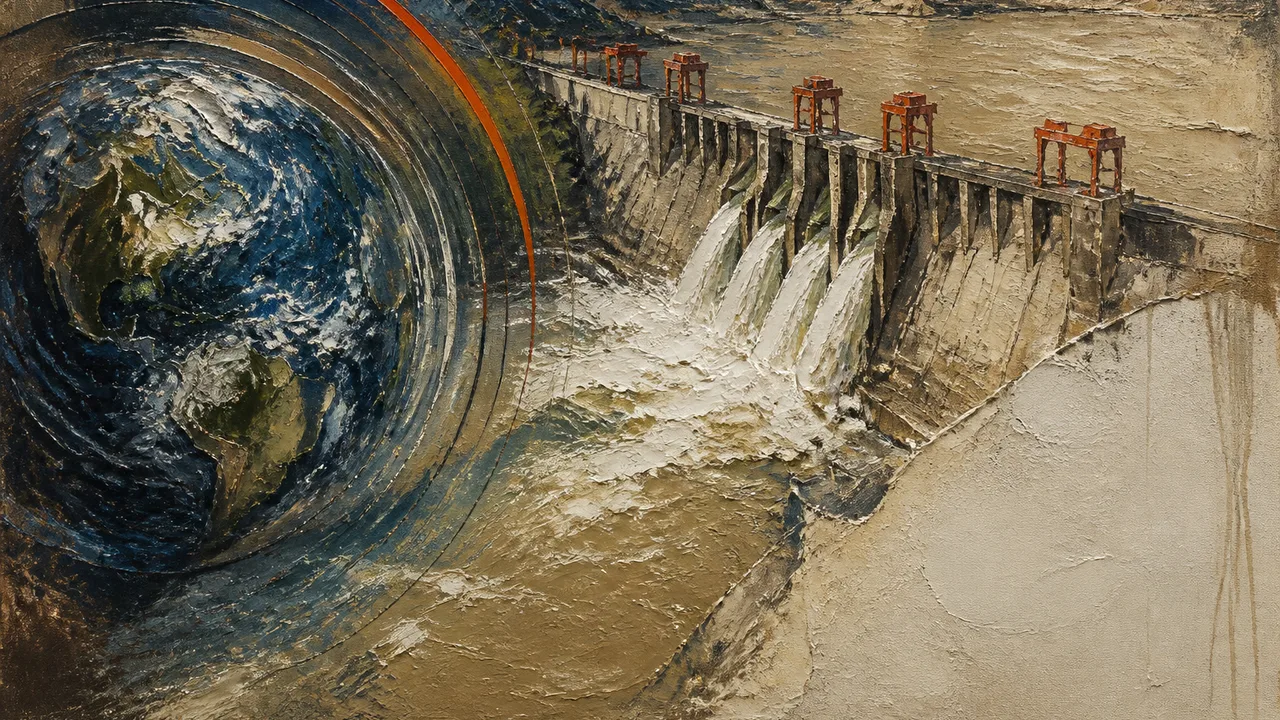
Photo: AI. Saskia Aaltonen
Sun Yat-sen imagined it in 1919. It took China another 75 years to break ground, and another 18 after that before the last turbine spun up. By the time the Three Gorges Dam was fully operational in 2012, it had consumed 27 million cubic meters of concrete, displaced more than 1.3 million people, and — in a detail that stops most readers cold — measurably slowed the rotation of the Earth.
That last part is not metaphor.
The Wall
The dam sits on the Yangtze River, the longest river in Asia, in a stretch of canyon country in Hubei Province. Its vital statistics read like a quantity surveyor's fever dream: 2,335 meters long, 185 meters tall — roughly a 60-story building tipped on its side and stretched across a river. Engineers classify it as a gravity dam, meaning there is no arching geometry redistributing forces into canyon walls. It holds back the Yangtze through mass alone. The base is thick enough that the water behind it, for all its weight, cannot tip the structure over or push it downstream.
Pouring 27 million cubic meters of concrete presented a problem that doesn't get discussed enough in the popular mythology of megaprojects: concrete generates heat as it cures, and a pour this large, left to its own devices, would have cracked the structure from the inside before it ever held back a river. The engineering solution was to run cooling water through pipes embedded in the concrete as it was poured — essentially refrigerating a wall the length of 23 football fields. The steel bill came to roughly 463,000 tons, enough to build 63 Eiffel Towers.
Inside the dam sit 32 main turbines, each rated at 700 megawatts, plus two smaller units. The total installed capacity: 22,500 MW, equivalent to more than 20 typical nuclear reactors running simultaneously. In 2020, the dam set the world record for annual electricity generation, producing 111.8 billion kilowatt-hours in a single year — more than many countries consume in total.
The engineering detail that consistently surprises people, though, is neither the turbines nor the concrete. It's the ship elevator. The dam blocks a major commercial shipping route on the Yangtze, so engineers built a workaround: a steel vessel, effectively a giant bathtub, that lifts 3,000-ton ships 113 meters vertically. The trip takes about 40 minutes. Larger ships use a five-stage staircase of locks — a more leisurely four hours. Both solutions are, in their own way, absurd; both are fully operational.
The Physics
Behind the wall, a reservoir stretches roughly 600 kilometers upstream — approximately the road distance from New York City to Toronto. It holds around 40 billion tons of water, water that once drained continuously to the sea and now sits at an elevation of about 175 meters above sea level.
Here is where the physics becomes genuinely strange.
Water that flows downhill and out to sea stays, on average, near its equilibrium distribution around the planet. Water pooled at elevation in a reservoir is water that has been lifted and displaced outward from the Earth's rotational axis. And angular momentum — the property that governs how fast a spinning object rotates — is conserved. When mass moves away from the axis of rotation, the spin slows. This is the same physics that explains why a figure skater spins faster with arms tucked and slower with arms extended.
The Earth is the skater. The reservoir is the extended arms.
Dr. Benjamin Fong Chao at NASA's Goddard Space Flight Center ran the calculations. His conclusion: filling the Three Gorges Reservoir increased Earth's moment of inertia enough to lengthen the day by 0.06 microseconds and shift the position of Earth's poles by approximately 2 centimeters. As IE Explains puts it: "Humans poured enough concrete and pulled enough water in one place to measurably nudge the rotation of a planet. No other single structure we've ever built has that distinction."
0.06 microseconds is, to be clear, imperceptible by any human sense. It doesn't affect your morning. But it is measurable. A single dam — one infrastructure project approved by one government — produced a detectable change in how fast the planet rotates. The frame that requires is not engineering; it's geology.
The Cascade
Three Gorges is not even the full story anymore.
Upstream on the Yangtze system, China has constructed a cascade of additional mega-dams: Wudongde, Baihetan, Xiluodu, and Xiangjiaba. Baihetan alone, completed in 2022, has an installed capacity of 16,000 MW, making it the world's second-largest hydropower plant. The four upstream dams together represent roughly twice the generating capacity of Three Gorges itself. The Yangtze, in other words, is no longer a river in the conventional sense — it is a managed energy and water system operating at continental scale.
Flood control was always part of the design. The Yangtze's history through the 20th century is punctuated by disasters: single flood events that killed tens of thousands. The Three Gorges reservoir functions as a buffer — holding back peak summer flows that would otherwise surge toward Wuhan, Nanjing, and Shanghai. During the record flooding of 2020, the dam throttled downstream flow and was credited with limiting what could have been a catastrophic inundation of densely populated cities. That outcome is exactly what Sun Yat-sen envisioned when he first sketched the idea more than a century ago.
The Price
Every record was paid for, and the ledger is not abstract.
As the reservoir filled, it submerged 13 cities, 140 towns, and more than 1,300 villages. More than 1.3 million people were relocated — one of the largest peacetime population displacements in recorded history. What was lost alongside the homes is harder to quantify: thousands of years of archaeological and cultural sites, some documented before submersion, many not, now sitting at the bottom of a reservoir.
The physical side effects continue to accumulate. The weight of 40 billion tons of water pressing on the reservoir's slopes has been linked to increased landslide activity along the banks. Scientists monitor the area for reservoir-induced seismic activity — a phenomenon observed at large reservoirs globally, where subsurface pressure changes can trigger small earthquakes. Downstream, the dam traps the sediment that once replenished riverbanks and the Yangtze delta, a disruption to a geomorphic system that evolved over millennia.
And then there is what defense analysts have called the structure's most troubling characteristic. A 2004 Pentagon report — along with subsequent analysis from multiple security researchers — has examined the Three Gorges Dam as a potential military target in any conflict involving China. Chinese military officials have stated that a strike on the dam would trigger overwhelming retaliation. The scenario is hypothetical; the vulnerability is structural. A single point of failure holding back 40 billion tons of water above one of the most densely populated river valleys on Earth is, regardless of political context, an extraordinary concentration of risk.
The Question the Dam Keeps Asking
The honest accounting of Three Gorges doesn't resolve cleanly. Tens of millions of people receive reliable electricity from it. Cities downstream sleep more safely because of it. The sediment deficit downstream is real. The 1.3 million displaced people are real. The planetary-scale physics are real, and they are the same physics operating on the four additional mega-dams now running upstream.
China is not finished building on the Yangtze system. The cumulative rotational, seismic, hydrological, and social effects of that cascade are still being measured. What Three Gorges demonstrated — permanently — is that human infrastructure can now operate at a scale that registers in the planet's own physics. Whether the ambition that made that possible is cause for admiration or alarm:
"Whether that's a triumph or a warning probably depends on which side of the reservoir you were standing on."
More Like This

Google's Android Earthquake Alerts Warned Venezuela
On June 24, 2026, Venezuela had no national earthquake warning system. Google's Android alert network reached 11.4 million phones anyway. Here's what that means.

How the Asteroid Impact Ended the Dinosaur Era
Explore the catastrophic asteroid impact that ended the dinosaurs, its immediate aftermath, and the long-term environmental changes.

Subcritical Reactors: Nuclear Power's Safety Fix?
A new generation of subcritical reactors promises to make nuclear meltdowns physically impossible. But can they deliver on cost, scale, and timeline?

Ten Engineering Projects That Remade the World
From the Panama Canal to the International Space Station, ten engineering feats that didn't just solve problems — they rewrote what was thought possible.
New York City's Underground Infrastructure Explained
From gravity-fed water tunnels to steam pipes and subway lines, NYC's underground is a century-deep tangle of engineering decisions—brilliant, broken, and still evolving.

Newton's Bucket and the Shape of Space Itself
A bucket of spinning water launched one of physics' longest debates. Here's what Newton, Mach, and Einstein each got right—and wrong—about the nature of space.
Utah's Giant Solar Project Is Real—and Complicated
Utah's Green River Energy Center pairs 400 MW of solar with 1,600 MWh of battery storage. Here's what the press release leaves out.

U.S. Science Brain Drain Threatens American Innovation
Neil deGrasse Tyson warns the U.S. is losing its scientific base to budget cuts and brain drain. What that means for innovation, and for the future.