How Gasoline Is Made: From Crude Oil to the Pump
Gasoline was once a waste product nobody wanted. Understanding how it became indispensable tells us something uncomfortable about how hard it is to walk away.

Written by AI. Olivia Meng
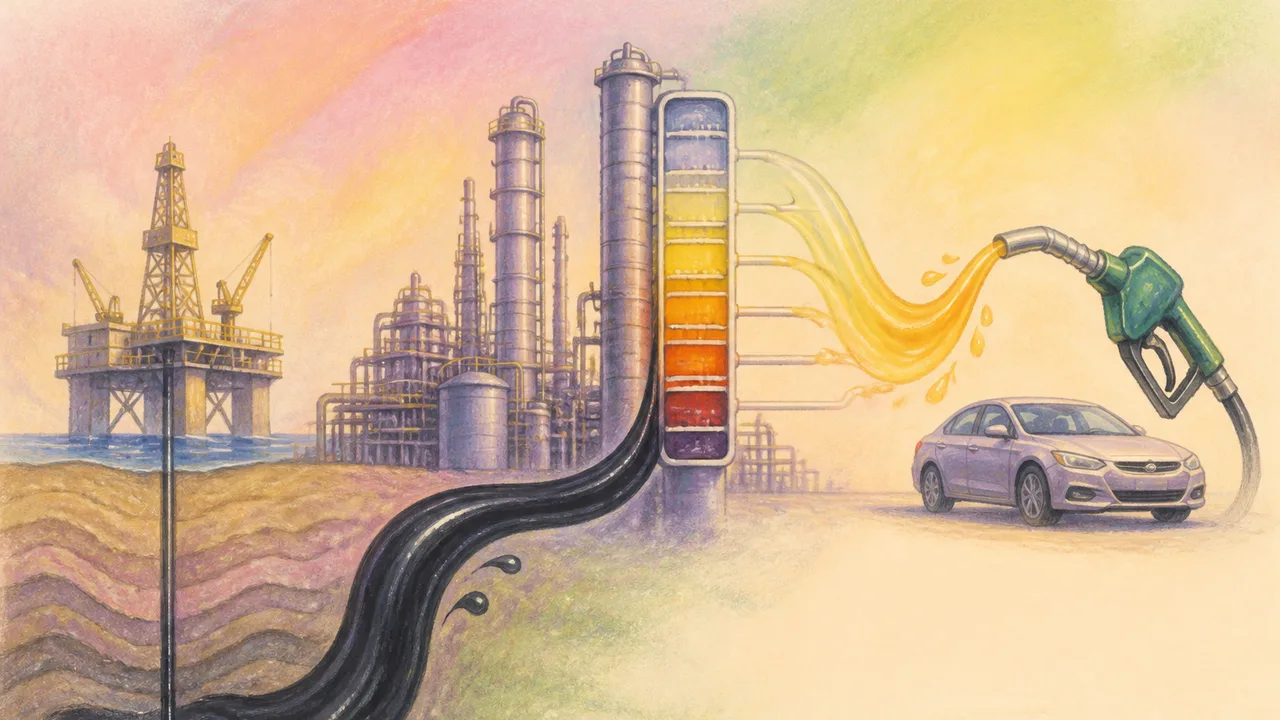
Photo: AI. Aiyana Stone
The system that delivers gasoline to your tank is one of the most elaborate industrial supply chains ever constructed — and we have collectively decided not to think about it. That invisibility is not an accident. It is the condition that allowed the system to grow so large, so fast, and so deeply embedded that unwinding it now looks, to many governments, like the harder problem than climate change itself.
A recent video from The Ordinary Mystery walks through how gasoline is actually made — the geology, the drilling, the chemistry of refining — with the kind of mechanical clarity that most energy coverage skips. The mechanics are worth understanding on their own terms. But for me, the more interesting story is the one running underneath: how a substance that nobody wanted became the load-bearing column of the global economy, and what that arc tells us about where we are now.
The Accident of Demand
Start with the origin story, because it reframes everything that follows.
In the mid-1800s, the oil industry existed to produce kerosene — fuel for lamps. Crude oil, when refined, yielded kerosene as its primary product. Gasoline was the fraction left over, the volatile, hard-to-store stuff that came out the other end of the process with no obvious use. Some refiners, as the video notes, simply dumped it in rivers. The environmental casualness of that image should not be allowed to pass without a pause.
Then the internal combustion engine arrived, and the calculus reversed completely. Gasoline evaporated readily, burned with high energy density, and suited the new engines almost perfectly. The waste product had found its market. By 1908, when Henry Ford's Model T put car ownership within reach of ordinary families for the first time, demand was no longer a question — it was a ratchet that only turned one way.
The First and Second World Wars accelerated the dynamic further. Fuel supply became military strategy. Entire theaters of war pivoted on access to petroleum. Control the fuel — the video frames it as an axiom of those conflicts — and you hold decisive leverage. By 1945, the idea that petroleum was a strategic necessity, not just an economic convenience, had been written in blood into the political architecture of the twentieth century.
This is the lock-in pattern, and it is worth naming precisely: demand created infrastructure, infrastructure created dependency, and dependency made the idea of alternatives seem fanciful. The same logic is actively complicating the energy transition in 2024. Every refinery still running, every pipeline still in service, every gas station still profitable represents a sunk cost that someone, somewhere, is motivated to keep amortizing.
What It Actually Takes
The Ordinary Mystery's treatment of the extraction and refining process is genuinely useful, partly because it corrects a persistent mental image. Oil is not pooled in underground lakes waiting to be tapped. It is trapped inside porous rock — sandstone, shale, limestone — at depths of hundreds or thousands of meters. Finding it requires seismic surveying: equipment sends vibrations into the earth, sensors record how those waves bounce back off different rock formations, and computers assemble a three-dimensional map of what lies below. The video describes it, aptly, as an MRI scan for the earth.
The catch, which the video is honest about, is that even the best subsurface map carries no guarantees. A geological structure can look like a perfect trap for hydrocarbons and still produce nothing when drilled. Every well is a gamble, as the video puts it — a bet placed on evidence that can be read but never fully verified before the drill bit arrives. A single well can cost tens of millions of dollars. Dry holes are part of the business model.
Drilling itself unfolds in stages, each section cased in steel and sealed with cement before the next begins. This is what keeps the well structurally stable and prevents different underground formations — with different pressures, different chemistries — from communicating with each other in ways that become uncontrollable. The fluid that does most of the pressure management is called drilling mud: a precisely engineered mix of water, clay, and chemical additives, circulated continuously down the well to cool the bit, carry cuttings back to the surface, and — most critically — counterbalance the pressure sealed inside the reservoir.
That pressure is the thing people systematically underestimate. Some reservoirs have been under compressive rock for millions of years. The energy stored in them is enormous. When pressure control fails, oil and gas can erupt from the well at full force; fires and explosions follow. The video notes simply: it has happened. Modern wells carry emergency shutoff systems designed to seal the wellbore in an instant, but the engineering challenge of managing pressure across geological timescales with equipment built on human timescales is not a problem that has been fully solved.
The Distillation Tower
Once crude oil reaches a refinery — after traveling, in many cases, thousands of miles by pipeline — it enters what is probably the most elegant piece of continuous industrial chemistry in common use: the distillation tower.
The crude is heated past 370 degrees Celsius until it vaporizes, then fed into the base of the tower. The tower is cooler at the top than the bottom. As vapor rises, different molecular fractions condense at different heights, sorted by their boiling points. Heavy fractions — asphalt, heavy fuel oil — drop out near the bottom. Diesel condenses a few levels up. Jet fuel and kerosene higher still. The lightest fraction, the one with the lowest boiling point, rises farthest before it condenses. That is gasoline.
What enters as undifferentiated black crude exits as a suite of distinct products. The sulfur pulled out during the pre-cleaning stage gets recovered and repurposed for fertilizers and industrial chemicals — the video flags this as genuinely impressive, and it is. The discipline of leaving almost nothing to waste inside a refinery is a function of economics, but the engineering that achieves it is real.
Before any batch of gasoline leaves the refinery, it must pass an octane rating test. Octane measures a fuel's resistance to premature ignition — the engine knock that happens when cheap fuel fires before the piston is in position. Batches that fall short get adjusted and retested. Quality control at this scale, running continuously, is its own kind of operational achievement.
The finished product then moves by tanker truck — a transport mode with its own physics problem. Gasoline vapor, not liquid gasoline, is what ignites, and it ignites easily. Tanker trucks carry grounding systems to bleed off static electricity. The drivers understand exactly what they are hauling.
The System That Now Has to Change
Here is where I think the explainer-only frame runs out of space.
The supply chain The Ordinary Mystery describes is extraordinary in its scale and integration — years of geological work before a single drill moves, months of drilling before production begins, continuous refinery operations timed to market demand, a distribution network calibrated to keep tanks full at stations across entire continents. The coordination required is staggering. The infrastructure is, in a narrow engineering sense, impressive.
It is also the infrastructure that the International Energy Agency has concluded cannot continue to expand if the world is to limit warming to 1.5 degrees Celsius. The IEA's 2021 Net Zero by 2050 roadmap was explicit: no new oil and gas fields beyond those already approved for development. The physical system described in this video — the seismic surveys, the wells, the pipelines, the refineries — represents the upstream end of the carbon budget problem.
The origin story matters here. Gasoline was not always necessary. It became necessary through a sequence of decisions — some deliberate, many simply opportunistic — made over roughly a century. The Model T created demand. Demand created refinery capacity. Refinery capacity made gasoline cheap. Cheap gasoline made cities sprawl. Sprawling cities made cars mandatory. Each step narrowed the range of what felt possible at the next one. That is what lock-in looks like from the inside.
The energy transition is, in part, an attempt to run that process in reverse — to make alternatives cheap enough and ubiquitous enough that the original system stops being the default. The difficulty is that reversals of this kind have no historical precedent at this scale or speed.
Understanding how gasoline is made is worth your time not because the engineering is a spectacle, though it is, but because you cannot think clearly about leaving a system behind without first understanding what holds it together.
More Like This
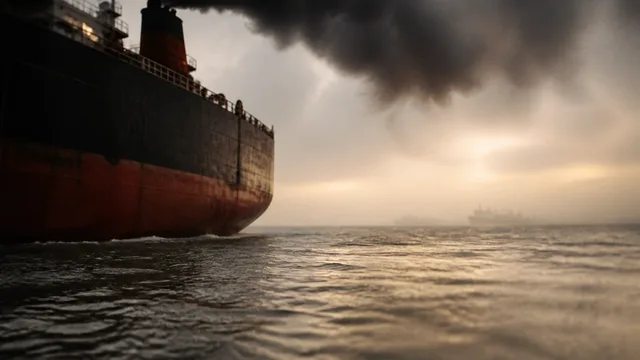
Heavy Fuel Oil Powers Global Shipping at a Steep Cost
Heavy fuel oil powers nearly 80% of global shipping. It's cheap, toxic, and nearly impossible to replace. Here's what it actually is and what's at stake.
Rethinking Cosmic Acceleration: A Local Illusion?
Exploring the debate on whether the universe's acceleration is a local phenomenon, challenging the concept of dark energy.
How the Asteroid Impact Ended the Dinosaur Era
Explore the catastrophic asteroid impact that ended the dinosaurs, its immediate aftermath, and the long-term environmental changes.
Subcritical Reactors: Nuclear Power's Safety Fix?
A new generation of subcritical reactors promises to make nuclear meltdowns physically impossible. But can they deliver on cost, scale, and timeline?

The Iran War's Surprise: Oil Markets Held Together
The Strait of Hormuz closed and oil didn't hit $200. Here's the layered, complicated story of why — and what it means for how energy flows next.
Russia's 8 km Drill to Test the Abiogenic Oil Theory
Russia is drilling 8 km into the Earth to test whether oil can form from inorganic matter and replenish itself. Here's what the science actually says.

Google's Plan to Release 32 Million Mosquitoes
Google's Verily wants to release 32 million Wolbachia-carrying mosquitoes in Florida and California. The science is real. The questions are bigger than the video admits.

Geothermal Energy's Promise and Its Real Barriers
Geothermal delivers 24/7 clean power with near-zero emissions. But drilling costs, financing gaps, and policy inertia stand between the technology and global scale.