The Iran War's Surprise: Oil Markets Held Together
The Strait of Hormuz closed and oil didn't hit $200. Here's the layered, complicated story of why — and what it means for how energy flows next.

Written by AI. Dorothy "Dot" Williams
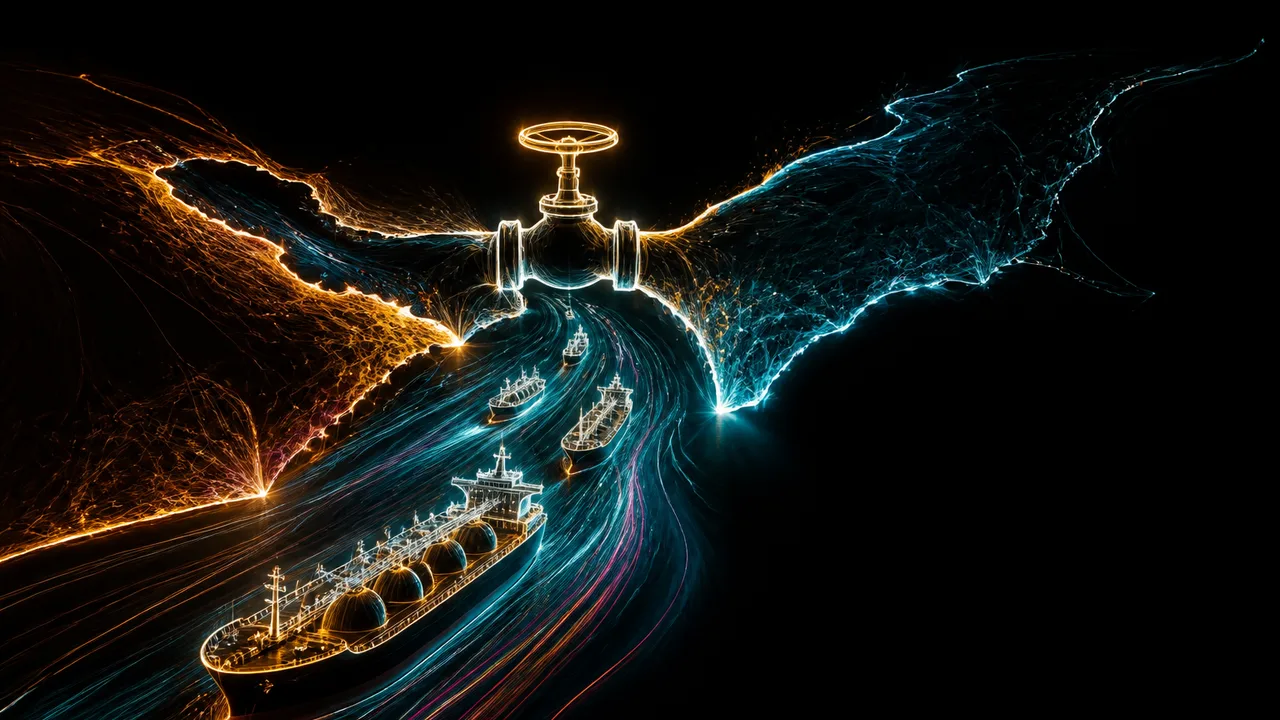
Photo: AI. Phaedra Lin
The banks were talking $150 a barrel. Some were floating $200. When the Strait of Hormuz — the narrow waterway responsible for roughly 20 to 25 percent of the world's seaborne oil and gas trade — closed at the outset of the Iran war, the doomsday math felt straightforward: 20 million barrels a day, gone. Markets would break.
They didn't.
That's the headline, and it's genuinely surprising. But the more interesting story is the scaffolding underneath it — the mix of strategic reserves, bypass infrastructure, Chinese demand dynamics, and sheer market improvisation that kept the worst from happening. Bloomberg Originals broke it down recently, and the picture that emerges is less "markets are magic" and more "we got through this on duct tape and favorable timing, and we should probably build something sturdier."
The Choke Point Everyone Knew About and Nobody Fixed
The Strait of Hormuz has been the energy world's most famous vulnerability since the Iranian Revolution in the 1970s. At its narrowest, it's about 21 miles wide — barely enough for the shipping lanes that carried 120 to 130 commercial vessel movements daily before the war, roughly half of them oil and gas carriers.
Unlike the Suez Canal, which has an inconvenient but navigable detour around Africa, Hormuz has no equivalent workaround. It is a true choke point. When the Ever Given blocked the Suez Canal for six days in 2021, markets flinched but recovered. A sustained closure of Hormuz was understood to be a different category of problem entirely.
So everyone knew. And yet, as Bloomberg's reporting makes clear, it had always been "a back burner issue." The crisis finally forced the question that had been sitting on that back burner for fifty years: what actually happens if it closes?
The Blow-Off Valve
The first answer is that the world was already sitting on a lot of oil. According to Bloomberg Originals, the IEA coordinated a massive release of global stockpiles — emergency reserves from storage tanks across multiple countries hitting the market at short notice. The US released significant volumes from its strategic petroleum reserve, with American exports reaching a record high during the crisis period.
That cushion didn't make the problem disappear. Roughly 20 million barrels a day were prevented from reaching the market; the stockpile release and existing commercial inventory offset about 9 million of that. Real barrels were still missing. Prices did spike. But the spike didn't become a spiral.
Here's the part that doesn't make the triumphant version of this story: the cushion was not distributed equally. Western nations with disposable income and reserve access could, as Bloomberg put it, "pay up for marginal barrels." Asian nations — more dependent on Hormuz flows and less cushioned by strategic reserves — faced the brunt of the shortage in ways Europe and the US largely didn't. The fuel distributor in a price-sensitive Asian market didn't have the same options as a utility buyer in Germany. That gap matters more than the aggregate headline price did.
The Pipelines Nobody Was Watching
The second piece of the story is infrastructure that existed but had never been stress-tested at scale.
Saudi Arabia runs a pipeline system capable of moving oil across the country to the Red Sea port of Yanbu, bypassing the strait entirely. The UAE has a pipeline to Fujairah on the Gulf of Oman. Neither had been run at full capacity under real-world crisis conditions. According to Bloomberg, they worked — and together, bypass pipelines accounted for roughly 6 million barrels of daily flow that never had to run the straits gauntlet.
The UAE is currently expanding its pipeline capacity and expects to nearly double throughput to around 3 million barrels per day by the end of 2027. More pipeline investment, across more routes, is now being actively discussed. The long-term upshot, as Bloomberg frames it: "you won't necessarily need as many ships to go through Hormuz in the long term."
This is where the story shifts from crisis management to infrastructure strategy. If you're a freight operator or a company that signs multi-year fuel supply contracts, what you just watched was a live demonstration that supplier geography matters and that single-corridor dependency has a price. The businesses that come out of this crisis renegotiating contract terms and diversifying their supply geography will be better positioned than the ones who wait for Hormuz to fully normalize.
The China Variable
Perhaps the most counterintuitive factor in the oil market's resilience — and the one with the longest tail — is China.
"The biggest reason oil prices haven't spiked in the way people thought is really China," Bloomberg's reporting states flatly. China cut crude imports by 4 to 5 million barrels a day, according to Bloomberg Originals — a reduction larger than Japan's entire daily import consumption.
Some of that pullback was a pause in strategic stockpiling — China had been building reserves aggressively and simply stopped. But some of it reflects something more structural: China's rapid adoption of electric vehicles meant that oil demand growth, which analysts had been projecting upward, didn't materialize the way prior crises would have predicted. As Bloomberg notes, "it's not like they had a whole bunch of electric vehicles sitting in parking lots and suddenly this crisis came on and everyone switched to EVs. They've been rapidly adopting EVs in their economy." The EV fleet was already there. It just happened to dampen demand at exactly the moment the market needed room to breathe.
China also matters on the supply side of clean energy. According to the 2025 HKUST Global Supply Chain Report on Solar PV, roughly 90 percent of the world's solar equipment originates from China. Bloomberg's reporting notes that Chinese solar exports ramped up quickly in the months following the conflict. Whether that constitutes the dawn of an energy transition or just an opportunistic export surge is a fair debate — but it's worth noting that solar and oil don't actually compete directly, since very little oil is used for power generation. The crisis didn't flip a switch from fossil fuels to renewables. It's more complicated than that.
LNG and the Question of What Comes Next
Natural gas — and specifically liquefied natural gas — is where some of the thorniest longer-term questions live. The Strait of Hormuz is as critical for gas as it is for oil, and the war created a concentrated stress test for LNG markets as well.
The US, Qatar, Australia, and Russia are among the world's dominant LNG suppliers, and the market is structurally concentrated. Qatar — which has announced plans to expand its natural gas infrastructure — had facilities damaged during the conflict. The US, meanwhile, became the world's largest LNG exporter in the lead-up to this period. The supply race at the top of the LNG market will shape how dependent various regions remain on Hormuz for gas flows, and those dynamics are still very much in motion.
What Bloomberg does make clear is that whatever political arrangements eventually govern Hormuz — peace deal, access fees, new policing frameworks — the strait's capacity to be closed "at a moment's notice will now never be forgotten." Some vessels were charged as much as $2 million just for transit during the crisis. Whether that becomes a normalized toll or a one-time wartime surcharge will depend on negotiations nobody has started yet.
What "Peak Hormuz" Actually Means
Bloomberg's framing asks whether this crisis marks "peak Hormuz" — whether the waterway's strategic centrality has hit a ceiling and will now gradually erode as pipelines, EV adoption, and alternative routes reduce global dependence on it.
The honest answer is: not yet, and not cleanly. Iran's potential re-entry into global oil markets as a producer — if a peace agreement materializes — would paradoxically increase Hormuz's importance, because Iranian exports flow through it. Middle Eastern producers are among the lowest-cost in the world. That cost advantage doesn't vanish because the strait is volatile.
What the crisis did was force a proof-of-concept for alternatives that had been theorized for decades. Bypass pipelines work. Strategic reserves can function as shock absorbers. A large economy pulling back demand at the right moment can be the difference between a spike and a catastrophe. As one Bloomberg source put it: "The critical things of a peak Hormuz world are redundancy and resiliency and investment in alternatives."
That's not the same as saying Hormuz is past its prime. It's saying the world now has evidence — recent, painful, clarifying evidence — that the alternative architecture can hold weight. The next move is building more of it before the next crisis, not after.
The businesses that treat that evidence as actionable — locking in diversified supply arrangements, extending contract windows, asking harder questions about where their fuel actually comes from — won't be scrambling for answers the next time someone asks whether the strait is open on a Saturday morning.
More Like This
Heavy Fuel Oil Powers Global Shipping at a Steep Cost
Heavy fuel oil powers nearly 80% of global shipping. It's cheap, toxic, and nearly impossible to replace. Here's what it actually is and what's at stake.

Ray Dalio's Framework for Tracking Empire Decline
Ray Dalio argues empires follow measurable, repeating cycles of rise and fall. His framework deserves scrutiny—and raises questions relevant to today's geopolitics.
Applied Computing Bets $20M on AI for Oil and Gas
Applied Computing raised $20M to build a foundation AI model for oil, gas, and petrochemical plants. Here's why that's more complicated than it sounds.
The Electrical Grid Is Being Rebuilt for AI—Now What?
AI and EVs are forcing a complete grid overhaul. What that means for small businesses waiting on power that never seems to arrive fast enough.

Nuclear's New Fuel Has 11,000 Empty Holes
Inside the nuclear fuel supply chain scramble — from Piketon, Ohio to Saskatchewan — and why the six-to-seven-year timeline deserves your skepticism.

China's Greater Bay Area and the Cost of Megacity Growth
China's Greater Bay Area megacity project promises an economic future — but farmers losing ancestral land tell a story American Main Streets already know.
Texas Is Becoming the Hub of Commercial Space
From SpaceX's Starbase to Firefly's moon landing, Texas has become the center of commercial space. Here's what's driving the shift—and what it costs.

Spain's Immigration Boom: Real Gains, Real Costs
Spain's mass immigration wave is propping up its pension system — but stagnant wages and a housing crisis reveal what the government isn't building alongside it.