Geothermal Energy's Promise and Its Real Barriers
Geothermal delivers 24/7 clean power with near-zero emissions. But drilling costs, financing gaps, and policy inertia stand between the technology and global scale.

Written by AI. Olivia Meng

Photo: AI. Dante Nwosu
The grids that will determine whether we hit 1.5°C or blow past it are being designed and financed right now — not in five years, not after the next IPCC cycle. The decisions happening in energy ministries, development bank boardrooms, and utility procurement offices this year will lock in infrastructure that operates for decades. Which makes the current moment in geothermal energy worth understanding precisely, not romantically.
A recent documentary from Interesting Engineering, filmed at Maspo Energy's binary-cycle plant in Turkey's Alaşehir Valley, offers a useful starting point — technically detailed, genuinely illuminating about how the technology works, and honest about where the gaps remain. It's a good briefing. What it doesn't fully reckon with is the distance between "this technology works" and "this technology scales." That distance is not mainly an engineering problem.
What the physics promises
The appeal of geothermal is structural. The earth's interior radiates heat continuously — a function of residual formation energy and the decay of radioactive isotopes — and that heat is, on any timescale relevant to human civilization, inexhaustible. Tap it, and you get power that runs at full capacity regardless of cloud cover, wind speed, or season. That last property matters enormously as grids absorb more solar and wind: the intermittency problem that storage is being asked to solve is the same problem geothermal simply doesn't have.
In volcanic regions, where tectonic activity brings heat close to the surface, the engineering is well understood and the economics are already competitive. The Alaşehir Valley plant illustrates the binary-cycle approach: geothermal brine extracted at around 165°C passes through a heat exchanger where it vaporizes a secondary working fluid with a lower boiling point. That vapor spins turbines; the brine is re-injected into the reservoir; the working fluid is condensed and cycled back. The system is closed, the water is recycled, and the emissions profile is, as the video puts it, "near zero greenhouse gases." Lifecycle emissions from geothermal power are typically estimated at 15–55 grams of CO₂-equivalent per kilowatt-hour, according to IPCC assessments — well below gas, coal, or even some lifecycle estimates for solar manufacturing.
Turkey has built aggressively on this foundation. According to International Geothermal Association data, Turkey ranks among the top five countries globally in installed geothermal capacity — the precise ranking fluctuates between fourth and fifth depending on the source and reference year, so treat any single figure with appropriate caution. What's not in dispute: over 63 plants, predominantly binary-cycle, producing approximately 1.7 gigawatts and supplying roughly 3% of national electricity. The district heating network serves more than 125,000 homes and 4.5 million square meters of greenhouses year-round. That's not a demonstration project. That's a functioning energy system.
The Larderello field in Tuscany, where Piero Ginori Conti ran the first geothermal electricity demonstration in 1904 — a small proof-of-concept, not the commercial operation that came later — has been producing at industrial scale for over a century and remains operational today. Longevity, where geological conditions cooperate, is one of geothermal's genuine competitive advantages.
Where the physics stops cooperating
Outside volcanic and tectonically active zones, the geology changes the economics entirely. Reaching useful temperatures in most of the world requires drilling to roughly 10 kilometers — depths where conventional rotary drilling becomes progressively less reliable. The rock heats and softens, the drill string flexes under its own length, and bit wear accelerates dramatically. The Kola Superdeep Borehole in Russia, completed over a span of roughly 24 years between 1970 and 1994 (with significant pauses for equipment, analysis, and funding), reached 12.2 kilometers — and that project had no requirement to do so cheaply or at pace. Commercial geothermal cannot tolerate either the timeline or the cost structure of a Soviet scientific program.
This is the chokepoint that determines whether geothermal remains a regional advantage for geologically lucky countries or becomes a genuinely global baseload resource.
Two companies are pursuing different angles on the problem. Quaise Energy is developing millimeter-wave drilling: a surface-based gyrotron fires high-frequency electromagnetic energy down a waveguide to vaporize rock rather than cut it, with pressurized gas carrying debris to the surface instead of drilling mud, which degrades at depth. The company has reported reaching a 100-meter milestone at speeds significantly faster than their previous benchmarks — a meaningful proof of concept, though the gap between 100 meters and 10 kilometers is not incremental; it is the entire problem. Fervo Energy is working a different angle: drilling to around 3 kilometers and then extending laterally for thousands of feet, maximizing exposure to lower-temperature rock over a longer fluid pathway. Fervo has also developed proprietary algorithms for identifying optimal drilling locations — a recognition that geological intelligence is as important as drilling technology in making enhanced geothermal systems economic.
The system beyond the drill bit
Here is where the engineering briefing tends to stop and the harder question begins: even if Quaise or Fervo or a competitor cracks the deep-drilling problem within the next decade, what has to move for that breakthrough to translate into deployed capacity?
The answer is: quite a lot, and none of it is automatic.
Capital structure. Geothermal development is front-loaded in a way that makes private financing reluctant. The exploration and drilling phase — before a single kilowatt-hour is generated — can consume 50–70% of a project's total capital cost, according to analyses from the International Renewable Energy Agency (IRENA). If the well underperforms, that capital is largely unrecoverable. For solar or wind, a developer who misjudges a site can reposition; for geothermal, a dry or underperforming well is a write-off. This asymmetric risk profile keeps commercial lenders conservative and drives up the cost of capital for geothermal projects relative to their actual operational risk once running. What changes this is concessional finance — development banks, green bonds with first-loss guarantees, government exploration risk-sharing schemes of the kind that Iceland and Kenya have deployed effectively. Without those structures, "drilling breakthrough" does not automatically equal "project gets financed."
Policy and grid integration. Geothermal's 24/7 baseload profile is valuable precisely because grids with high renewable penetration need it. But capturing that value requires electricity market structures that price firm, dispatchable capacity appropriately — capacity markets, long-term power purchase agreements with utilities, or regulated cost-of-service frameworks that reward reliability rather than just the lowest marginal cost in any given hour. Spot markets that price power at solar's near-zero marginal cost during midday don't reward geothermal's continuous output. Without deliberate policy design — the kind that recognizes and compensates baseload capacity — geothermal cannot compete on price alone against subsidized intermittent generation.
Grid infrastructure. The best geothermal resources are rarely located near existing transmission. The Alaşehir Valley's proximity to both tectonic heat and Izmir's grid is not accidental — it's part of why Turkey has been able to move so fast. In the American West, the Horn of Africa, or Southeast Asia, promising geothermal zones often sit far from load centers and existing transmission corridors. Connecting them requires the same grid expansion investment that is already contested and slow everywhere.
None of this undermines geothermal's technical credentials. It clarifies the nature of the problem. The drilling challenge is real, but solving it produces a project opportunity, not a project. The gap between opportunity and operating plant runs through financing, regulatory approval, grid connection, and power purchase — each with its own timeline and its own set of actors who have to say yes.
What Turkey's trajectory actually shows
Turkey's rise to near the top of global geothermal rankings didn't happen because Turkish geology is uniquely cooperative — though it helps. It happened because the government structured favorable feed-in tariffs through the YEKDEM renewable energy support mechanism, maintained consistent policy signals over a long enough period for developers to build supply chains and institutional expertise, and allowed the industry to iterate through dozens of projects. Maspo's Alaşehir Valley plant is not a pioneer; it is the beneficiary of a policy environment that made its predecessors possible.
That's what a geothermal scale-up looks like in practice: not one dramatic technology leap, but a decade of aligned policy creating the conditions for an industry to learn by doing. The drilling technologies Quaise and Fervo are developing could open vastly larger resource bases. But whether those resources become power plants depends less on the gyrotron than on whether governments structure the investment conditions that gave Turkey its fleet of 63 plants.
The single policy choice that most determines the answer is also the most straightforward to name: exploration risk guarantees. If development banks and national governments absorb the dry-hole risk during the exploration phase — the same mechanism that unlocked oil and gas development in frontier basins for decades — private capital will follow into geothermal at scale. Without that de-risking mechanism, the drilling breakthrough, when it comes, will sit on a shelf next to a lot of other technologies that worked in the lab and waited for someone to finance the first commercial plant.
The earth's heat isn't the constraint. It never was.
More Like This
How the Asteroid Impact Ended the Dinosaur Era
Explore the catastrophic asteroid impact that ended the dinosaurs, its immediate aftermath, and the long-term environmental changes.
Subcritical Reactors: Nuclear Power's Safety Fix?
A new generation of subcritical reactors promises to make nuclear meltdowns physically impossible. But can they deliver on cost, scale, and timeline?

Nuclear's New Fuel Has 11,000 Empty Holes
Inside the nuclear fuel supply chain scramble — from Piketon, Ohio to Saskatchewan — and why the six-to-seven-year timeline deserves your skepticism.

Fusion Energy Is No Longer Just a Physics Problem
Fusion reactors have cleared their core scientific hurdle. What remains are hard engineering challenges—and a tight race against the clock and other clean energy sources.
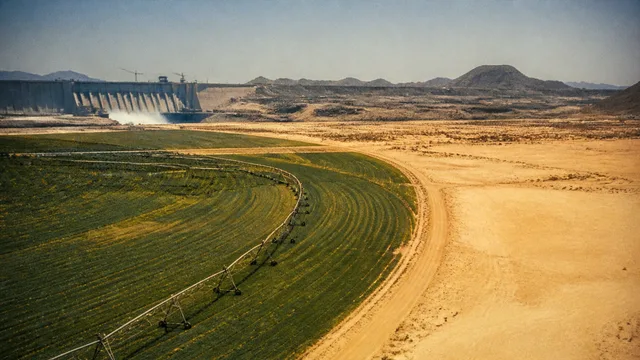
Egypt's New Delta Project: Green Miracle or Mirage?
Egypt is engineering a new Nile in the desert. But satellite data, groundwater depletion, and a troubling history raise urgent questions about who this is really for.

Understanding the Real Risk of Brain-Eating Amoebas
Explore the facts and myths surrounding brain-eating amoebas. How real is the threat, and can climate change affect its spread?

How Air Pressure Works, From Barometers to Champagne
Neil deGrasse Tyson explains the physics of air pressure — and why understanding it matters beyond parlor tricks and party science.

Antimatter Rockets: The Energy Economics of Interstellar Travel
Antimatter propulsion promises interstellar travel, but its staggering energy production costs reveal a deeper lesson about civilizational-scale infrastructure investment.